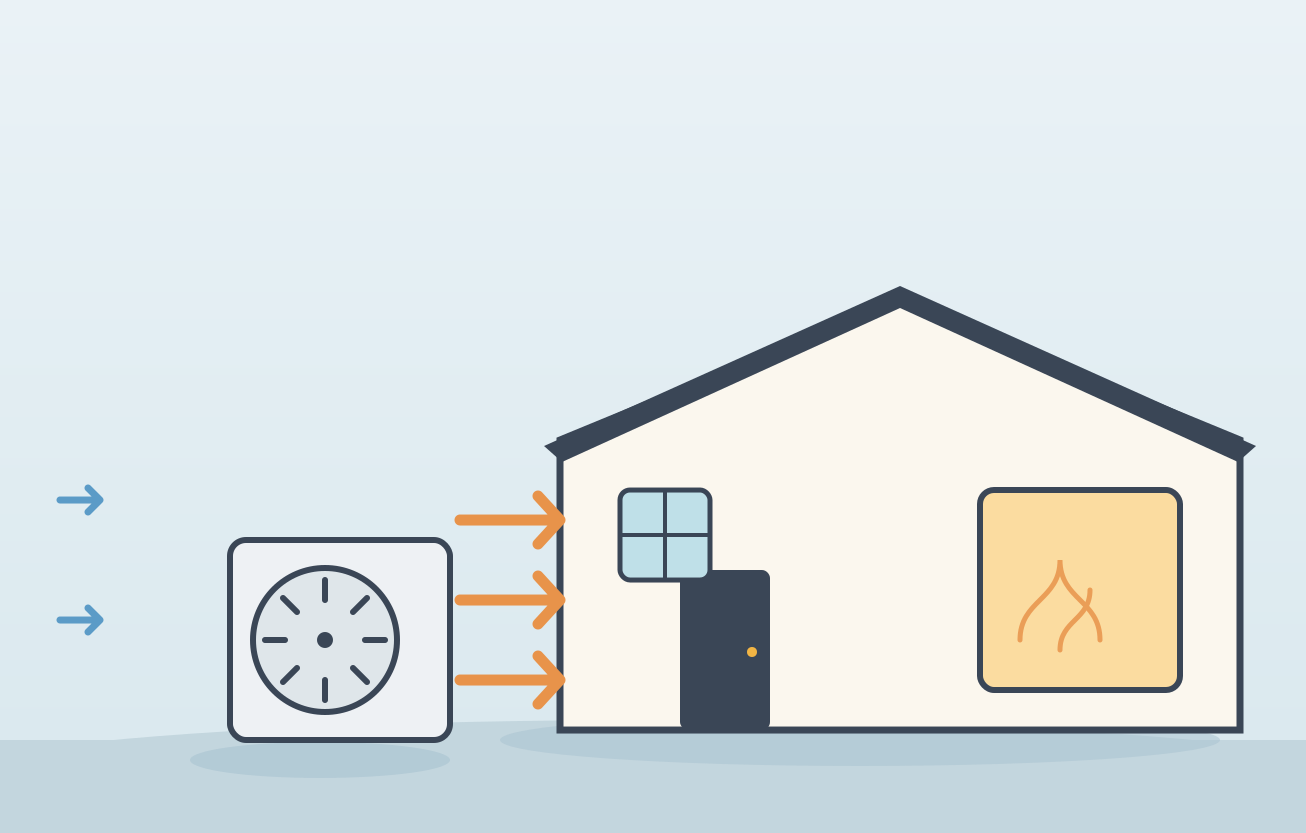
Are heat pumps worth it? If you're thinking about replacing your heating system with a heat pump, you've probably already encountered the big claims.
Lower energy use. Lower carbon emissions. Heating and cooling from one system.
But there's another number that tends to get left out:
The cost of actually making the switch.
The answer depends on the home, the heating system you're replacing and the cost of making the switch.
A heat pump can deliver several units of heat for each unit of electricity it uses, potentially reducing energy use and running costs. But the higher upfront cost of installation can make the financial calculation very different from one property to another.
An efficient gas boiler, an old oil system and direct electric heating all create very different starting points. So while heat pump costs and efficiency matter, they are only part of the equation.
In this guide, we'll look at installation costs, running costs, efficiency, payback periods, radiators, insulation and the difference between air-source and ground-source systems — and, most importantly, when switching actually makes financial sense.
The real question isn't whether heat pumps are good. It's whether one is worth it for your home.
Heat pumps / In a nutshell
Residential heating · visual guide
A heat pump does not
make heat.
It moves heat from one place to another.
Once you understand that one idea, the rest becomes much
easier: electricity powers the process, outdoor heat is
collected and the system delivers that heat to your home
at a higher temperature.
00
How a heat pump actually works
start here
Think of it as a
refrigerator in reverse.
A refrigerator takes heat from the inside of the
fridge and releases it into your kitchen.
A heat pump does the opposite:
it takes heat from outside and
moves it into your home.
It can do this even when the outdoor air feels cold,
because “cold” air still contains thermal energy.
The refrigerant cycle extracts that energy and
upgrades it to a temperature useful for heating.
Start here:
↓
Cold place
Heat is collected from outdoor air,
the ground or another heat source.
↑
Warm place
That heat is delivered into the building
at a useful heating temperature.
The heat pump extracts heat that is already present
and uses electricity to move it to a higher temperature.
01 / COLLECT
Take heat in.
A refrigerant absorbs heat from the outside source.
In an air-source heat pump, that source is
outdoor air.
02 / UPGRADE
Raise its temperature.
A compressor uses electricity to increase the
refrigerant's pressure and temperature, making
the captured heat useful for the building.
03 / DELIVER
Put the heat inside.
The heat is transferred into the home's heating
system — for example through radiators,
underfloor heating or air.
3–5×
Indicative efficiency range
Heat pumps can deliver several units of heat
for each unit of electricity used.
COP 3
Simple operating example
1 kWh of electricity delivers about 3 kWh
of heat at that particular operating point.
40–45°
Typical low-temp heating
Many efficient heating systems operate around
this flow-temperature range.
50–55°
Domestic hot water
Hot water is normally produced at a higher
temperature than space heating.
01
The energy flow
heat moves uphill
↓
Outdoor air
Even cold outdoor air contains thermal energy.
The heat pump extracts some of it through the
refrigerant cycle.
↗
Heat pump
Electricity powers the compressor, allowing
low-temperature heat to be upgraded.
↑
Your home
Heat is delivered through radiators,
underfloor heating or an air system.
02
Efficiency
COP explained
The simple rule
COP tells you how much
heat you get for the
electricity you use.
A COP of 3.0 means that, under
a particular set of conditions, 1 unit of
electricity produces 3 units of useful heat.
The important catch is that COP is not a permanent
property of the machine. It changes with outdoor
temperature and the temperature the heat pump
has to deliver.
Electricity
1 kWh
Environmental heat
2 kWh
Delivered heat
3 kWh
03
Why temperature matters
illustrative relationship
relative efficiency →
colder conditions →
The rule
The smaller the
temperature lift,
the easier the job.
If the heat source is relatively warm and the
heating system only needs moderately warm water,
the heat pump has less work to do.
This is why insulation, radiator size, underfloor
heating and weather compensation are so important.
higher efficiency
lower efficiency
04
Flow temperature
lower is generally better
30°C
very low-temperature systems
40°C
efficient heating
50°C
higher emitter demand
60°C
harder operating point
70°C
boiler-like territory
01 / THE BUILDING
Heat loss
A poorly insulated building loses more heat.
That increases the required heating capacity and
can make low-temperature operation harder.
Heat-loss calculation comes before machine size.
02 / THE EMITTERS
Radiators & floors
Radiators originally designed around hot boiler
water may not deliver enough heat when supplied
with much cooler water.
Larger radiators and underfloor heating can make
lower-temperature operation easier.
03 / THE CONTROLS
Weather compensation
Good controls adjust flow temperature as outdoor
conditions change, helping the system run steadily
rather than constantly cycling.
The controls are part of the system.
Air source
ASHP
Heat from outdoor air.
Usually simpler to install and requiring less land
than a ground-source system. Its performance changes
with outdoor temperature because the heat source itself
becomes colder in winter.
Ground source
GSHP
Heat from the ground.
Ground temperatures are generally more stable than
outdoor air, but installation normally requires
ground loops or boreholes and more site work.
The annual electricity bill then depends on the
electricity tariff and the actual seasonal performance
of the complete installation.
This is why a single laboratory COP can be misleading
when comparing systems. For annual planning, look at
the expected SPF / SCOP and the
conditions behind that figure.
≈
The heat pump is only one part of the equation.
A good installation is a system:
heat loss + emitter size + flow temperature
+ controls + heat-pump capacity + electricity price.
The biggest mistake is choosing the machine first
and treating the building as an afterthought.
DATA NOTE — The 3–5× figure is an indicative range,
not a guaranteed efficiency for every heat pump or
operating condition. COP is a point-in-time performance
measure; SPF/SCOP describes performance over a season.
The 40–45°C heating and 50–55°C domestic-hot-water
ranges are illustrative rather than universal requirements.
The performance curve is an explanatory illustration,
not a product test. Actual performance depends on the
heat source, flow temperature, system design, controls,
climate, building heat loss and operating conditions.
01Is a heat pump actually worth it?
The short answer is:
Often, but not automatically.
A heat pump doesn't exist in isolation.
You're replacing something — a gas boiler, oil boiler, LPG system, direct electric heating, an older heat pump, or perhaps a heating system that hasn't been installed yet.
The economics can look completely different in each case.
Someone moving from oil or LPG may have a very different financial calculation from someone replacing a modern gas boiler.
Someone using direct electric heaters is another case entirely.
The starting point matters
Upfront investment · illustrative comparison
The same heat pump can make
very different financial sense
depending on what it replaces.
A household replacing an inexpensive, modern gas boiler
faces a different investment decision from one replacing
oil, LPG or direct electric heating. The baseline matters
before the savings calculation even begins.
Gas boiler
Reference baseline
1×
reference
Air-to-water heat pump
Including radiator modifications
2–4× gas boiler
2–4×
reported range
Oil · LPG · electric
Different starting economics
varies
by market & system
Don't compare the heat pump
with nothing.
Compare the complete heat-pump investment with the cost
and future running costs of the system you would otherwise
install. A heat pump can look expensive against a new gas
boiler while looking very different against an oil or LPG
system with high running costs.
Data source —
International Energy Agency (IEA),
The Future of Heat Pumps (2022).
The IEA reported that even the cheapest air-to-water
heat pumps, including modifications to existing radiator
systems, remained approximately 2–4× more costly upfront
than natural-gas boilers in most major heating markets.
The comparison is a market-level indicative range,
not a quotation for an individual property.
Actual costs vary by country, building, system design,
installation requirements, incentives and market maturity.
Therefore, thequestion isn't whether heat pumps are efficient.
It's whether their additional upfront cost produces enough value over the system's lifetime.
And this is where heat pumps become particularly interesting.
The technology has moved from being a relatively niche heating solution to an increasingly important part of the global heating system. The International Energy Agency estimates that heat pumps supplied around 12% of global space-heating needs in buildings in 2024.
12
%
Global heating
Heat pumps supplied around
12% of global space-heating needs
in buildings in 2024.
A useful reminder of how far the technology has moved
beyond a niche heating solution — while still leaving
most global space heating served by other technologies.
Data source —
International Energy Agency (IEA),
Heat Pump Monitor 2026. 2024 global estimate for
space-heating needs in buildings.
But global growth doesn't mean every individual home is automatically a good candidate.
A technology can be excellent while a particular installation is a poor investment.
02What are you replacing?
This may be the most important question in the entire article.
THE BASELINE
The starting point changes the answer.
01 — House A
High-cost heating
Older oil-heated home
Relatively high annual heating costs.
There is more potential room for savings.
high running cost
02 — House B
Lower-cost heating
Efficient gas-heated home
A relatively modern boiler and lower
existing heating costs.
lower running cost
Same heat-pump system · Same installation quote
House A
More saving potential
Replacing a costly heating system can create
a larger annual saving, making the additional
investment easier to recover.
House B
Smaller saving potential
If the existing system is already relatively
inexpensive to run, the same heat pump may
produce a smaller financial benefit.
The question to ask
What will the heat pump replace?
The technology is only one part of the calculation.
Your existing heating cost sets the baseline against
which the investment is measured.
CONTEXT — International Energy Agency (IEA), analysis of
heat-pump economics. Relative economics vary with
electricity and fossil-fuel prices, capital costs,
system performance and local conditions. The House A /
House B examples above are illustrative rather than
representative savings estimates.
This is why you should never evaluate a heat pump using a generic "average saving".
Your starting point matters.
The IEA's current analysis of heat-pump economics similarly finds that the relative cost of heat pumps varies by country and system, with electricity prices, fossil-fuel prices, capital costs and operating conditions all influencing the result.
Europe · 2025
2.9m
domestic heat pumps sold across
21 European countries.
Annual change
+13%
sales growth in 2025 after
two years of decline.
Installed stock
29.3m
heat pumps in the 21-country
dataset.
DATA SOURCE — European Heat Pump Association (EHPA), 2026 market data.
2025 figures cover 21 European countries. Sales rose 13% year-on-year.
Installed-stock figures include the countries covered by the EHPA dataset.
So before asking what a heat pump costs, ask:
What will it replace?
03How much does a heat pump cost to run?
A conventional electric resistance heater converts electricity directly into heat.
A heat pump works differently.
It moves heat from one place to another, using electricity to drive the process rather than creating all of the heat directly.
That means a heat pump can deliver several units of heat for each unit of electricity it consumes.
COP: the basic efficiency measure
The relationship between electricity consumed and heat delivered is described by the coefficient of performance (COP).
COP = heat output ÷ electricity input
For example, if a heat pump delivers 4 kWh of heat while using 1 kWh of electricity:
COP = 4
But there's an important catch.
A heat pump won't necessarily operate at COP 4 throughout the year.
Outdoor temperature, flow temperature, system design, defrosting, controls and hot-water production can all affect its performance.
That's why SCOP — seasonal coefficient of performance — is often more useful than a single headline COP figure.
The number that actually matters
The real-world question isn't:
"What's the maximum COP?"
It's:
"How much electricity will this system actually use to heat my house over a year?"
That distinction matters when you're calculating running costs.
A heat pump with an impressive laboratory efficiency figure isn't necessarily the cheapest system to operate if it's poorly matched to the building or has to run at unnecessarily high temperatures.
The house, the heating system and the heat pump all work together.
Efficiency in practice
A heat pump doesn't make
heat from electricity.
It uses electricity to move heat from one place to another.
That distinction is why a heat pump can deliver more heat
energy than the electrical energy it consumes.
Energy in / useful heat out
illustrative example
Electricity in
1
kWh electricity
Heat pump
Useful heat
3–4
kWh heat
1 kWh electrical input
+ heat collected from the environment
= useful heat delivered indoors
Coefficient of performance
COP =
heat output
÷ electricity input
In the example above, if the system delivers
4 kWh of heat using
1 kWh of electricity,
its instantaneous COP is 4.
COP tells you how efficiently the system is
operating at a particular moment.
A COP of 4 does not mean the heat pump will maintain
that performance all winter. COP changes with outdoor
temperature, the temperature of the water being heated,
defrost cycles, controls and other operating conditions.
SCOP
Seasonal coefficient of performance
The annual picture is
more useful.
SCOP is intended to describe performance across a
heating season rather than at one particular operating
point. It therefore gives a better indication of how much
electrical energy a system may require over a typical
season.
Outdoor temperature
Heat pumps generally work harder as the temperature
difference between the heat source and the heating
system increases.
Flow temperature
Lower-temperature heating systems can allow the heat
pump to operate more efficiently.
Real building demand
Insulation, weather, hot-water demand and controls all
affect how much electricity the system actually uses.
The useful number isn't the
maximum COP.
For a real homeowner, the more important question is how
much electricity the system will consume over an entire
year. Seasonal performance, heat demand and the
required flow temperature ultimately determine
the running cost.
04Why your house matters more than the heat pump brochure
A heat pump is only one part of a heating system.
The building determines how much heat it needs.
The radiators or underfloor heating determine how that heat is delivered.
And the heat pump determines how efficiently electricity is turned into useful heat.
The performance chain
The heat pump is only one part of the
equation.
A home's fabric determines how much heat it needs.
That demand influences the temperature the heating system
has to deliver. And the conditions the heat pump operates
under affect how efficiently electricity becomes useful heat.
01
Heat loss
Heat escaping through walls,
windows, roofs and air leakage.
02
Heat demand
The amount of heat the building
actually needs to stay warm.
03
Flow temperature
The temperature of the water sent
around the heating system.
04
Efficiency
How much useful heat the pump
produces for each unit of electricity.
05
Running cost
The electricity required to deliver
the home's useful heat.
Small changes at the
beginning of the chain
can affect everything that follows.
A well-insulated, airtight home generally loses less
heat, so it needs less heat output. That can allow the
heating system to operate at lower flow temperatures —
conditions that are generally more favourable for a
heat pump's efficiency.
This is why the performance of the whole system matters.
Insulation, windows, air leakage, radiator sizing
and heating controls
can influence the result just as much as the
specification of the heat pump itself.
insulation
windows
air leakage
radiators
controls
This is also why I'd be cautious about any article that tells you exactly how much a heat pump will save without knowing anything about the house.
Your home isn't an average house.
05Can heat pumps work with existing radiators?
Yes.
This is one of the biggest misconceptions surrounding heat pumps.
You don't automatically need underfloor heating.
The real question is whether your existing radiators can deliver enough heat at the lower flow temperatures at which heat pumps generally work most efficiently.
A boiler might traditionally heat water to a much higher temperature. A heat pump generally performs better when it doesn't have to work as hard to produce extremely hot water.
So an existing radiator that works perfectly with a boiler might not deliver enough heat at a lower temperature.
But that doesn't mean you need to replace every radiator.
A proper room-by-room heat-loss calculation can identify which rooms actually need larger emitters — and which can work perfectly well with the radiators already there.
That's the question worth asking: Can my existing radiators heat each room adequately at the proposed heat-pump flow temperature?
That's much more useful than simply asking whether your radiators are "compatible" with a heat pump.
And it's one reason I'd be cautious about a quote that recommends replacing every radiator without showing you the underlying heat-loss calculation.
06Is a heat pump worth it in an old house?
An old house isn't automatically a bad candidate.
But an old building can make the calculation more complicated.
Older properties can have:
higher heat loss
less insulation
draughtier construction
smaller radiators
heating systems designed around higher water temperatures
That can create a chain reaction:
The chain reaction
In old houses, one problem can travel
through the whole system.
The building affects the heat demand.
Heat demand affects the temperature
the heating system needs to deliver.
01
Higher heat loss
More heat escapes through the
building fabric and ventilation.
02
More heat required
The heating system has to deliver
more heat to maintain the room.
03
Higher flow temperature
The system may need hotter water
to deliver that additional heat.
04
Lower efficiency
A greater temperature lift generally
makes the heat pump work harder.
The important bit:
improving the beginning of the chain
can improve what happens at the end.
FabricDemandFlow temp.
Efficiency
This is why improving the building can sometimes be more important than choosing a particular heat-pump model.
You don't necessarily need to transform an old house into a modern passive house.
But you do need to understand where the heat is going.
There is also a practical reason to think about insulation before the heating system.
If you reduce the amount of heat your house loses, you reduce the amount of heat the heating system needs to provide.
That can potentially allow for a smaller system and lower operating temperatures.
In other words:
The cheapest heat to produce is often the heat your house doesn't lose in the first place.
07How much does a heat pump cost?
This is where I'd resist giving readers one giant "average heat pump cost" number.
It varies enormously by country and property.
More importantly, you're not really buying a heat pump.
You're buying a heating system.
The real cost
The outdoor unit is only
part of the project.
A heat-pump quote covers much more than the machine itself.
The building, heating system, hot water, controls and electrical
work can all change the final price.
What the project actually contains
equipment + installation + building
01
Heat pump
The main equipment.
The outdoor unit, compressor, heat exchanger
and refrigeration system form the core machine.
02
Installation
Making it work.
Labour, pipework, connections, commissioning and
the practical work needed to integrate the system.
03
Heat emitters
Getting heat into rooms.
Existing radiators may work — or they may need
upgrading to deliver enough heat at lower flow
temperatures.
04
Hot water
More than space heating.
If the heat pump also supplies domestic hot water,
a cylinder and associated equipment may be required.
05
Controls
The system's brain.
Thermostats, weather compensation, sensors and
control hardware determine how the system operates.
06
Electrical work
Connecting the power.
Cabling, protection, consumer-unit work or other
electrical upgrades may be needed depending on
the installation.
07
Groundworks
Especially for ground source.
Ground loops, trenches or boreholes can make
ground-source installations substantially more
involved than air-source systems.
That is why two homes can receive
very different quotes
for seemingly similar heat pumps.
The machine is only one component of the project.
The condition of the house, existing heating system,
hot-water requirements, electrical installation and
site itself can all change what has to be done.
≠
Don't compare heat pumps by the outdoor unit alone.
Compare the complete installed system — equipment,
installation, modifications, controls and site work.
The upfront-cost gap
2–4×
The IEA has found that even the cheapest air-to-water
heat pumps, including modifications to existing radiator
systems, can cost two to four times more upfront than
natural-gas boilers in many major heating markets.
The investment problem is often
front-loaded.
A heat pump can have attractive operating economics while
still being difficult to justify financially because the
installation requires more capital at the beginning.
Equipment can cost more than a conventional boiler.
Installation can involve more system integration.
Radiators or electrical infrastructure may need upgrades.
Ground-source systems add excavation or drilling.
DATA SOURCE — International Energy Agency, The Future of Heat Pumps.
The IEA states that even the cheapest air-to-water heat-pump models,
including modifications to existing radiator systems, remain roughly
two to four times more costly than natural-gas boilers in most major
heating markets. Actual project costs vary substantially by country,
building and installation.
08How long does a heat pump take to pay for itself?
The simplest way to think about payback is to compare the extra money you spend upfront with the money the new system saves each year.
PAYBACK PERIOD = NET INSTALLATION COST ÷ ANNUAL SAVINGS
Imagine the additional cost of switching to a heat pump is €12,000, and the estimated annual saving is €1,200.
Try the scenarios
See how a small change in the house can
travel through the system.
Move the sliders and watch the chain change.
This is a teaching model, not a heat-pump quote:
real performance depends on the actual building,
weather and heat pump.
Change the assumptions
Heat loss
7.0 kW
How much heat the house needs to replace
on the chosen design condition.
Flow temperature
45°C
The temperature of the water leaving
the heat pump for the heating system.
Electricity price
£0.30 / kWh
Used only to illustrate the running-cost
effect. It does not change the heat pump's COP.
MODEL NOTE — Heat loss is illustrative. Flow temperature
and COP are not universally interchangeable: actual COP
must come from the manufacturer's data for the specific
unit and operating conditions.
What the model is showing
A lower heat demand can make
lower-temperature heating
easier to achieve.
Heat required
7.0
kW
Illustrative COP
3.6
heat / electricity
Electricity needed
1.94
kW*
Illustrative cost
£0.58
/ hour*
01
Heat loss
02
Heat needed
03
Flow temp
04
COP
05
Electricity
In this illustration, reducing the building's heat
demand makes it easier to meet the load with lower
flow temperatures. Lower flow temperatures generally
favour heat-pump efficiency, but the exact COP must
be checked against the chosen machine's performance
data.
* Educational calculation only. Electricity required here
is calculated as heat demand ÷ illustrative COP. Cost is
electricity required × the selected electricity price.
The COP values are deliberately presented as illustrative
scenario values, not as measured or manufacturer-certified
performance.
Technical basis: Energy Saving Trust explains that COP and
heat-pump output are affected by outdoor temperature and
flow temperature, and recommends room-by-room heat-loss
calculations and manufacturer performance data when sizing
systems. MCS guidance likewise requires explanation of the
relationship between flow temperature and efficiency and
provision of design information.
10 YEARS
That's deliberately simple. Real projects are more complicated.
Energy prices change. Your heating demand changes. Maintenance costs money. Government incentives can reduce the upfront cost.
But there's another number that can completely change the calculation: the cost of the heating system you would have bought anyway.
If your old boiler is already 15 years old and you're facing a €5,000 replacement, the relevant question isn't whether a heat pump costs €12,000.
It's whether spending the additional €7,000 delivers enough annual savings to justify the upgrade.
That's the comparison that actually matters.
09When is a heat pump not worth it?
Sometimes the right answer is:
Not yet.
A heat pump may be a weaker investment when...
09 · When it may not make sense
Sometimes the right answer is
not yet.
A heat pump can be an excellent investment, but there are
situations where the numbers simply don't work yet.
01
The building has very high heat loss.
02
The system needs unnecessarily high flow temperatures.
03
Installation requires extensive and expensive modifications.
04
The existing heating system is already relatively inexpensive to run.
05
The projected savings aren't based on a proper heat-loss calculation.
06
You don't expect to stay in the property long enough to recover the investment.
The technology isn't necessarily the problem.
The project economics might be.
A less attractive financial case doesn't mean a heat pump
is a bad technology. It means the particular installation
may not produce enough value to justify the investment
yet.
This doesn't mean the technology is bad.
It means the project economics aren't attractive yet.
And sometimes the smartest heat-pump decision is to improve the building first.
There's also a broader point here.
Heat-pump adoption isn't simply constrained by technology. The IEA identifies upfront costs, installation costs, installer availability and building characteristics among the barriers slowing adoption in different markets.
The technology is only half the story.
10Air-source vs ground-source heat pumps
This is where the geothermal connection becomes particularly interesting.
The two technologies work according to the same basic principle.
The difference is where they collect heat from.
Air source / Ground source
This is where the
geothermal connection
becomes particularly interesting.
Both systems use the same basic idea:
move heat from outside the building into the home.
The difference is where they collect that heat from.
01
Same principle · different heat source
winter heating
Air source
ASHP
outdoor unit
heat pump
The outdoor unit extracts heat from the air
and the heat pump raises its temperature so it can
heat the home.
Ground source
GSHP
buried ground loop
heat pump
A buried collector loop exchanges heat with the
ground, then the heat pump concentrates that heat
and transfers it into the home.
4.5–21°C
shallow-ground temperature range
DOE cites roughly 40–70°F (4.5–21°C)
for the relatively constant temperature
of shallow Earth.
Why the ground is interesting
Outdoor air can swing dramatically between seasons.
At sufficient depth, the ground is much more stable.
In many locations, the ground is therefore
warmer than the air in winter and cooler than
the air in summer.
That gives a ground-source heat pump a relatively
consistent heat source for heating and a heat sink
for cooling. :contentReference[oaicite:1]{index=1}
01 / SOURCE
Air follows the weather.
An air-source system exchanges heat with
outdoor air, so its heat source
changes with outdoor conditions.
02 / GROUND
Ground is more stable.
Ground-source systems exchange heat with the
subsurface, where temperatures
are much less affected by short-term weather.
03 / INSTALLATION
Stability comes with infrastructure.
The system needs a ground collector — typically
horizontal loops or vertical boreholes —
which adds excavation, planning and installation work.
≈
Same heat-pump idea. Different place to collect the heat.
An air-source heat pump takes heat from the
outdoor air.
A ground-source heat pump takes heat from the
ground.
The ground option can provide a more stable heat
source, but you have to install the infrastructure
that connects the heat pump to it. :contentReference[oaicite:2]{index=2}
DATA SOURCE —
U.S. Department of Energy, Geothermal Heat Pumps
and Geothermal FAQs. DOE states that temperatures
around 30 ft below the surface remain relatively
constant at approximately 50–59°F (10–15°C), while
its FAQ gives a broader shallow-Earth range of
approximately 40–70°F (4.5–21°C), depending on
location and depth. Ground-source heat pumps use
buried or submerged heat-exchange loops to transfer
heat between the ground and the building.
:contentReference[oaicite:3]{index=3}
Ground temperatures are generally more stable than outdoor air temperatures.
That can give ground-source systems a more consistent heat source.
10–15°C
SHALLOW GROUND
Around 9 m underground, ground temperatures
can remain relatively stable through the year.
1.5–100m+
LOOP DEPTH
Horizontal collectors stay relatively shallow;
vertical systems can extend much deeper.
25–50 yrs
GROUND LOOP
Underground geothermal infrastructure can
have a long service life.
DATA SOURCE — U.S. Department of Energy,
Geothermal Heat Pumps; DOE, Guide to Geothermal
Heat Pumps. Figures are indicative and vary by
location, system design and installation.
But there's a catch:
You need a ground collector.
That can mean buried horizontal loops or boreholes.
And that means more excavation, more planning and usually a higher upfront cost.
11Is geothermal heating worth it?
This deserves its own section because people often use geothermal and heat pump interchangeably.
They're related, but they're not the same thing.
Geothermal / ground-source
Geothermal isn't another kind of heat pump.
It's a description of where the heat comes from.
This distinction matters because the word geothermal
is often used loosely. In residential heating, a geothermal
heat pump usually means a ground-source heat pump:
an electric heat pump that exchanges heat with the ground,
rather than directly with outdoor air.
The broader idea
Geothermal energy
Heat associated with the Earth. The term covers several
technologies, from direct geothermal heating to geothermal
power generation and ground-source heat pumps.
The homeowner's technology
Ground-source heat pump
A specific heat-pump system that uses the relatively stable
temperature of shallow ground as its heat source in winter
and, when reversible, as a heat sink in summer.
How geothermal heating actually works
simplified cross-section
heat pump
vertical borehole
another way to exchange
heat with the ground
Heat source
The ground stays much more stable than
outdoor air through the seasons.
Ground loop
Fluid circulates through buried pipes,
exchanging heat with the surrounding ground.
surfacerelatively stable subsurfacedeeper ground
The ground isn't
making the heat.
It's providing a
remarkably stable
place to collect it.
A few feet below the surface, ground temperatures vary
much less than outdoor air temperatures. In winter,
that gives the heat pump a comparatively stable heat
source; in summer, the same ground can act as a heat
sink for cooling.
The buried loop is the important extra piece. A fluid
circulates through pipes in the ground and exchanges
heat with the surrounding soil or rock. The heat pump
then upgrades that low-temperature heat so it can be
useful inside the home.
The investment question
More efficient does not automatically mean better value.
Ground-source systems can offer a more stable heat source
and high efficiency, but the economic case depends on the
additional capital cost, expected annual
energy savings, site conditions, electricity prices,
available incentives and how long the system will be used.
The ground loop is often the biggest variable. Horizontal
loops require suitable land; vertical boreholes require
drilling and suitable geology. That is why a ground-source
system can look very different economically on a new-build
site than on a finished property where excavation and
drilling are difficult.
DATA SOURCE — U.S. Department of Energy, Geothermal Heat Pumps /
Energy Saver / Geothermal Technologies Office. DOE describes
geothermal heat pumps (also called ground-source heat pumps)
as systems that use relatively stable underground temperatures
for heating and cooling. DOE materials report approximately
25–50% lower energy consumption versus air-source systems in
certain comparisons and cite 300–600% efficiency ranges for
geothermal heat pumps. These figures are technology-level
reference data, not guarantees for an individual home.
Source:
U.S. Department of Energy, “Guide to Geothermal Heat Pumps”
and “Geothermal Heating & Cooling.”
12Does the heat pump itself matter?
Yes.
But probably not in the way a shopping guide suggests.
There are major manufacturers including Daikin, Mitsubishi Electric, Vaillant, Panasonic and Viessmann, with systems designed for different climates, output requirements and heating configurations.
But comparing the badge on the outdoor unit is only part of the decision.
What matters is how the system performs in your house.
13What To Compare
Scop
Seasonal efficiency.
Cold-weather performance
How does output and efficiency change as temperatures fall?
Flow Temperature
Can it comfortably heat the home without constantly operating at inefficiently high temperatures?
Minimum Output
Can the unit modulate down sufficiently for the house?
Noise
Particularly important for the outdoor unit.
Controls
Weather compensation and good system controls can have a meaningful effect on operation.
Warranty
Important because this is a long-life household system.
Installer
Potentially more important than tiny differences between competing models.
This is why I wouldn't turn this article into a ranking of "the best heat pumps."
A model can have excellent specifications and still be a poor choice if it's badly sized or badly installed.
14A few heat pumps worth knowing
If you're researching the market, there are several major systems you'll encounter.
Daikin Altherma
Daikin's air-to-water heat-pump platform, widely used for residential heating and hot water.
Mitsubishi Electric Ecodan
A major air-to-water range designed around hydronic heating systems.
Vaillant aroTHERM
A popular European air-source platform, particularly relevant to homes using radiators or underfloor heating.
Panasonic Aquarea
A broad residential heat-pump platform covering different system configurations.
Viessmann Vitocal
A residential heat-pump range from a manufacturer with a long history in heating technology.
But I'd treat these names as starting points for research, not recommendations.
The more useful question is:
Which system can deliver the required heat in my house at an efficient operating temperature, and who can install and commission it properly?
That's a much harder question to answer from a product page.
It's also the question that matters.
15What should you ask before buying one?
If you're getting quotes, these questions are arguably more useful than asking for a particular brand.
Before you sign
Ask these 10 questions
before comparing heat-pump quotes.
The equipment brand and efficiency number are only part
of the picture. These questions reveal what the installer
is actually designing, promising and pricing.
Questions checked
0
/ 10
Why it matters
This is the starting point for sizing the system.
The heat pump should be matched to the home's
actual heat demand, rather than
simply choosing a familiar size.
What you want to see
A heat-loss calculation in kW, including
the design outdoor temperature.
Why it matters
Heat pumps generally perform better when they
don't have to produce very hot water. Flow
temperature also determines whether your
existing radiators can deliver enough heat.
What you want to see
A specific design flow temperature — not simply
“the heat pump can reach 60°C”.
Why it matters
A radiator that works perfectly with hot boiler
water may deliver considerably less heat at a
lower heat-pump flow temperature.
What you want to see
Room-by-room emitter calculations and a clear
list of any radiators that need changing.
Why it matters
This is much closer to the number that determines
your actual running cost. A laboratory COP alone
cannot tell you your annual electricity use.
What you want to see
Estimated annual kWh of electricity, together
with the assumptions behind the calculation.
Why it matters
SCOP describes seasonal performance under defined
conditions. It is more useful for annual planning
than quoting a single COP measured at one operating
point.
What you want to see
The SCOP value and the temperature regime
used to calculate it.
Why it matters
The coldest conditions are when the building
needs the most heat and the heat pump can be
operating under more demanding conditions.
What you want to see
The design temperature, available heat-pump
output at that temperature and any backup
heating assumption.
Why it matters
The installation may require changes to the
electrical supply, consumer unit, protection
or wiring.
What you want to see
A written description of electrical work and
whether it is included in the quoted price.
Why it matters
Two quotes can look very different while covering
very different scopes of work. The heat pump itself
is only one part of an installation.
What you want to see
Equipment, labour, pipework, cylinder, controls,
electrical work, commissioning and any groundwork
clearly itemised.
Why it matters
The purchase price isn't the whole lifetime cost.
Maintenance requirements, servicing and component
replacement can affect long-term economics.
What you want to see
Recommended servicing intervals and an indication
of expected ongoing maintenance costs.
Why it matters
A predicted saving is only as good as the
assumptions behind it. Energy prices, heat demand,
system efficiency and operating temperatures can
all change the result.
What you want to see
The calculation itself — including energy prices,
annual heat demand, efficiency and comparison
system assumptions.
Your quote check
Mark each question once you've received a satisfactory
answer from the installer.
0
/ 10
Start with the fundamentals.
A good quote should explain how the system was sized,
how it will operate and what the quoted price actually
includes.
EDITORIAL NOTE — These questions are intended as a practical
checklist for comparing heat-pump proposals. Exact design
requirements vary by building, climate, system and installer.
COP and SCOP figures should always be considered alongside
the operating conditions under which they were measured.
And I'd add one more question:
This is the question that sits behind
all ten questions above.
A heat-pump quote is ultimately a prediction:
how much heat your house will need, how efficiently
the system will produce it, and how much electricity
you will use.
The useful thing is knowing what happens when
reality turns out to be different.
01 / CHECK
Compare reality with the design.
Start with the numbers that were promised:
calculated heat loss, design flow temperature,
expected annual electricity use and assumed
SCOP/SPF.
Don't judge performance from one unusually
cold day or one month's bill.
02 / FIND
Find the assumption that changed.
Higher electricity consumption does not
automatically mean the heat pump is faulty.
The house may need more heat than expected,
the system may be running at a higher flow
temperature, or controls may not be operating
as designed.
03 / FIX
Fix the system, not just the machine.
Commissioning, weather compensation,
radiator sizing, hydraulic balancing,
insulation and controls can all affect
the result.
The heat pump is only one component
of the system.
The numbers worth keeping after installation
Predicted heat demand
vs. actual heating requirement
Predicted electricity use
vs. actual annual consumption
Design flow temperature
vs. temperature actually required
Expected SCOP / SPF
vs. measured seasonal performance
Quoted installation scope
vs. what was actually installed
≠
A disappointing result isn't necessarily
a disappointing heat pump.
If the numbers don't match, the important
question is why.
A good installation should leave you with
enough information to trace the difference
between the original prediction and what
actually happened.
That's why the best questions to ask before
buying are often the same numbers you want
to understand afterwards.
Editorial note — Actual performance depends on
building heat loss, climate, flow temperature,
controls, system design, occupant behaviour,
domestic-hot-water demand and equipment operation.
Predicted performance should therefore be treated
as a design estimate rather than a guaranteed
household outcome.
If an installer is confident enough to give you a detailed energy estimate, they should also be able to explain the assumptions behind it.
16Is a heat pump worth it?
After all the technology and numbers, the decision comes down to a handful of variables.
The important question is not simply
“Will a heat pump save money?”
It is whether the building, the heating system,
the energy prices and the investment cost work
together to produce a sensible result.
01
Current cost
What are you actually spending today
on heating and hot water?
02
Heat demand
How much useful heat does the building
actually require over a year?
03
Efficiency
What seasonal efficiency is realistic once
outdoor and flow temperatures are considered?
04
Total cost
What will the complete installation cost —
not simply the price of the outdoor unit?
05
Annual saving
What is the credible difference between
the old system and the new one?
A simple example
Useful heat demand
12,000 kWh
The amount of useful heat the home needs
over one year.
÷
Seasonal performance
SPF 3.0
An illustrative seasonal performance factor
for the complete heating system.
Electricity required
4,000 kWh / year
12,000 kWh of useful heat ÷ SPF 3.0
gives approximately 4,000 kWh of electricity.
What this tells you
Not the bill
Multiply electricity consumption by the
applicable electricity tariff to estimate
the operating cost.
The comparison that matters
Compare the heat pump with
what you would otherwise spend.
Suppose a complete heat-pump installation costs
€18,000.
A new boiler or equivalent replacement would cost
€7,000.
If replacing the heating system is unavoidable,
the relevant additional investment is therefore
approximately €11,000.
If the heat pump then saves
€1,100 per year in operating costs,
its simple payback on that additional investment
would be approximately 10 years.
Heat-pump route
Complete installation:
€18,000
Lower annual operating cost:
− €1,100/year
Alternative route
Replacement heating system:
€7,000
Plus its own future fuel,
electricity and maintenance costs.
Simple payback
useful first check
Additional investment
÷
annual operating saving
=
simple payback period
In the example above:
€11,000 ÷ €1,100 = 10 years.
But simple payback does not capture everything.
It ignores the time value of money and can overlook
financing, maintenance, equipment lifetime,
replacement costs and future energy prices.
∑
The better question is what the heat costs over time.
For a serious comparison, look beyond the first
few years.
Capital cost + installation + energy + maintenance
can be considered together over the expected life
of the system.
This is the basic logic behind
levelised cost of heat: instead of
comparing equipment prices alone, you compare the
cost of delivering useful heat over time.
≈
The cheapest heat pump is not necessarily the
cheapest way to heat the house.
A lower-priced system can perform poorly if it is
badly sized or forced to operate at unnecessarily
high temperatures. Conversely, a higher upfront
investment can make sense if it materially reduces
energy consumption over many years.
DATA / METHOD — The 12,000 kWh ÷ SPF 3.0 example is
illustrative and is not a prediction for a particular
home. SPF refers to seasonal performance rather than
a single laboratory COP. The €18,000 / €7,000 / €1,100
example is also illustrative and is intended to show
the difference between total project cost and
additional investment relative to an alternative
heating system. Lifetime-cost analysis considers
capital expenditure together with operating and
maintenance costs rather than comparing equipment
purchase prices alone.
If your existing boiler is about to fail, for example, comparing a heat pump against the cost of doing absolutely nothing isn't particularly useful.
You're going to spend money on heating either way.
The real question is what you get for the additional investment.
The Bottom Line
So, is a heat pump worth it?
For many homes, yes.
But not because heat pumps are automatically cheaper than every other heating system.
They're worth considering because they can deliver large amounts of heat using relatively little electricity, particularly when the building and heating system are designed around their strengths.
The strongest candidates tend to be homes with reasonable insulation, manageable heat loss and heating systems that can operate efficiently at lower temperatures.
The calculation becomes less straightforward when installation costs are high, the building needs major improvements or an existing heating system is already relatively cheap to operate.
Ground-source systems add another layer.
They can offer excellent efficiency and stable performance, but the additional installation cost means that higher efficiency doesn't automatically mean a faster financial return.
And that's probably the most important thing to remember.
The best heat pump isn't necessarily the most efficient heat pump.
It's the system that works efficiently in your house, at a cost that makes sense for your energy prices and your expected use.
Before buying one, don't just ask:
"What can this heat pump do?"
Ask:
"What does my house actually need?"
That is the calculation that matters.
LIVE PERFORMANCE MAP
See where heat pumps
are being monitored.
Explore real-world heat-pump systems monitored by
HeatpumpMonitor.org. Locations are approximate.
FAQs
The questions worth asking
A heat pump can be worth it when its lower energy use and
operating costs justify the upfront installation cost.
Whether it makes financial sense depends on what heating
system you are replacing, your home's heat demand, local
electricity and fuel prices, and the cost of installation.
The most useful question is therefore not simply whether
heat pumps are worth it, but whether a heat pump is worth
it for your particular house and heating system.
Not necessarily in every market. A heat pump uses electricity,
so its running cost depends on the electricity price, the
price of the fuel it replaces and the heat pump's seasonal
efficiency.
A heat pump can use substantially less energy than a gas
heating system to provide the same amount of useful heat,
but the financial saving depends on the relative cost of
electricity and gas in your location.
Heat pumps can work well in old houses, but the building's
heat loss needs to be understood before the system is sized.
Older properties can have higher heat demand, draughts,
lower insulation levels and heating systems designed around
higher water temperatures.
A room-by-room heat-loss assessment can show whether insulation,
draught reduction, radiator upgrades or other improvements
are needed before installing the heat pump.
Yes. Existing radiators can often be used with a heat pump,
provided they can deliver enough heat at the system's
intended flow temperature.
Some radiators may need to be made larger or replaced if
they cannot provide sufficient heat at lower temperatures.
This is why radiator sizing should be assessed alongside
the home's heat loss rather than assuming every radiator
needs to be replaced.
No. Underfloor heating can work very well with heat pumps
because it can provide useful heat at relatively low
temperatures, but it is not a requirement.
Appropriately sized radiators can also work with a heat
pump. The important factor is whether the heat emitters
can provide enough heat at an efficient flow temperature
for the particular building.
There is no single installation price for a heat pump.
The total cost depends on the type and size of the system,
the property, heat demand, existing radiators, hot-water
system, electrical work and local installation costs.
Air-source heat pumps are generally less expensive to
install than ground-source systems because ground-source
systems require buried collectors, excavation or drilling.
The most useful figure is therefore the complete installed
cost rather than the price of the heat-pump unit alone.
Electricity consumption depends on the home's heating
demand and the heat pump's seasonal efficiency. A system
with a seasonal performance of 3 would theoretically need
about 1 kWh of electricity to deliver 3 kWh of heat over
the relevant period.
Actual electricity use varies with outdoor temperatures,
flow temperature, hot-water production, controls, system
sizing and the thermal performance of the building. SCOP
is therefore generally more useful for estimating annual
performance than a single maximum COP figure.
The payback period depends on the additional cost of the
heat-pump installation and the annual savings compared
with the heating system it replaces.
A simple calculation is net additional installation cost
divided by estimated annual savings. A more realistic
assessment should also consider maintenance, incentives,
energy-price changes, the expected lifetime of the system
and the cost of replacing the existing heating system.
A heat pump may be a less attractive investment when the
installation requires extensive and expensive modifications,
the building has very high heat loss, the proposed system
needs unnecessarily high flow temperatures or the existing
heating system is already inexpensive to operate.
It can also be harder to justify financially if the expected
annual savings are small relative to the additional upfront
cost or if you do not expect to remain in the property long
enough to benefit from the investment.
Air-source heat pumps extract heat from the outdoor air,
while ground-source heat pumps extract heat from the ground
through a buried ground-loop system.
Ground temperatures are generally more stable than outdoor
air temperatures, which can provide a more consistent heat
source. However, ground-source systems normally require
more extensive installation work and a higher upfront
investment.
Not exactly. Geothermal is a broader term referring to
heat from the Earth, while a ground-source heat pump is a
specific heating and cooling technology that exchanges
heat with the ground.
For homeowners, the more useful comparison is usually
between air-source and ground-source heat pumps. Ground-source
systems can offer stable performance, but the additional
cost and installation requirements need to be considered.
They can be, particularly when a property has enough land
for a suitable ground loop, the system will be used for many
years and the additional efficiency or performance provides
enough value to justify the higher installation cost.
However, higher efficiency does not automatically mean a
faster financial return. The right comparison is the total
lifetime cost of the ground-source system against the
alternatives available for that particular property.
REFERENCES
Sources & further reading
Official data, research and technical guidance behind the
costs, efficiency, installation and performance discussed
in this guide to heat pumps.
Heat-pump performance and costs vary substantially by climate,
property, insulation, heat demand, system design, electricity
prices, installation conditions and local incentives. The
figures and comparisons in this article should therefore be
treated as benchmarks rather than quotes for a particular home.