Introduction
Electric vehicles have become one of the most visible symbols of the global transition away from fossil fuels. Governments promote them as essential to net zero pathways. Automakers are investing hundreds of billions into electrification. Consumers increasingly see them as the “clean” alternative to petrol and diesel cars.
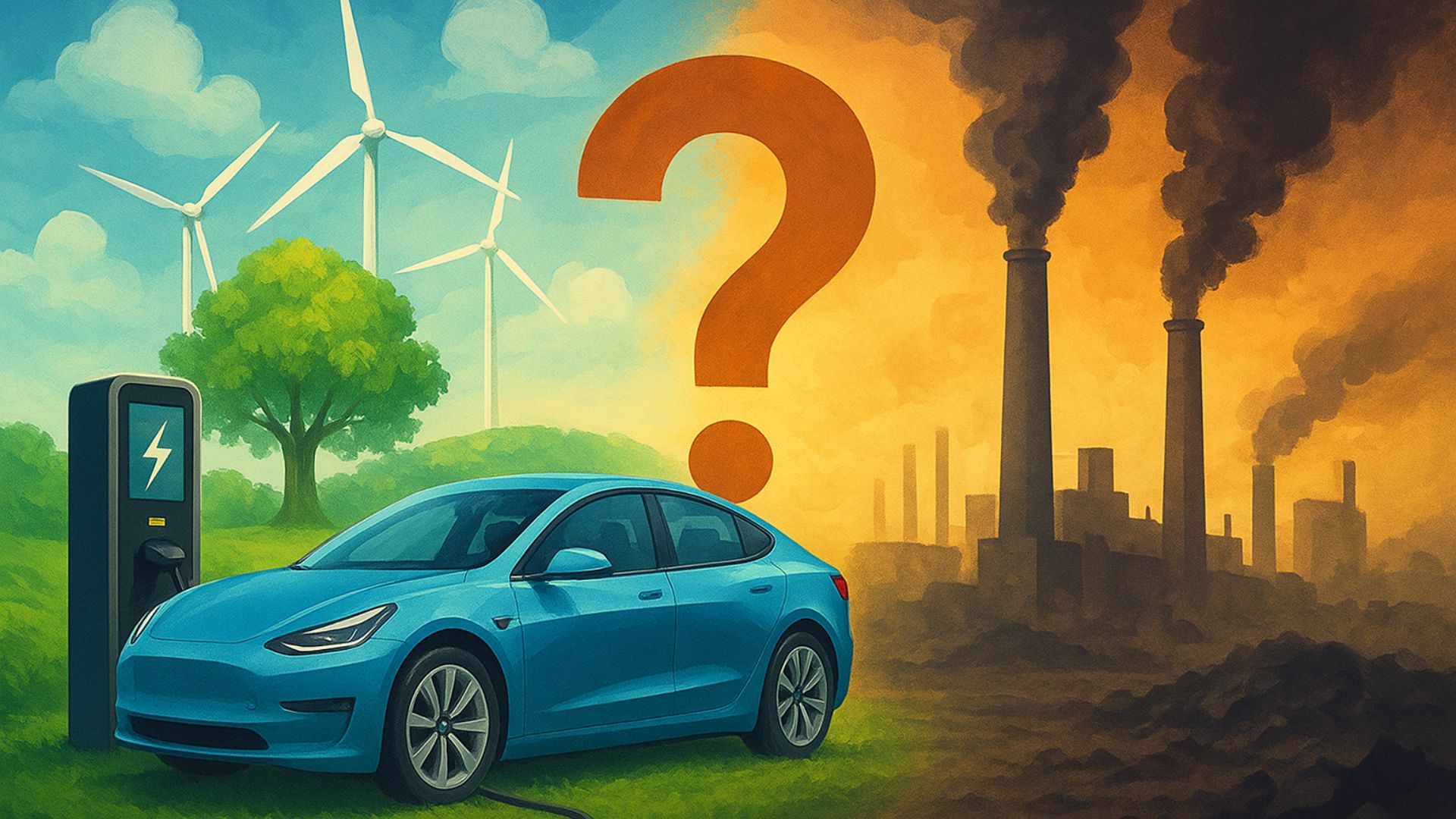
Yet the question remains more complicated than the marketing suggests. Are electric cars actually better for the environment, or do they simply shift emissions from one part of the system to another?
The answer depends on how you define environmental impact: production, electricity generation, battery supply chains, and long-term usage all matter. The environmental case for electric vehicles is real, but it is conditional rather than absolute.
How Electric Cars Actually Work in Environmental Terms
To understand the environmental impact of electric vehicles, it is necessary to move beyond tailpipe emissions and look at the full lifecycle.
Unlike internal combustion engine vehicles, electric cars produce no direct emissions during driving. However, emissions are embedded in:
- Battery production
- Electricity generation
- Raw material extraction
- Manufacturing processes
This means the environmental performance of electric vehicles is distributed across global supply chains rather than concentrated at the exhaust pipe.
The key distinction: operational vs lifecycle emissions
Traditional cars emit carbon dioxide continuously during use. Electric cars shift a large portion of emissions to the production phase.
This creates a trade-off:
- Higher emissions at manufacturing stage
- Lower emissions during operation
- Dependence on grid cleanliness
The result is that environmental performance depends heavily on time horizon and geography.
The Battery Problem: Where Most Emissions Begin
Lithium, cobalt, and nickel extraction
Electric vehicle batteries require energy-intensive mining and refining processes. Key materials include lithium, cobalt, and nickel.
These materials are often extracted in regions with carbon-intensive energy systems or environmentally damaging mining practices.
The production of a single electric vehicle battery can generate significant emissions before the car is even driven.
However, this does not necessarily determine the overall environmental outcome. It front-loads emissions rather than eliminating them.
Battery manufacturing emissions intensity
Battery production is currently one of the most carbon-intensive parts of electric vehicle manufacturing.
Factors include:
- Energy used in refining materials
- Transportation of components
- Industrial-scale chemical processing
Studies consistently show that battery production increases the initial carbon footprint of electric vehicles compared to conventional cars.
The key question is whether these emissions are offset over the vehicle’s lifetime.
Electricity Matters More Than People Think
Grid carbon intensity determines outcomes
Electric vehicles are only as clean as the electricity used to charge them.
In countries with low-carbon electricity grids, electric vehicles deliver substantial emissions reductions.
In countries heavily reliant on coal or gas, the advantage is significantly reduced.
This creates a fragmented global picture rather than a uniform environmental outcome.
Example of divergence
- In France or Norway, electric vehicles are strongly low-carbon due to nuclear and hydropower-heavy grids
- In coal-dependent regions, emissions savings are much smaller
This means the environmental case for electric vehicles is geographically dependent rather than universal.
When Electric Cars Become Cleaner Than Petrol Cars
The concept of “carbon payback period”
Because electric vehicles start with higher production emissions, they need time on the road to “pay back” this carbon debt.
The break-even point depends on:
- Battery size
- Grid cleanliness
- Vehicle efficiency
- Driving patterns
On average, electric vehicles become cleaner than petrol cars after a certain mileage threshold, often within a few years of use.
After this point, they generally outperform internal combustion engines significantly in emissions terms.
Why usage duration matters
The longer an electric vehicle is used, the stronger its environmental advantage becomes.
This is because:
- No tailpipe emissions accumulate over time
- Operational emissions remain lower
- Battery emissions are amortised across years of use
Short-term comparisons can therefore be misleading.
Beyond Carbon: Other Environmental Impacts
Resource extraction and ecological pressure
Electric vehicles reduce tailpipe emissions but increase pressure on mineral supply chains.
Key concerns include:
- Water usage in lithium extraction
- Habitat disruption from mining
- Waste management challenges
These impacts are real but differ in nature from combustion emissions. They are often localised rather than global atmospheric effects.
Battery recycling and circular systems
Battery recycling is still an emerging industry but is expected to play a critical role in reducing long-term environmental impact.
Effective recycling can:
- Reduce demand for new raw materials
- Lower lifecycle emissions
- Improve resource efficiency
However, recycling systems are not yet operating at full industrial scale.
Comparison with Internal Combustion Engines
Why petrol and diesel remain structurally inefficient
Internal combustion engines are inherently inefficient in converting energy into motion.
A significant proportion of fuel energy is lost as heat rather than used for movement.
Electric motors, by contrast, are far more efficient in energy conversion.
This structural efficiency advantage is one of the strongest arguments in favour of electric vehicles.
Lifecycle emissions comparison
When comparing full lifecycle emissions:
- Petrol and diesel cars produce continuous emissions during operation
- Electric vehicles concentrate emissions upfront but reduce them over time
Over a full lifecycle, electric vehicles generally produce lower total emissions, particularly in cleaner electricity grids.
The Infrastructure Factor
Charging networks and energy systems
The environmental impact of electric vehicles is closely linked to infrastructure development.
Key variables include:
- Charging station availability
- Grid capacity expansion
- Renewable energy integration
Without decarbonised electricity systems, the full environmental benefits of electric vehicles remain limited.
The transition problem
Electric vehicles alone do not decarbonise transport. They require parallel transformation of energy systems.
This includes:
- Renewable energy scaling
- Grid modernisation
- Storage infrastructure
Transport electrification is therefore part of a broader systems transition rather than a standalone solution.
Policy and Industrial Strategy Implications
Why governments are still pushing EV adoption
Despite complexities, governments continue to support electric vehicle adoption because:
- They reduce urban air pollution
- They lower long-term transport emissions
- They align with climate targets
Policy frameworks assume that electricity grids will continue to decarbonise over time, improving EV performance further.
Industrial competition and strategic positioning
Electric vehicles are also part of industrial competition between major economies.
Countries are investing heavily in:
- Battery supply chains
- Domestic EV manufacturing
- Critical mineral access
This makes electric vehicles not just an environmental issue but also a geopolitical and industrial one.
So Are Electric Cars Actually Better for the Environment?
The balanced answer
Electric vehicles are generally better for the environment than internal combustion engine vehicles over their full lifecycle, but the extent of their advantage depends on several conditions.
They are:
- Clearly lower-emission in operation
- Increasingly lower-emission in production
- Highly dependent on electricity mix
- Resource-intensive in early stages
They are not zero-impact technologies, but they represent a structural reduction in emissions within transport systems.
The core misconception
The key misconception is that electric vehicles are “clean”.
A more accurate framing is:
Electric vehicles are not emission-free. They are emission-shifting and emission-reducing technologies that depend on system-wide decarbonisation to reach their full potential.
Conclusion
The environmental case for electric vehicles is neither myth nor absolute reality. It sits in between.
Electric vehicles reduce emissions significantly compared to fossil fuel cars, but their impact is shaped by battery production, electricity generation, and material supply chains.
They are best understood not as a final solution, but as a transitional technology within a broader energy system transformation.
The real environmental outcome depends less on the vehicle itself, and more on the system that powers it.