How Much Electricity Does a Wind Turbine Produce? | The Numbers Explained
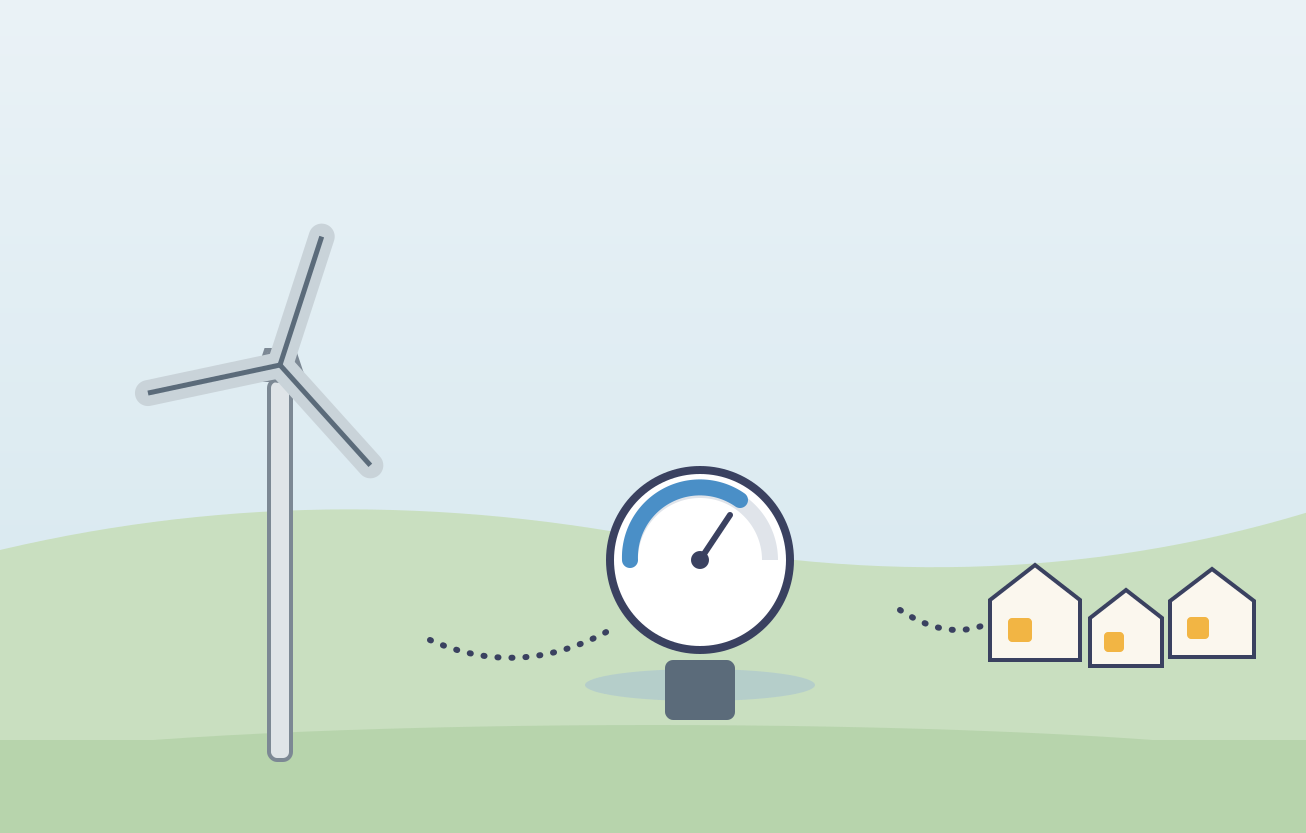
A wind turbine can generate anything from thousands to millions of kilowatt-hours of electricity each year, depending on its size, location and wind conditions. But how much power does a turbine really produce in a day or year—and how many homes could that electricity supply? Dive into the numbers and discover what wind turbines can actually deliver.
A modern wind turbine can generate hundreds of thousands to tens of millions of kilowatt-hours (kWh) of electricity per year, depending on its size, wind conditions, location and capacity factor.
A large 5-megawatt (MW) wind turbine, for example, could theoretically produce 43.8 million kWh per year if it operated at full power continuously. In reality, wind turbines do not run at maximum output all the time. At a 35% capacity factor, the same turbine would generate about 15.3 million kWh per year, or an average of roughly 42,000 kWh per day.
The important point is that a turbine's advertised capacity is not the same as the amount of electricity it actually produces.
So how much electricity does a wind turbine really generate? Let's work through the numbers.
In a nutshell
A turbine's MW rating tells you
how powerful it can be — not how much
electricity it will produce over a year.
5
MW rated capacity
×
35%
capacity factor
=
15.33
GWh / year
01 Capacity
The turbine's maximum instantaneous
electrical output under rated conditions.
02 Generation
The total electricity actually produced
over a period of time.
≠
Capacity ≠ generation.
Wind conditions, turbine design, location,
availability and other factors determine
how much electricity is actually produced.
Illustrative 5 MW turbineAnnual generation
5
MW rated capacity
Maximum electrical output at any given moment
×
35%
capacity factor
Average generation relative to maximum possible output
01How much electricity does a wind turbine produce?
The amount of electricity a wind turbine produces depends mainly on:
the turbine's rated capacity
wind speed and consistency
rotor size
turbine height
location
capacity factor
maintenance and downtime
restrictions imposed by the electricity grid
Wind turbines vary enormously in size. The U.S. Energy Information Administration (EIA) notes that small turbines can have capacities around 10 kW, while the largest operating turbines are around 15 MW. (U.S. Energy Information Administration)
That means there isn't one answer to the question.
A useful way to think about it is:
Bigger turbine + stronger, more consistent wind = more electricity generated.
But even a very large turbine won't produce its maximum rated output every hour of the year.
02Power vs. electricity generation
Before looking at the calculations, it helps to understand two terms that are often confused: power and energy.
Power
Power is the rate at which electricity can be produced.
It is measured in:
watts (W)
kilowatts (kW)
megawatts (MW)
A wind turbine rated at 5 MW can produce up to 5 MW of electrical power under the conditions for which its rated output applies.
Electricity Generation
Electricity generation is the amount of electricity produced over a period of time.
It is commonly measured in:
kilowatt-hours (kWh)
megawatt-hours (MWh)
gigawatt-hours (GWh)
For example, a 1 MW generator operating continuously for one hour produces 1 MWh of electricity. (U.S. Energy Information Administration)
This distinction is crucial when answering how much electricity a wind turbine produces.
A 5 MW turbine doesn't necessarily produce 5 MWh every hour.
It might produce 5 MW for part of an hour, 3 MW at another time, 1 MW later, and nothing when the wind is below its operating range.
Power × time = energyOne simple distinction
Power
5 MW
The rate at which the turbine can produce electricity.
×
Time
1 hr
How long the turbine operates at that output.
one hour
=
Energy
5 MWh
The amount of electricity produced over that period.
5 MW × 1 hour = 5 MWh
rate × time = amount
03How much electricity does a 5 MW wind turbine produce?
Let's use a 5 MW turbine as an example.
There are:
8,760 hours in a year
If the turbine somehow operated continuously at its full 5 MW capacity:
5 MW × 8,760 hours = 43,800 MWh
That's:
43.8 million kWh per year
But this is a theoretical maximum.
One year of operation
Theoretical maximum
8,760
hours
in one year
Jan
Feb
Mar
Apr
May
Jun
Jul
Aug
Sep
Oct
Nov
Dec
365 days × 24 hours
8,760 hours
5 MW
rated capacity
×
8,760
hours
=
43.80 GWh
theoretical maximum
Maximum annual generation
43.80 GWh
Wind turbines don't operate at full output continuously, so we need to account for their capacity factor.
Same 5 MW turbine
Annual generation at different capacity factors
43.80 GWh
100%
Theoretical maximum
19.71 GWh
45%
Capacity factor
15.33 GWh
35%
Capacity factor
10.95 GWh
25%
Capacity factor
04What is a wind turbine's capacity factor?
Capacity factor measures how much electricity a generator actually produces compared with what it could have produced if it operated continuously at full power during the same period.
In simple terms, it tells us how much of a turbine's theoretical maximum output is actually being generated over time. The EIA defines it as the ratio of actual electrical energy produced to the energy that could have been produced at continuous full power.
Capacity factor · Europe
Same turbine · different output
A 5 MW turbine
does not mean 5 MW all year.
Capacity factor compares the electricity actually generated
with the turbine's theoretical maximum output over the same
period.
To see why that matters, keep the turbine the same and change
the capacity factor.
HYPOTHETICAL 5 MW TURBINE
5 MW
rated capacity
If it ran at full power
for every hour of the year
43.80 GWh
What happens in reality
Same 5 MW turbine.
Different annual output.
Applying European fleet-average capacity factors
to the same hypothetical turbine.
Onshore · EU fleet
2024 average capacity factor
23%
10.95 GWh
annual generation
Equivalent to 23% of the turbine's
theoretical maximum annual output.
Offshore · EU fleet
2024 average capacity factor
35%
15.33 GWh
annual generation
Equivalent to 35% of the turbine's
theoretical maximum annual output.
New turbines can perform differently
WindEurope estimates higher capacity-factor ranges
for new projects than for the entire existing fleet.
New onshore
30–35%
New offshore
42–55%
→
The important point is not that offshore turbines
always produce more. It is that
rated capacity alone does not tell you annual generation.
Wind resource, turbine design, location and operating conditions all matter.
Source:
WindEurope, Wind energy in Europe: 2024 Statistics
.
2024 EU fleet capacity factors: 23% onshore and 35% offshore.
WindEurope estimates new onshore projects at 30–35% and new
offshore projects at 42–55%. Fleet figures include older turbines.
But turbines don't operate at full power continuously. The wind itself is constantly changing. Wind conditions vary enormously across Europe — and even at the same location, they change from hour to hour. This variation is one reason a turbine's rated capacity doesn't translate directly into its annual electricity production.
Wind across Europe · Current model
Loading model
The wind is
constantly moving.
This map shows the latest available
ECMWF IFS wind field at 100 metres
above ground across Europe.
The animation follows the modelled
wind speed and direction,
rather than representing electricity generation.
Loading latest European wind field
ECMWF IFS HRES ·
100 M
Waiting for latest model run
Wind speed · m/s
05101520+
Weather model
IFS HRES
ECMWF · approximately 9 km
Model cycle
—
Latest available run
Wind height
100 m
Above ground level
Wind speed is not
the same as power output.
The map shows the
wind resource
at a particular height.
A turbine converts only part of that
available energy into electricity. Its output
also depends on rotor diameter, turbine design,
air density, operating limits and the local
distribution of wind speeds.
The animation therefore shows
the wind itself,
not a real-time map of electricity generation.
Suppose our 5 MW turbine has a 35% capacity factor.
First, calculate its theoretical maximum annual generation:
5 MW × 8,760 hours = 43,800 MWh
That's 43.8 GWh if the turbine operated at full power for every hour of the year.
Now apply the 35% capacity factor:
43,800 MWh × 0.35 = 15,330 MWh
So the turbine would generate approximately 15.3 GWh per year, or 15.3 million kWh.
5 MW turbine · explore the output
Theoretical maximum
43.80 GWh / year
Change the
capacity factor. Watch the output.
Capacity factor represents the share of a turbine's
theoretical maximum annual generation
that is actually produced.
Move the slider to see how the same 5 MW turbine
produces different amounts of electricity.
Capacity factor
35%
Drag to explore
10% — 60%
10%
35%
60%
Annual generation
15.33
GWh
15.33 million kWh / year
Daily average
42,000
kWh
Average across 365 days
Share of theoretical maximum
35%
5 MW
×
8,760 hours
×
35%
→
15.33 GWh
→
A 5 MW turbine has a theoretical maximum of
43.80 GWh per year if it operated
at full power for all 8,760 hours. The slider applies
the selected capacity factor to that maximum.
Actual generation varies with wind conditions,
turbine design, availability and site characteristics.
05 How much electricity does a wind turbine produce per day?
Using our 5 MW example and a 35% capacity factor:
15.33 million kWh ÷ 365 = approximately 42,000 kWh per day
So, on average, our hypothetical turbine would generate about:
42,000 kWh per day
But there's an important qualification.
That does not mean the turbine generates exactly 42,000 kWh every day.
Wind is variable.
One day might be exceptionally windy and produce considerably more electricity. Another could be relatively calm and produce much less.
The 42,000 kWh figure is simply the annual average divided by 365.
Wind generation also varies seasonally. For example, EIA analysis of U.S. wind plants has found substantial seasonal differences in capacity factors. (U.S. Energy Information Administration)
06How much electricity does a wind turbine produce per year?
So, how much electricity can a wind turbine actually produce? The answer comes down to three numbers: its capacity, the hours in a year, and its capacity factor.
Wind power / The calculation
A simple way to estimate annual generation
A turbine's annual electricity production depends on its
capacity, the number of hours in a year and its capacity
factor.
The basic calculation
Capacity
×
hours per year
×
capacity factor
Example / 5 MW turbine
5 MW
×
8,760 hours
×
35%
=
15,330 MWh
Annual generation
15.33
GWh per year
15.33 million
kWh
A few examples
Illustrative calculations
Turbine
Capacity factor
Annual generation
2 MW
30%
5.26 GWh
5 MW
35%
15.33 GWh
10 MW
40%
35.04 GWh
15 MW
45%
59.13 GWh
*
These are illustrative calculations, not guarantees.
In a real wind project, annual generation depends on
the site's wind resource, the turbine itself, availability
and other operating conditions.
07What determines how much electricity a wind turbine produces?
Wind power / The variables
What determines how much electricity a wind turbine produces?
A turbine's rated capacity is only part of the story.
Wind conditions, turbine design, site characteristics
and operating constraints all shape how much electricity
is ultimately generated.
Electricity
generated
over time
01
Wind speed
More available wind generally means more generation.
02
Rotor diameter
A larger swept area can capture more energy from the wind.
03
Height
Wind conditions can change significantly with height.
04
Location
Wind resources vary dramatically between sites.
05
Turbine design
Rotor and generator characteristics affect output.
06
Capacity factor
Summarises generation relative to maximum possible output.
07
Availability
Maintenance and downtime reduce production.
08
Grid limits
Transmission constraints can limit delivered output.
The turbine
What it can capture
Rotor size, height and turbine design determine
how effectively the machine can capture energy
from the wind.
The site
What nature provides
Wind speed and local conditions determine how much
energy is available to the turbine.
The system
What gets delivered
Availability and grid constraints determine how much
of that potential becomes delivered electricity.
1. Wind speed
Wind speed is one of the most important factors.
A turbine needs sufficient wind to operate, and its electrical output changes as wind speed changes.
This means that two identical turbines can produce very different amounts of electricity if they are installed in different locations.
A turbine in an exceptionally windy location may generate considerably more electricity over a year than the same model in a less suitable location.
wind speed ↑ potential generation ↑
2. Turbine size
Larger turbines generally have the potential to produce more electricity.
Modern wind turbines can be enormous compared with the small turbines used for individual properties.
The EIA notes that turbine size varies widely, with small turbines capable of around 10 kW and the largest operating turbines reaching roughly 15 MW. (U.S. Energy Information Administration)
But generator capacity isn't the only factor.
larger turbine → greater generating potential
3. Rotor diameter
The blades capture energy from the moving air.
A larger rotor sweeps through a larger area and can capture more energy from the wind.
This is one reason modern turbines have become increasingly large: increasing rotor size allows turbines to capture more energy, including in locations where wind speeds aren't exceptionally high.
rotor diameter → swept area
4. Turbine height
Wind speeds generally increase with height above the ground.
That makes taller towers attractive for many wind projects.
The precise benefit depends on the characteristics of the site, including terrain and surface roughness.
wind conditions change with height
5. Location
The same turbine model can have very different annual electricity production depending on where it is installed.
Developers therefore spend considerable effort assessing the wind resource before building a wind farm.
The EIA notes that wind generation depends strongly on the availability of wind resources, which vary by region and season. (U.S. Energy Information Administration)
site-specific wind resource
6. Capacity factor
Capacity factor brings all of these variables together.
A high capacity factor means a turbine is producing relatively close to its maximum possible output over the course of the year.
A lower capacity factor means its actual annual generation is further below its theoretical maximum.
Importantly, capacity factor isn't the same thing as efficiency.
A 35% capacity factor does not mean the turbine is "65% inefficient."
It means the turbine's average electricity generation over the period was equivalent to operating at 35% of its maximum rated capacity continuously.
average generation relative to maximum rated output
08How much electricity does an offshore wind turbine produce?
Offshore wind turbines can be substantially larger than many onshore turbines. They can also benefit from stronger and more consistent wind resources in suitable locations.
To see how this translates into electricity generation, consider a hypothetical 15 MW offshore turbine operating at a 45% capacity factor.
Under these assumptions, the turbine would generate approximately 59.1 GWh of electricity per year.
That figure is an estimate, not a fixed output. Actual generation depends on the turbine's design, wind conditions, availability and the characteristics of its offshore location.
09How many homes can one wind turbine power?
A wind turbine's annual electricity generation can also be expressed in terms of household electricity consumption.
For homeowners considering renewable electricity, solar is generally a more practical option than installing a utility-scale wind turbine. If you're considering solar for your home, see our guide to how much it costs to install solar panels on a house, including system sizes, batteries, installation costs and payback.
Take our hypothetical 5 MW turbine, which generates approximately 15.33 million kWh per year.
If a household uses 3,500 kWh of electricity per year, we can compare the two.
Under these assumptions, the turbine's annual generation is equivalent to the annual electricity consumption of approximately 4,400 homes.
This is an annual electricity equivalent, not a measure of how many homes the turbine supplies at any given moment. Wind generation varies over time, as does household electricity demand, and the electricity is delivered through the wider grid.
10How much electricity does a wind farm produce?
A wind farm is simply a collection of wind turbines operating together.
Suppose a hypothetical wind farm contains:
hypothetical wind farm · turbine count
50 turbines
and each turbine produces:
one turbine · annual electricity generation
15.33 million kWh / year
Wind / scale
One turbine is small.
Fifty start to add up.
A simple hypothetical example showing how
individual turbine output becomes a utility-scale
electricity figure.
50
turbines
annual output / turbine
15.33m
kWh per year
Annual generation
766.5
million kWh / year
Same electricity
0.77
TWh / year
50 turbines×15.33 million kWh→766.5 million kWh=0.77 TWh
What this means
50 turbines → 0.77 TWh / year
At wind-farm scale, individual turbines quickly add up
to a substantial amount of electricity.
Actual output varies with wind, turbine design and availability.
Wind farm / annual generation
The arithmetic scales quickly.
One hypothetical turbine produces
15.33 million kWh per year.
1
turbine
15.33 GWh
per year
10
turbines
153.3 GWh
per year
25
turbines
383.25 GWh
per year
50
turbines
766.5 GWh
per year
50 turbines
hypothetical annual generation
0.77 TWh
11Why doesn't a wind turbine produce electricity all the time?
A common misconception is that a turbine is either producing its full rated capacity or producing nothing.
In reality, output can vary continuously.
Wind speed →
The stronger the wind, the more quickly
the rotor turns — until the turbine reaches
its operating limit.
airflow
A turbine may:
produce relatively little electricity in weak winds
increase its output as wind speed rises
reach its rated output at sufficiently high wind speeds
maintain rated output over a range of wind speeds
shut down when winds become extremely strong
stop temporarily for maintenance or technical reasons
The result is a fluctuating electricity output over the course of hours, days and seasons.
This is why annual electricity production is much more useful than simply looking at the turbine's nameplate capacity.
12What happens when there is no wind?
When wind speeds are too low for a turbine to operate, it produces little or no electricity.
That doesn't mean the electricity system stops working.
When there is no wind
The grid doesn't stop.
Something else steps in.
Wind generation · high
wind
GRID
balance
storage
other generation
Wind output
100%
Drag the wind down.
Watch the grid adapt.
Simplified illustration — not a physical grid model.
The electricity grid has to continuously balance electricity supply and demand. Other generators, energy storage, interconnections and changes in electricity consumption can all play roles in maintaining that balance.
This is one reason why understanding generation over time, rather than simply installed capacity, is so important when discussing wind power.
13How much electricity can a wind turbine produce? A simple calculation
If you want to estimate the annual electricity production of a wind turbine, you can use this formula:
You can use the same formula for almost any turbine.
For example, a 10 MW turbine with a 40% capacity factor:
10 × 8,760 × 0.40 = 35,040 MWh
So its estimated annual generation would be:
35.04 GWh
The calculation is simple. Determining a realistic capacity factor is the harder part.
14Wind turbine capacity vs. electricity generation
A wind turbine’s capacity tells you how much electricity it can produce at its maximum output. Generation tells you how much electricity it actually produces over a period of time.
The difference is important because a turbine does not operate at its maximum output all the time. Wind speeds change, so the amount of electricity produced depends on how often the turbine is generating and how much power it is producing when it does.
To see why this matters, compare two turbines.
Turbine A has a capacity of 5 MW and a capacity factor of 35%.
Turbine B has a capacity of 10 MW, making it twice as large, but its capacity factor is only 20%.
Now calculate how much electricity each produces in a year.
Same year · different turbines
Bigger capacity doesn't
automatically mean more electricity.
Turbine ABaseline
5
MW capacity
15.33
GWh / year
Capacity factor
35%
Annual generation
15.33
GWh
Turbine B2× capacity
10
MW capacity
17.52
GWh / year
Capacity factor
20%
Annual generation
17.52
GWh
+14%
Turbine B has twice the installed capacity,
but produces only about 14% more electricity per year
in this example.
Turbine A 5 × 8,760 × 0.35 = 15.33 GWh/year
Turbine B 10 × 8,760 × 0.20 = 17.52 GWh/year
Despite having twice the installed capacity, Turbine B produces only around 14% more electricity.
This is why installed capacity on its own does not tell you how much electricity a wind project will generate. The chart below explains the three measures to look for: capacity, generation and capacity factor. It shows what each one means and how they relate to each other.
Wind power · At a glance
5 MW example
Capacity is not
the same as generation.
A 5 MW turbine can produce
5 megawatts at full output.
But wind does not blow at the exact speed
needed for maximum output all the time.
Rated capacity
5 MW
The turbine's maximum instantaneous
electrical output.
×
Capacity factor
35%
An illustrative average for a wind
turbine operating over time.
=
Average output
1.75 MW
Equivalent average output across the year.
What this means
The turbine is not running at 35%.
A 35% capacity factor means that,
averaged over a year, the turbine produces the
same amount of electricity as if it had operated
at 35% of its rated capacity continuously.
In reality, its output is constantly changing
with the wind.
Maximum
5 MW
Instantaneous rated output
Average
1.75 MW
Average output at 35% capacity factor
Annual generation
15.33 GWh
Approximately 15,330 MWh per year
Simple relationship:
5 MW × 35% × 8,760 hours ≈ 15.33 GWh per year.
Actual production varies with wind conditions,
turbine design, availability and site characteristics.
15Does a bigger wind turbine always produce more electricity?
Not necessarily on a simple one-to-one basis.
A larger turbine generally has greater generating potential, but the electricity it actually produces depends on the wind resource and how well the turbine is matched to its location.
A turbine with a very large generator installed at a relatively low-wind site could have a lower capacity factor than a smaller turbine at an excellent wind site.
The goal isn't simply to build the turbine with the biggest possible nameplate capacity.
The goal is to maximise useful electricity generation over the turbine's operating life.
16Why modern wind turbines are getting bigger
One of the major trends in wind energy has been increasing turbine size.
Larger rotors and taller towers allow turbines to capture more wind energy and can increase electricity production from a given site.
Offshore wind has particularly benefited from this trend because transporting and installing very large machines can be more practical at sea than on land.
The IEA continues to track substantial growth in global wind capacity and generation as turbine technology develops. (IEA)
But bigger turbines also create engineering and logistical challenges, including transportation, foundations, installation, maintenance and grid infrastructure.
17How much electricity does a wind turbine produce compared with its rated capacity?
Here's the simplest way to visualise the relationship.
Imagine a 5 MW turbine.
If it operated at full output for every hour of the year:
43.8 million kWh/year
If its average capacity factor were 25%:
10.95 million kWh/year
At 35%:
15.33 million kWh/year
At 45%:
19.71 million kWh/year
So the same 5 MW turbine could have substantially different annual electricity production depending on the conditions under which it operates.
That's why the question "How many megawatts is the turbine?" doesn't, by itself, tell you how much electricity it produces.
Energy explained
Bigger doesn't
always mean more.
A wind turbine's rated capacity tells you
how powerful it can be. Generation tells you
how much electricity it actually produces.
Scroll to explore
The distinction
Two numbers.
One very common
misunderstanding.
01 / Capacity
MW
Maximum output
The maximum electrical power a turbine
is designed to deliver at a particular moment.
02 / Generation
GWh / YEAR
Actual electricity
The total amount of electricity the turbine
actually produces over a period of time.
01 — The calculation
Capacity is only
the beginning.
Annual electricity generation depends not
only on how large the turbine is, but on
how often it actually operates at full output.
5 MW
× 8,760 hours
× 35%
=
Annual generation
15.33GWh
Capacity factor
35%
02 — The plot twist
Twice the capacity.
Not twice the electricity.
Compare two hypothetical turbines.
The larger turbine has twice the rated capacity,
but a much lower capacity factor.
Turbine A
01
5
MEGAWATTS CAPACITY
35%
Capacity factor
15.33
GWh / year
Annual generation
15.33 GWh
Turbine B
02
10
MEGAWATTS CAPACITY
20%
Capacity factor
17.52
GWh / year
Annual generation
17.52 GWh
The takeaway
2× capacity
≠ 2× generation.
03 — Play with the numbers
Build your
own turbine.
Change the assumptions and see how quickly
annual generation changes.
Capacity
8 MW
Capacity factor
35%
Estimated annual generation
24.53GWh
FAQs❓
1. How Much Electricity Does a Wind Turbine Produce Per Day?
+
It depends on the turbine's size and the wind conditions at its location. As an illustrative example, a 5 MW wind turbine operating at a 35% capacity factor would generate approximately 42,000 kWh per day on average, based on annual generation of about 15.33 million kWh. Actual daily production can be much higher or lower because wind speeds vary over time.
2. How Much Electricity Does a Wind Turbine Produce Per Year?
+
There is no single figure because wind turbines vary greatly in size and location. For example, a hypothetical 5 MW turbine operating at a 35% capacity factor would generate approximately 15.3 GWh of electricity per year. Actual annual production depends on factors including wind speed, turbine design, location, availability and capacity factor.
3. How Much Power Does a 5 MW Wind Turbine Produce?
+
A 5 MW wind turbine has a rated capacity of 5 MW, meaning it is designed to produce up to 5 MW of electrical power under the appropriate operating conditions. It does not necessarily produce 5 MW continuously. Actual output changes with wind speed and other operating conditions. The U.S. Energy Information Administration explains the distinction between a generator's capacity and its actual electricity generation.
U.S. Energy Information Administration
4. How Many Homes Can One Wind Turbine Power?
+
It depends on how much electricity the turbine generates and how much electricity households use. Using an illustrative 5 MW turbine producing approximately 15.33 million kWh per year and assuming annual household electricity consumption of 3,500 kWh, the turbine's generation would be equivalent to the annual electricity use of approximately 4,400 homes. This is an annual comparison rather than an indication that the turbine directly supplies those homes at all times.
5. Do Wind Turbines Produce Electricity at Night?
+
Yes. Wind turbines can produce electricity at night whenever wind conditions are suitable. Unlike solar panels, wind turbines do not require sunlight to generate electricity. Their output depends primarily on the speed and characteristics of the wind at the turbine's location.
6. What Happens to a Wind Turbine When There Is No Wind?
+
When wind speeds fall below a turbine's operating range, the turbine will stop generating electricity. It can resume operation when wind speeds return to suitable levels. Wind turbines can also temporarily stop because of maintenance, technical issues or very strong winds that require the turbine to shut down for protection.
7. Is a 5 MW Wind Turbine Always Producing 5 MW?
+
No. 5 MW is the turbine's rated capacity, not its constant output. A turbine may produce less than 5 MW when wind speeds are below the level needed for maximum output. Its actual generation can change continuously as wind conditions change. This is why annual electricity production and capacity factor are more useful measures of a turbine's output than rated capacity alone.
8. What Is the Capacity Factor of a Wind Turbine?
+
Capacity factor measures the electricity a turbine actually generates over a period compared with the amount it could have generated if it had operated continuously at its full rated capacity. For example, a 5 MW turbine with a 35% capacity factor would generate the equivalent of operating at 35% of its maximum capacity continuously over the year. The U.S. Energy Information Administration provides the formal definition of capacity factor.
U.S. Energy Information Administration
9. How Much Electricity Does an Offshore Wind Turbine Produce?
+
Offshore wind turbines can be much larger than many onshore turbines. As an illustrative example, a 15 MW offshore turbine operating at a 45% capacity factor would generate approximately 59.1 GWh of electricity per year. This is a calculation based on the stated capacity and assumed capacity factor, rather than a universal production figure. The U.S. Department of Energy and National Renewable Energy Laboratory have developed a 15 MW reference offshore wind turbine for research and technology development.
U.S. Department of Energy
10. What Factors Affect How Much Electricity a Wind Turbine Produces?
+
Several factors affect wind turbine electricity production, including wind speed, turbine size, rotor diameter, turbine height, location, capacity factor and operating availability. Wind conditions are particularly important because the same turbine can generate different amounts of electricity at different locations. The U.S. Energy Information Administration provides further information on turbine types, capacity and wind electricity generation.
EIA: Types of Wind Turbines
The bottom line
So, how much electricity does a wind turbine produce?
The answer depends on the turbine and where it operates.
A useful example is a 5 MW wind turbine:
Maximum theoretical annual generation: 43.8 million kWh
At a 25% capacity factor: 10.95 million kWh/year
At a 35% capacity factor: 15.33 million kWh/year
At a 45% capacity factor: 19.71 million kWh/year
At a 35% capacity factor, that works out to an annual average of roughly 42,000 kWh per day.
The most important lesson is that a turbine's capacity isn't the same as its electricity production. Wind speed, rotor size, turbine design, location and capacity factor all determine how much electricity actually reaches the grid.
And as wind turbines have become larger, their potential output has increased dramatically. The largest operating turbines are now around 15 MW, according to the EIA, while the wind industry continues to develop even larger machines. (U.S. Energy Information Administration)
That makes wind turbine capacity only the starting point. To understand how much electricity wind power can really provide, you need to look at annual generation and capacity factor together.
REFERENCES
Sources & Further Reading
Research, official data and technical resources used to inform
this guide to wind turbine electricity generation.