Energy
Aug 17

How Much Does It Cost to Install Solar Panels on a House?

How much do solar panels cost for a house? We break down installation costs, system sizes, batteries, savings and payback — with a look at the U.S., Europe and Asia.

Solar energy / Explained
Contents
16 sections
  1. Introduction
  2. 01 How much do solar panels cost for a house?
  3. 02 Why can two solar quotes be so different?
  4. 03 The panels aren't actually most of what you're paying for
  5. 04 How big a solar system does a house need?
  6. 05 A 5 kW solar system doesn't produce 5 kWh every hour
  7. 06 What actually determines how much electricity your panels produce?
  8. 07 How much does a solar battery cost?
  9. 08 Do you actually need a battery?
  10. 09 Solar costs are very different in Europe (and elsewhere)
  11. 10 Europe is showing what happens when lots of homes get solar
  12. 11 What about Asia?
  13. 12 India is taking a different route
  14. 13 So where is solar cheapest?
  15. 14 How long does it take for solar panels to pay for themselves?
  16. 15 Solar panels don't stop working after 20 years
  17. 16 Is solar worth it?
  18. Key takeaway

Introduction

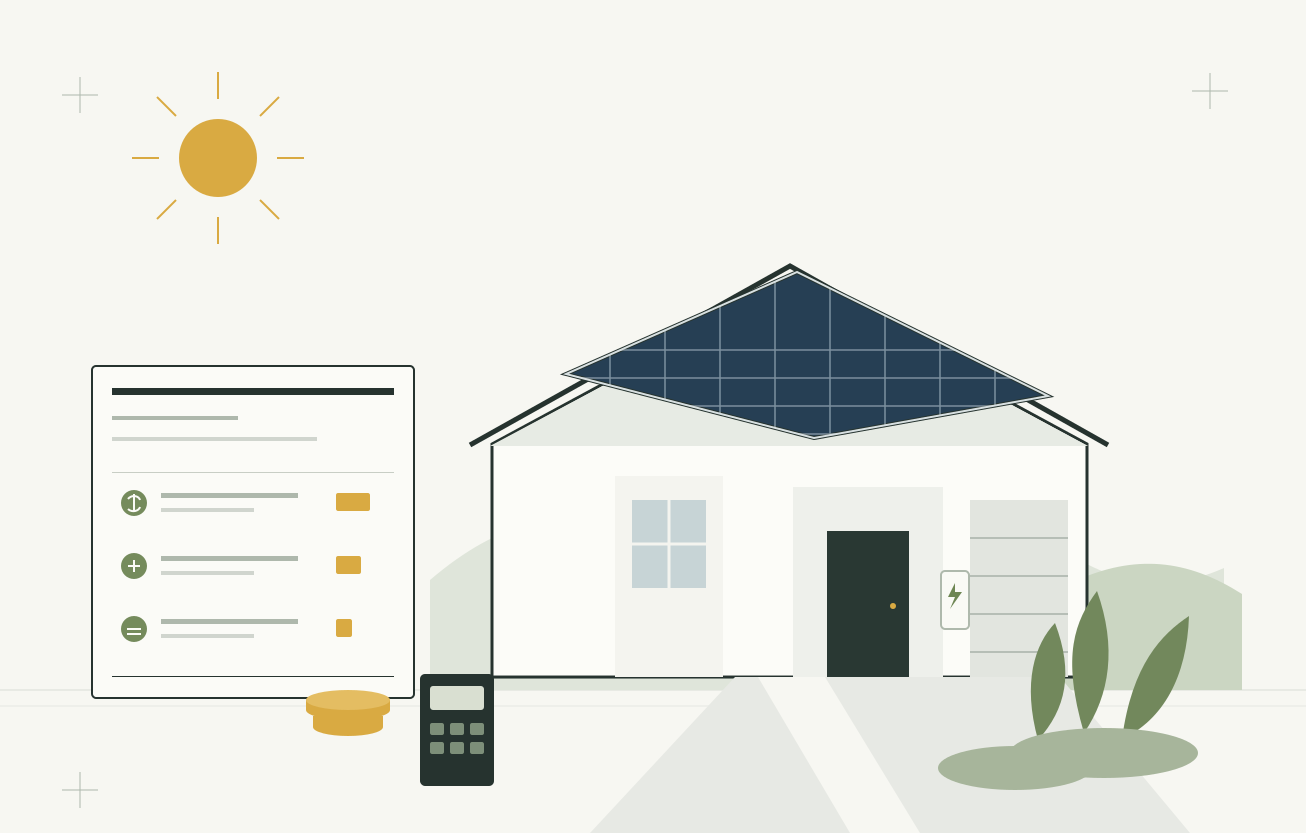
If you're thinking about putting solar panels on your house, the first question is probably the simplest one:

How much is this actually going to cost?

The frustrating answer is that there isn't one number.

In the U.S., recent residential solar quotes have been coming in at around $2.48 per watt, according to EnergySage's marketplace data for the first half of 2025. The U.S. Department of Energy's benchmark for a representative 8 kW residential system was higher, at $3.15 per watt.

That puts an 8 kW system somewhere around:

$19,840–$25,200

before incentives.

That's a useful starting point, but it isn't necessarily what you'll pay.

Your roof, your electricity consumption, the equipment you choose, where you live, whether you add a battery and even the way your local electricity market works can all change the calculation.

Before sizing a solar system, it's also worth looking at the wider energy needs of your home. Our guide to sustainable home energy solutions covers insulation, heat pumps, efficient appliances, energy management, batteries and other ways to reduce energy demand before adding generation.

And that's really the important part.

Solar isn't just about how much the panels cost. It's about how much the system costs, how much electricity it produces and what that electricity is worth to you.

Let's break it down.

In a nutshell
Solar isn't really about the price of the panels. It's about what the complete system costs — and what its electricity is worth over time.
8
kW system
×
€/W
installed cost
=
€€
total system cost
01 Cost
Compare the complete installed system: panels, inverter, mounting, labour, electrical work and any other project costs.
02 Value
What matters in the long run is how much electricity the system produces and what that electricity is worth to your household.
Cheap panels don't automatically mean cheap solar. System size, roof complexity, installation costs, batteries, electricity prices, incentives and local grid rules can all change the economics.
Solar power / The real cost

What does a complete solar system cost?

It isn't just the panels. You're paying for the system that turns sunlight into usable electricity — from the modules on the roof to the inverter, installation and everything needed to connect it to your home.

The real question
What are you actually paying for?
The panels are only one part of the system.
01
Panels

The modules that capture sunlight and generate electricity.

02
Inverter

Converts the electricity produced by the panels into usable AC power.

03
Installation

Labour, mounting equipment, electrical work and the physical installation.

04
Roof & access

Roof complexity, scaffolding, access and any preparation the site requires.

05
Battery

Optional storage that lets a household use more of its solar electricity after sunset.

06
Grid & permits

Connection requirements, approvals and other project costs can add to the final bill.

The headline number
Installed cost

The useful number is the price of the complete installed system — not simply the retail price of the panels.

The variable
System size

A 3 kW, 5 kW or 10 kW system can have very different upfront costs and very different electricity output.

The wildcard
The battery

Adding storage can materially increase the upfront cost, but may change how much of your solar electricity you use yourself.

01How much do solar panels cost for a house?

DATA POINT EnergySage's median residential quote was $2.48/W in the first half of 2025.

A typical residential solar system is priced by its capacity, measured in kilowatts (kW). The installed cost can be estimated by multiplying system size by the price per watt.

Installed cost = system size × price per watt
System EnergySage DOE benchmark
5 kW System size
$12,400 $2.48/W
$15,750 $3.15/W
8 kW System size
$19,840 $2.48/W
$25,200 $3.15/W
10 kW System size
$24,800 $2.48/W
$31,500 $3.15/W
Data note. This section simulates the U.S. residential solar market using EnergySage's median quoted price of $2.48/W for the first half of 2025 and a DOE benchmark of $3.15/W for a representative residential system. Figures are illustrative, rounded, and shown before incentives. Actual costs vary by location, roof, equipment, labour and installation.
Rooftop generation
Solar isn't about the price of the panels. It's about what the complete system costs — and what its electricity is worth.
01 Cost
Compare the complete installed system, not the price of the panels alone.
02 Value
The real return depends on production, self-use and electricity prices.
Cheap panels ≠ cheap solar. Roof, labour, battery, incentives and grid rules can all change the final economics.

These figures are a starting point, not a quote. Actual costs depend on the roof, equipment, labour, battery, location and local installation requirements.

02Why can two solar quotes be so different?

This is where the headline price per watt becomes less useful.

Imagine two houses.

One has a large, uncomplicated south-facing roof with plenty of usable space.

The other has several roof sections, dormers, skylights, a chimney, partial shading and an older electrical system.

They could use exactly the same solar panels.

They aren't going to cost the same to install.

Your roof matters

Solar installers have to work around the building that's already there.

A simple roof is easier to design and install. A complicated roof takes more labour, more mounting equipment and potentially more electrical work.

The condition of the roof matters too.

If you're going to need a new roof in a few years, installing solar now can create an expensive problem later when the panels have to be removed and reinstalled.

Your electrical system matters

Some homes need electrical upgrades before the solar system can be connected.

There may also be costs associated with permitting, inspections and connecting the system to the grid.

Labour matters

Solar panels may be manufactured thousands of kilometres away from your house.

The person putting them on your roof isn't.

Local wages, construction costs and installer competition can make a surprisingly large difference to the final price.

And this is one reason solar prices don't simply follow the price of solar panels.

03The panels aren't actually most of what you're paying for

This is one of the stranger things about residential solar.

The panels themselves have become incredibly cheap.

The finished installation hasn't fallen in price by anything like the same amount.

That's because you're not buying a pile of panels.

You're buying an operating electricity system.

The DOE's residential PV cost model includes the modules, inverter, structural equipment, electrical equipment, installation labour, office work and other project costs. Its 2024 benchmark for an 8 kW residential system was $2.74/W at its minimum sustainable price and $3.15/W at its market-price benchmark. (The Department of Energy's Energy.gov)

So if someone tells you that solar modules can be bought for a few tens of cents per watt, that doesn't mean you should expect a complete rooftop system to cost a few tens of cents per watt.

There's a lot more involved in getting those panels from a factory to your roof.

04How big a solar system does a house need?

This is another question where bigger isn't automatically better.

A solar installer will usually look at your electricity consumption and the amount of sunlight available at your property.

A household using 4,000 kWh of electricity a year doesn't necessarily need a 10 kW system.

Likewise, a house using 12,000 kWh may need considerably more capacity.

The roof itself can also become the limiting factor.

A modern residential solar panel might produce around 400 W, so an 8 kW system could contain roughly:

8,000 ÷ 400 = 20 panels

If each panel occupies around 2 m², that's roughly:

20 × 2 = 40 m²

of panel area.

That's a very simplified calculation — spacing, roof geometry and equipment also matter — but it gives you an idea of the physical size of a system.

05A 5 kW solar system doesn't produce 5 kWh every hour

This is an easy mistake to make.

A 5 kW system has a maximum electrical output of 5 kW under its rated conditions.

It doesn't mean it produces 5 kWh every hour.

Solar production changes throughout the day.

At night, production is zero.

In the morning it increases.

Around the middle of a sunny day it can be much higher.

Then it falls again in the evening.

Clouds, temperature, shading, orientation and the angle of the panels all affect the result.

This is why a proper solar estimate should tell you annual electricity generation, not just the size of the system.

06What actually determines how much electricity your panels produce?

There are several big variables.

Sunlight

A roof in southern Spain will generally receive more solar energy than an otherwise identical roof in northern Europe.

But that doesn't mean solar only works in sunny countries.

Germany is one of the world's largest solar markets despite having considerably less annual sunshine than southern Europe.

sunlight → annual irradiation

Roof orientation

The direction your roof faces matters.

So does its pitch.

roof direction + pitch → yield

Shading

Trees, buildings and chimneys can reduce production.

shading → reduced production

Temperature

Solar panels actually tend to become less efficient as they get hotter, so very hot conditions aren't automatically better.

higher temperature → lower efficiency

System losses

The electricity has to pass through wiring, inverters and other equipment before you can use it.

All of these factors are why two identical 8 kW systems can produce different amounts of electricity.

solar energy → system → usable electricity

07How much does a solar battery cost?

This is where the price can jump.

The DOE's 2024 benchmark for an 8 kW residential solar system was $3.15/W without storage.

Its benchmark for the same PV system paired with a 13.5 kWh battery was $5.19/W. (The Department of Energy's Energy.gov)

For the benchmark system, that means:

Solar only

8,000 × $3.15 = $25,200

Solar + battery

8,000 × $5.19 = $41,520

DOE benchmark / 8 kW residential system
2024
Solar only 3.15 / W
8 kW PV
$25,200
Solar + battery 5.19 / W
8 kW + 13.5 kWh
$41,520
Additional benchmark system cost +$16,320
Important: this is the difference between two complete system-cost benchmarks — not a retail price for buying a battery separately.

Again, this isn't saying that every homeowner will pay $16,320 for a battery.

It's a complete system-cost benchmark, not a battery-shop price.

But it shows the scale of the additional investment.

And whether the battery is worth it depends heavily on what happens to your electricity during the day.

08Do you actually need a battery?

Not necessarily.

This is probably one of the biggest misconceptions about residential solar.

Your solar panels can generate electricity without a battery.

The question is what happens to that electricity when you're not using it.

Imagine your panels are producing lots of electricity at lunchtime while nobody is home.

You have two basic options.

You can send some of that electricity to the grid.

Or you can store some of it in a battery and use it later.

Which option makes more sense depends on your local electricity rules.

If the grid pays you well for exported electricity, a battery may be less important.

If exported electricity is worth relatively little compared with the price you pay to buy electricity in the evening, a battery can become much more attractive.

That is why battery economics are really electricity-tariff economics.

09Solar costs are very different in Europe (and elsewhere)

This is where the American headline numbers can become misleading.

Solar isn't priced the same way everywhere.

In Austria, for example, IEA PVPS reported an average turnkey residential rooftop system price of approximately €1,551 per kWp in 2024. (IEA-PVPS)

An illustrative 8 kWp system would therefore be:

8 × €1,551 = €12,408

Austria / Residential PV
2024
Average turnkey cost
€1,551
per kWp
Illustrative system
×8
kWp
system
Estimated turnkey price
€12,408
Before incentives
One number worth remembering: system prices only become meaningful when compared with the electricity that system can produce and the value of that electricity.

That's considerably different from the U.S. figures above.

But you shouldn't simply conclude that solar is "cheaper in Austria."

The datasets aren't perfectly comparable, and the economics of the electricity are different too.

What matters is what the system costs relative to the value of the electricity it produces.

Austria is an interesting example because rooftop solar has grown rapidly.

Around 500,000 PV systems were operating in the country by the end of 2024, and approximately one-third of new decentralised systems installed that year included battery storage. (IEA-PVPS)

That's a sign of where the European residential market is heading.

Solar is increasingly becoming part of a broader household energy system involving:

  • batteries
  • electric vehicles
  • heat pumps
  • smart electricity tariffs
  • home energy management

The panels are still the centre of it, but they're no longer the whole story.

For most homeowners, solar is a much more practical way to generate renewable electricity than installing a wind turbine. If you're interested in the relative output of wind generation, see our guide to how much electricity a wind turbine produces.

10Europe is showing what happens when lots of homes get solar

Europe is now one of the world's biggest solar markets.

The EU added around 63 GW of PV in 2024, taking cumulative capacity to roughly 339 GW. (IEA-PVPS)

Some countries have gone particularly far.

According to IEA PVPS, solar supplied approximately 24% of electricity in Spain and 25.5% in the Netherlands in 2024. Austria was around 14%. (IEA-PVPS)

That creates an interesting problem.

When only a few houses have solar, sending excess electricity into the grid isn't particularly difficult.

When millions of homes are doing it at the same time, everyone is producing electricity at roughly the same time — usually around the middle of the day.

many rooftops → one midday peak

Suddenly the question becomes:

THE MIDDAY PROBLEM

That's one reason batteries and flexible electricity consumption are becoming more important.

The future of rooftop solar isn't simply about installing more panels.

It's about using the electricity at the right time.

11What about Asia?

Asia makes the global solar picture even more interesting.

China alone installed somewhere between 309 and 357 GW of solar in 2024, depending on the methodology used for estimating its capacity additions.

India added around 32 GW.

Japan added roughly 5.5 GW.

Asia / 2024 additions
Three very different solar markets — and one particularly important manufacturing story.
market + manufacturing
China
309–357GW
India
32GW
Japan
5.5GW
China is not just installing solar at enormous scale. Its manufacturing base also helps shape the price of panels sold around the world.
India and Japan show how the same technology can develop through very different markets, policies and energy systems.

Together, these markets show just how far solar has moved beyond the traditional Western residential market. (IEA-PVPS)

But there's an important distinction here.

China is both the world's largest solar market and the world's dominant solar manufacturer.

That enormous manufacturing base has helped drive solar-module prices down around the world.

China installed around 278 GW of new PV under its official 2024 figures, with distributed systems accounting for a substantial share. IEA PVPS reports that residential installations themselves actually fell in 2024, while commercial and industrial distributed solar continued to grow strongly. (IEA-PVPS)

So even in China, the story isn't simply "cheap panels = everyone puts solar on their roof."

The economics depend on the type of building, electricity prices, policy and how the electricity can be used.

12India is taking a different route

India is another useful comparison because solar isn't just about reducing the electricity bill of a wealthy homeowner.

Solar is being deployed at enormous scale across utility projects, businesses and homes, alongside efforts to expand rooftop generation.

India added approximately 32 GW of solar in 2024, taking cumulative PV capacity to around 125 GW.

India / Solar at scale
New solar capacity added in 2024, according to IEA-PVPS.

A different way
to think about solar.

31.9
GW of solar added · 2024
Growing deployment 2024
Solar in India isn't only a story about making electricity cheaper. At enormous scale, it can also mean expanding access, reducing dependence on expensive grid power and making electricity supply more resilient.
Utility
Commercial
Residential

Here, the value proposition can be different.

In some circumstances, solar can reduce dependence on expensive grid electricity.

In others, it can improve energy resilience or provide electricity where grid supply is less reliable.

The same technology therefore serves a different purpose.

13So where is solar cheapest?

This is actually the wrong question.

The cheapest solar panels aren't necessarily the cheapest solar system.

And the cheapest solar system isn't necessarily the best investment.

Solar economics / A simple comparison

The cheapest system isn't always the best investment.

Two houses. Two systems. The cheaper one costs less — but produces far less economic value.

House A
Better economics
House B
Lower upfront cost
System cost
€12,000
Annual generation
7,000 kWh
Electricity value
€0.30 / kWh
Annual electricity value
€2,100
Simple payback
€12,000 ÷ €2,100
5.7
System cost
€10,000
Annual generation
8,000 kWh
Electricity value
€0.10 / kWh
Annual electricity value
€800
Simple payback
€10,000 ÷ €800
12.5
Payback 5.7 years
Payback 12.5 years
Solar is an investment in electricity, not panels.
House B is €2,000 cheaper upfront. But House A creates €2,100 of annual electricity value versus just €800.

The result: 5.7 years vs 12.5 years to recover the initial investment.

House B is cheaper.
House A pays back faster.

THE LEARNING CURVE
Solar gets cheaper
because we keep
building it.
Every panel we make teaches the industry something. Manufacturing improves. Supply chains scale. Materials become cheaper. Engineers find better ways to do the same job.
MODULE PRICE
EXPENSIVE
CHEAP
CUMULATIVE INSTALLED CAPACITY
1976
$106
PER WATT
MODULE PRICES
2024
< $0.50
PER WATT
20%
LEARNING RATE
Historically, solar module prices have fallen by roughly 20% every time cumulative global capacity has doubled.
01 Build
02 Learn
03 Reduce cost
04 Build more
Source: Our World in Data, based on IRENA (2025), Nemet (2009), and Farmer & Lafond (2016). Module prices are in constant 2024 US dollars per watt and exclude installation and other system components.

14How long does it take for solar panels to pay for themselves?

The simplest calculation is:

Payback period = system cost ÷ annual savings

If you spend $20,000 and save $2,000 a year:

$20,000 ÷ $2,000 = 10 years

Simple payback
Drag the savings. Watch the payback move.
Time to recover the cost
10.0
years
The point at which accumulated electricity savings equal the original system cost.
Example system cost
$20,000
Annual savings
$2,000 / yr
Annual electricity savings $2,000
$500 $1,500 $2,500 $3,500 $5,000
$20,000 ÷ $2,000 = 10.0 yrs
cost recovered
0 5 10 15 20+ years
Why $20,000?
It's a deliberately simple example — not a universal solar price. The point is to show how the same system cost can have a very different payback depending on how much value the electricity produces.

But real solar projects are more complicated.

Electricity prices change.

Solar panels slowly degrade.

Your household electricity consumption changes.

You may export electricity to the grid.

You might add a battery.

You might finance the system.

And government incentives can materially change the upfront cost.

So a proper solar financial model should look at the system over its entire useful life rather than stopping at the simple payback number.

15Solar panels don't stop working after 20 years

Another reason the payback calculation can be misleading is that solar panels are long-lived assets.

They gradually lose output rather than suddenly reaching a point where they stop working.

NREL research generally puts PV degradation in the region of 0.5–1% per year, depending on the technology and conditions.

Using a simple 0.7% annual degradation assumption, a system producing 10,000 kWh in its first year would produce approximately:

10,000 × 0.993²⁵ ≈ 8,390 kWh

in year 25.

That's still a substantial amount of electricity.

So if your system pays for itself after eight or ten years, it doesn't necessarily mean its financial value ends there.

There can be another decade or more of electricity production afterwards.

16Is solar worth it?

After considering all these factors, you may wonder: Is solar really woth it? For many homes, solar can make excellent financial sense. But there is no universal answer. I’d look at five key numbers before making a decision:

01

What will the system actually cost?

Get several quotes and compare them on a $/W or €/kWp basis.

02

How much electricity will it produce?

Don't rely on the system size alone. Ask for an annual production estimate.

03

How much of that electricity will you use?

Self-consumed electricity can be particularly valuable because it replaces electricity you would otherwise buy.

04

What happens to excess electricity?

Find out exactly what your utility or electricity supplier pays for exports.

05

What happens after incentives?

Calculate the economics using the incentives actually available where you live today, rather than relying on an old solar article.

The bottom line

So, how much does it cost to install solar panels on a house?

In the U.S., a useful current starting point is roughly $2.50–$3.15 per watt installed, putting a 5 kW system around $12,400–$15,750 and an 8 kW system around $19,840–$25,200, before incentives. EnergySage's marketplace data gives us the lower end of that range, while the DOE's detailed cost benchmark gives us the higher benchmark. (EnergySage)

In Europe, prices can look very different. Austria's 2024 residential benchmark was around €1,551/kWp, for example. (IEA-PPS)

And in Asia, enormous manufacturing scale — particularly in China — has helped push the underlying cost of solar hardware down dramatically. China installed hundreds of gigawatts of solar in 2024 alone. (IEA-PVPS)

But none of those numbers tells you whether your house should have solar.

For that, you need to know what the system costs, how much electricity your roof can produce, what your electricity is worth and how much of that electricity you can actually use.

That's the calculation that matters.

The cheapest solar system isn't necessarily the best one.

The better question is:

How much will I spend, how much electricity will it produce, and how much will that electricity save me over the life of the system?

Once you look at solar that way, the answer becomes much more useful than simply asking how much a box of panels costs.

FAQs The questions worth asking

The cost depends mainly on how much electricity the house uses, the size of the solar system, the roof, local installation costs and whether a battery is included.

The most useful way to compare quotes is usually to look at the total installed cost relative to system size, such as €/kWp or $/W, rather than looking only at the number of panels.

The panels themselves are only one part of the cost of a home solar system. The final price can also include the inverter, mounting system, electrical work, installation, permits and other project costs.

This is why a low price per panel does not necessarily mean a low-cost solar installation. Compare the complete installed system rather than the panels alone.

There is no single average price that applies to every house. A small system on a simple roof can cost much less than a larger installation on a complex roof, and prices also vary substantially between countries and regions.

For a meaningful comparison, look at the total installed price, the system's kWp capacity, expected annual electricity generation and the assumptions behind the quote.

Installation is part of the total solar-system cost and can include labour, roof mounting, wiring, electrical protection, the inverter, commissioning and other work required to connect the system.

Installation costs can rise when a roof is difficult to access, requires additional structural or electrical work, or has a more complicated layout.

The right system size depends on the home's electricity consumption, available roof area, local sunlight and how much of the electricity you want the system to cover.

Start with the home's annual electricity use in kWh, then estimate how much electricity a solar system could produce at the property. A larger system is not automatically better if much of its electricity will be exported at a lower value.

There is no standard number of panels for a house. The number depends on the home's electricity consumption, the power rating of the panels and how much electricity each panel can produce at the location.

For example, a system using 400 W panels would need 10 panels to create 4 kWp of installed capacity. The actual annual electricity production would then depend on the property's solar conditions.

Several things can change the final price: system size, panel and inverter choice, roof shape and condition, mounting requirements, electrical work, installation complexity, local labour costs and whether the system includes a battery.

Incentives, taxes and local permitting requirements can also change the amount the homeowner ultimately pays.

Not directly. A larger house does not automatically need a larger solar system. What matters more is how much electricity the household actually uses and how much solar electricity the property can generate.

A small, electricity-intensive home can need more solar capacity than a much larger, highly efficient house.

Your savings depend on how much solar electricity the system produces, how much of it the household uses directly, the electricity price you would otherwise pay and the value of electricity exported to the grid.

Self-consumed solar electricity can be particularly valuable because it replaces electricity that would otherwise have to be purchased from the grid.

The payback period depends on the system's installed cost, electricity prices, annual solar production, self-consumption, export payments, maintenance costs and any incentives.

A simple starting calculation is to compare the net cost of the system with the annual financial benefit it provides. A more complete calculation should also account for changing electricity prices, panel degradation and future component replacement.

It depends on the economics of the individual property. A well-oriented roof, good solar resource, high electricity prices and a strong level of self-consumption can all improve the case for solar.

The better question is not simply whether solar panels are cheap. It is whether the cost of the complete system makes sense compared with the value of the electricity it is expected to produce.

Yes. A battery adds another major component to the system and therefore increases the upfront cost.

Its value depends on what the battery allows you to do. Storing daytime solar electricity for use later can increase self-consumption, but whether the additional investment makes financial sense depends on local electricity prices, export rates, battery cost and battery lifetime.

REFERENCES

Sources & further reading

Official data, cost benchmarks and research behind the numbers used in this guide to the cost of solar power for a house.

Costs vary substantially by country, roof, system size, financing, labour and local incentives. The figures in this article should therefore be treated as benchmarks rather than quotes for a particular home.

Share this article
Pinterest Reddit LinkedIn Medium Facebook
Greener Wisdom participates in various affiliate marketing programs, which means we may get paid commissions on products purchased through our links to retailer sites, including Amazon. As an Amazon Associate, we earn from qualifying purchases. This helps support our site and allows us to continue providing you with valuable content. Thank you for your support!

© 2026 Greener Wisdom. All rights reserved.