ChatGPT feels almost weightless.
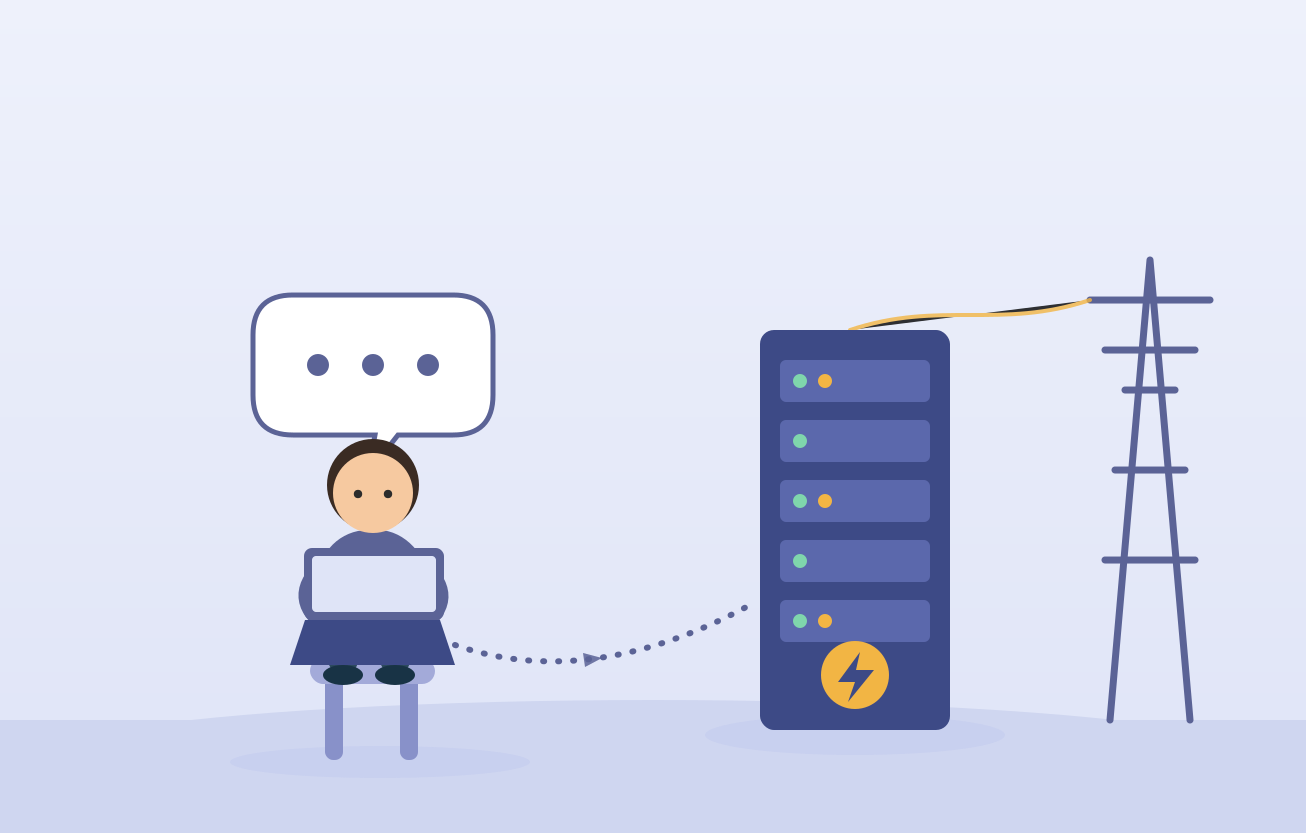
You type a question, wait a few seconds and a response appears. There is no visible machinery, no engine running in the background and no obvious sign that anything substantial has happened.
But behind that simple interaction is a very physical infrastructure.
Your request is processed by powerful computer chips inside a data centre. Those chips consume electricity, generate heat and require cooling. Multiply one request by millions of users and billions of interactions, and something that feels almost invisible starts to look much more like an industrial operation.
So how much electricity does ChatGPT actually use?
The short answer is less than you might think for a single text query — but potentially a lot when billions of AI interactions are combined.
There is no single number that applies to every ChatGPT conversation. The amount of electricity required depends on the model being used, the length and complexity of the request, the hardware processing it and the efficiency of the data centre.
Recent analysis from Epoch AI estimates that a typical ChatGPT query using GPT-4o consumes around 0.3 watt-hours (Wh) of electricity. OpenAI has also cited this estimate in its discussion of the environmental impact of AI. (OpenAI Academy)
That is considerably lower than some of the older figures that have circulated online.
But the individual query is only part of the story.
The more interesting question is what happens when AI is used by hundreds of millions of people, all day, every day.
A typical ChatGPT text request may use around 0.3 Wh of electricity, according to the Epoch AI estimate cited above.
To put that into perspective, 0.3 Wh is a very small amount of energy.
A single request is not going to have a meaningful effect on your household electricity bill. It is also misleading to compare one AI request with something like running a washing machine or charging an electric car.
The environmental question emerges from scale.
If millions of people use AI repeatedly throughout the day, the small energy requirement of individual requests becomes a much larger demand for computing infrastructure.
And not every AI task consumes the same amount of electricity.
A short text response is one thing. Generating a high-resolution image, processing audio, analysing a large document or creating video can require substantially more computation.
The energy cost of AI therefore depends heavily on what the AI is being asked to do.
This is one of the most common questions about AI energy consumption.
Older estimates often suggested that a ChatGPT request could consume roughly ten times as much electricity as a traditional Google search.
That comparison became popular because estimates put a conventional search query at around 0.3 Wh and some early estimates for generative AI at approximately 2.9 Wh.
But those figures should no longer be treated as a universal comparison.
AI models have become significantly more efficient, and the amount of computation required for a particular request varies considerably between models and workloads.
The important difference is not simply that one service is “AI” and the other is “search.”
A conventional search engine primarily retrieves and ranks information that already exists.
A large language model generates a response in real time.
When ChatGPT answers a question, the underlying model performs a large number of mathematical operations to determine what it should generate next. It then repeats that process across the response.
That requires considerably more computation than simply retrieving a previously indexed webpage.
The answer comes down to computation.
Modern AI models contain enormous numbers of parameters. When you send a prompt, specialised processors perform calculations across those parameters to generate the response.
This is why AI systems rely heavily on GPUs and other specialised accelerators.
The chips themselves consume electricity, but the electricity requirement doesn't stop there.
The servers have to communicate with one another. Networking equipment has to operate. Power has to be converted and distributed. And the heat generated by the computing equipment has to be removed.
According to the International Energy Agency, data-centre electricity consumption includes not only servers and other IT equipment but also cooling and other supporting infrastructure.
This is an important distinction.
When we talk about the electricity consumption of AI, we are really talking about an entire physical system.
One of the stranger aspects of AI is that something that looks like software increasingly requires infrastructure on an industrial scale.
A modern AI data centre can contain thousands of high-performance processors operating simultaneously.
Those processors generate enormous amounts of heat.
Cooling systems therefore become an essential part of the operation. Depending on the facility, this can involve sophisticated air cooling, chilled-water systems or increasingly advanced liquid-cooling technologies.
The electricity used to cool the equipment is part of the overall energy footprint of the data centre.
This is one reason measuring the precise energy cost of an individual AI query is so difficult.
The server performing your request is only one component of a much larger system.
This is where the numbers become much more significant.
According to the International Energy Agency's Energy and AI report, data centres consumed around 415 terawatt-hours (TWh) of electricity globally in 2024, equivalent to approximately 1.5% of global electricity consumption. (IEA)
The IEA expects that figure to more than double.
In its base case, global data-centre electricity consumption reaches approximately 945 TWh by 2030, representing just under 3% of global electricity consumption. (IEA)
That would put annual data-centre electricity consumption at roughly the same scale as the current electricity consumption of Japan.
AI is not responsible for all of that electricity.
Data centres also support cloud computing, websites, enterprise software, video streaming, storage and countless other digital services.
But AI is becoming one of the most important drivers of new data-centre demand.
The IEA says accelerated servers, whose growth is mainly driven by AI adoption, are expected to account for almost half of the net increase in global data-centre electricity consumption through 2030.
For years, computing became more efficient.
Processors became faster. Servers became more capable. Data centres improved their cooling systems and increased the amount of computing work they could perform with the same infrastructure.
But generative AI has introduced a new kind of demand.
Companies are building increasingly powerful data centres specifically designed to run AI models.
At the same time, AI is being incorporated into search engines, productivity software, smartphones, customer-service systems, coding tools and countless other products.
The result is a feedback loop.
More capable AI makes more applications possible.
More applications create more demand.
More demand requires more computing infrastructure.
And more computing infrastructure requires more electricity.
The problem with data centres is not only how much electricity they consume globally.
It is where that electricity is consumed.
Data centres tend to be geographically concentrated. A single large facility can create a substantial new electricity demand in a particular region, forcing utilities to consider new generation, transmission lines and grid connections.
The IEA notes that this geographic concentration can make data centres more challenging to integrate into electricity grids than their global share of electricity consumption might suggest. (IEA)
The issue is already becoming visible in the United States.
Reuters has reported on growing strain on PJM Interconnection, the largest US electricity grid, as rapidly expanding data-centre demand collides with limits on new generation and grid infrastructure. (Reuters)
The IEA estimates that around 20% of planned data-centre projects could face delays if grid-related risks are not addressed. (IEA)
This changes the conversation around AI.
The issue is no longer simply how much electricity one chatbot uses.
It is whether electricity grids can build generation and transmission infrastructure quickly enough to support the enormous computing capacity companies are planning.
Yes.
And this is an important part of the story that often gets overlooked.
The amount of computing required for a particular AI task can fall as hardware and software improve.
New processors can perform more calculations using less electricity. Models can be compressed and optimised. Smaller models can handle tasks that once required much larger systems.
The IEA's modelling explicitly includes different scenarios for hardware and software efficiency, AI adoption and infrastructure constraints. Its high-efficiency scenario shows that improvements in efficiency can significantly reduce projected electricity demand compared with a less efficient path. (IEA)
So it would be wrong to assume that every new generation of AI automatically requires proportionally more electricity.
The technology is getting better.
But there is another problem.
Making AI more efficient can actually encourage people to use more AI.
This is sometimes referred to as the rebound effect or Jevons paradox.
Imagine that an AI model becomes twice as efficient.
If people then use it three times as much because it has become cheaper and more accessible, total electricity consumption can still increase.
This is not unique to artificial intelligence.
Computing has followed a similar pattern for decades.
More efficient processors did not eliminate our demand for computing.
They made computing cheap enough to put computers everywhere.
AI could follow the same trajectory.
The more efficient AI becomes, the easier it becomes to integrate it into everyday products.
There is no simple yes-or-no answer.
ChatGPT requires electricity, and electricity generation can produce greenhouse-gas emissions depending on where that electricity comes from.
AI infrastructure also has other environmental impacts.
Data centres can consume water for cooling. Servers require raw materials and manufacturing. Chips, networking equipment and buildings all have their own environmental footprints.
But AI could also be used to reduce environmental impacts elsewhere.
The International Energy Agency's research on AI and energy highlights potential applications including improving electricity-grid operations, reducing energy waste and optimising energy systems. (IEA)
That creates a more complicated picture.
AI has an environmental cost.
But it may also become a tool for reducing environmental costs in other industries.
The question is whether the benefits ultimately outweigh the resources required to build and operate the technology.
The answer will depend on two competing forces.
The first is efficiency.
AI companies are under enormous pressure to make models cheaper and faster to operate. Better chips, smaller models and more efficient software could significantly reduce the amount of electricity required for individual tasks.
The second is adoption.
If AI becomes embedded into virtually every digital service, the number of AI-powered interactions could increase dramatically.
The IEA's base case projects global data-centre electricity consumption to reach around 945 TWh by 2030. It also says AI is the most important driver of this increase alongside broader growth in digital services. (IEA)
And the uncertainty is substantial.
The IEA's scenarios range from a much more efficient future to a high-growth “Lift-Off” case in which data-centre electricity demand could exceed 1,700 TWh by 2035. (IEA)
The future of AI energy consumption therefore isn't determined by one fixed number.
It depends on how quickly AI adoption grows, how efficient the technology becomes and how quickly electricity infrastructure can expand.
For a typical text-based ChatGPT query, a reasonable current estimate is around 0.3 Wh, based on independent analysis of GPT-4o cited by OpenAI.
That is a tiny amount of electricity on an individual basis.
But it would be a mistake to conclude from that that AI has no meaningful energy footprint.
The real story is scale.
One query is tiny.
Millions of queries are significant.
And the data centres required to process those queries represent a rapidly growing physical infrastructure.
According to the International Energy Agency, global data-centre electricity consumption is expected to more than double between 2024 and 2030. (IEA)
That is the number worth paying attention to.
It is tempting to ask whether you should feel guilty every time you use ChatGPT.
That is probably the wrong question.
The electricity consumed by a single AI interaction is relatively small.
The more important question is what happens when artificial intelligence becomes embedded in everything.
If AI becomes part of search engines, smartphones, offices, schools, software, healthcare, transportation and industrial systems, even highly efficient individual requests can add up to enormous demand.
That means the sustainability of artificial intelligence will depend on much more than making individual models efficient.
It will depend on where data centres are built, what powers them, how efficiently they operate, how much water they consume, how quickly electricity grids can expand and how much computing society ultimately decides it wants.
The interaction may feel like information appearing from nowhere.
It isn't.
Behind every AI response is a physical machine consuming physical resources somewhere in the world.
And as artificial intelligence becomes more powerful and more widespread, understanding that physical footprint is becoming just as important as understanding what the technology can do.