When the electricity goes out, most people don't need to power their entire house. They need the refrigerator to stay cold, the Wi-Fi to stay on, a few lights to work, and enough power to keep phones and other essentials charged.
That's where a portable generator can make a lot of sense. You can keep one stored away until you need it, bring it out when the power goes down, and choose a model based on the appliances you need to keep running. Depending on your needs, that could mean a traditional gas generator, a dual-fuel model, a quieter inverter generator, or a battery-powered solar generator.
If you're primarily preparing for outages, our guide to home generators for power outages covers the best options for keeping essential appliances running when the grid goes down.
If you're new to portable generators, it also helps to understand how a generator produces electricity before comparing different types and power ratings.
But portable generators aren't all the same. A compact 2,000-watt model might be easy to move around but won't handle the same loads as a 5,000- or 7,000-watt generator. And having plenty of power on paper doesn't help much if the generator is too loud, difficult to start, or doesn't have the runtime or fuel flexibility you need.
We've looked at the options with that in mind. The portable generators below are chosen for how useful they are around a real home, not simply for having the highest wattage or the longest list of features. We'll look at what each one does well, where it falls short, and how much power you'll actually need for the things you don't want to lose when the grid goes down.
We’ve narrowed down the best options for keeping the essentials running when the power goes out. These are the portable solar generators that stand out for their balance of power, battery capacity, portability, and overall value.
The BLUETTI Apex 300 stands out as the top pick, and the spec sheet backs it up:
- It doesn't choke on multiple appliances at once. Six separate 3,840W AC ports mean you're not juggling a power strip or unplugging one thing to run another, a real limitation on units with just one or two outlets.
- It has real headroom for surge loads. 3,840W continuous output with a 7,680W surge rating gives it the buffer to handle appliances with high startup draw, think fridges, pumps, or power tools, without tripping.
- It holds serious capacity without becoming impractical. At 2,764.8Wh, it sits comfortably above entry-level units while still being a single-unit purchase rather than requiring add-on battery packs to reach useful home-backup capacity.
We compared these generators across power output, portability, noise, safety features, value, and suitability for different home backup scenarios.
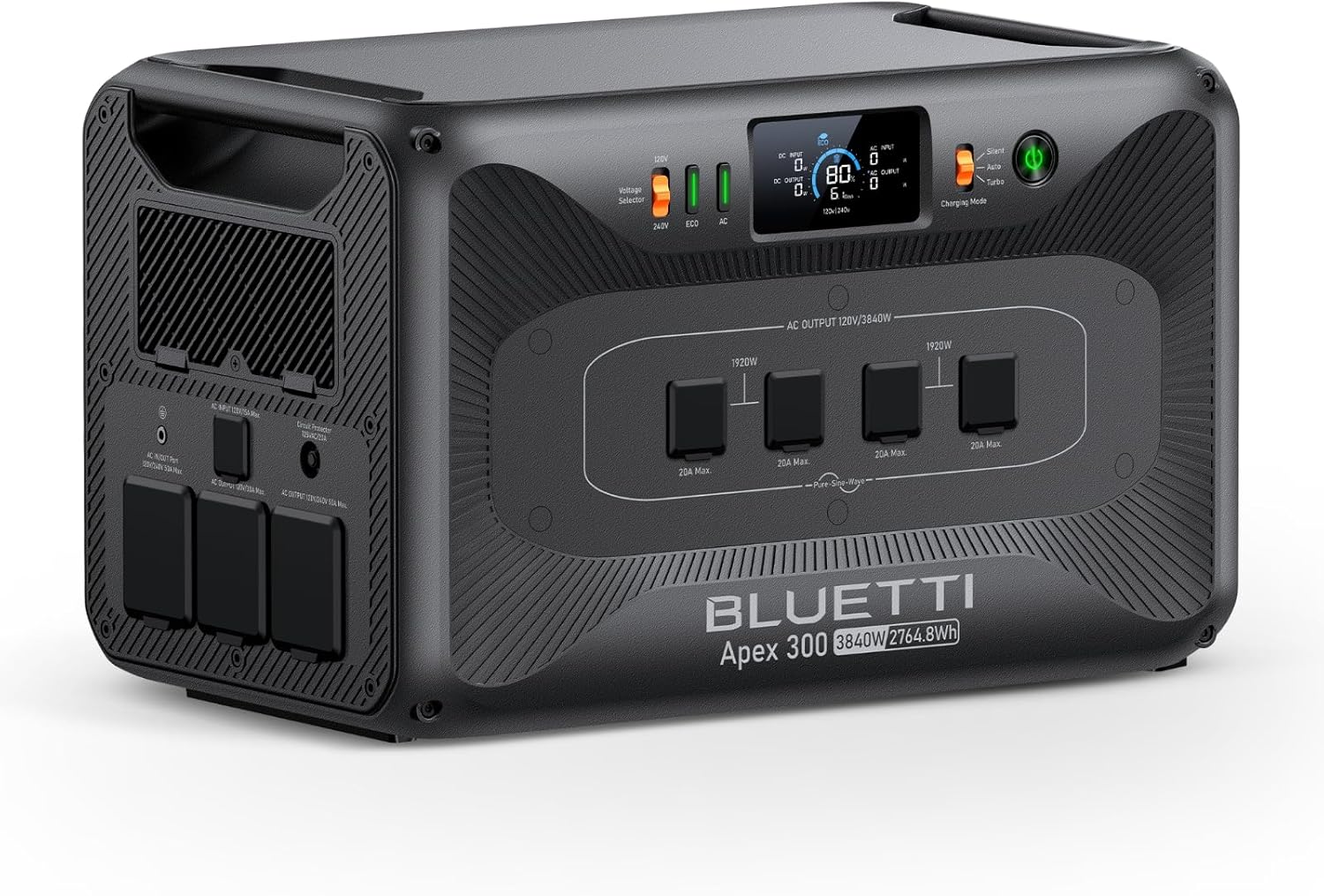
Built for serious home backup with high output, 240V capability, and black start for reliable power during extended outages.

A powerful LFP portable generator with 2,048Wh capacity and 2,400W output, ideal for essential home backup.

A high-capacity LFP portable generator, this Jackery model delivers 3,584Wh of capacity and 3,600W of output, making it a solid choice for essential home backup during outages.

A compact LFP portable generator with 512Wh capacity and 500W output, ideal for essential home backup and everyday portable power.

A powerful dual-fuel generator with 10,500W running output, ideal for whole-home backup during extended outages.
The most useful differences come down to running and starting watts, fuel type, runtime or capacity, weight, and which home backup scenario each unit suits best.
| Generator | Running watts | Starting watts | Fuel / power | Runtime / capacity | Weight | Best for |
|---|---|---|---|---|---|---|
|
01
BLUETTI Apex 300
Editor's Choice
|
3,840W | 7,680W surge | Battery (LiFePO4) | 2,764.8Wh 0–100% in 65 min | ~85 lbs (~38.5 kg) | Best overall |
|
02
EF ECOFLOW DELTA 3 Max
Fast-charging backup
|
2,400W | 3,400W X-Boost | Battery (LiFePO4) | 2,048Wh 0–80% in ~68 min | 44.8 lbs (20.3 kg) | Best value |
|
03
Jackery HomePower 3600 Plus
High-capacity backup
|
3,600W | 7,200W surge | Battery (LFP) expandable to 21kWh | 3,584Wh 0–100% in 2.5 hrs | 77.16 lbs (35 kg) | Best for larger home backup |
|
04
Jackery Explorer 500 v2
Essential backup
|
500W | 1,000W surge | Battery (LiFePO4) | 512Wh 0–100% in 1.3 hrs | 14 lbs (6.4 kg) | Best lightweight / portable |
|
05
DuroMax XP13000EH
Dual-fuel whole-home power
|
10,500W | 13,000W | Gas & Propane (dual fuel) | 8.2 gal tank ~8 hrs at 50% load | 234 lbs (106.1 kg) | Best for longer outages |
* Runtime and recharge figures vary by mode, input source, and ambient conditions. Figures shown reflect each manufacturer's published fast-charge, standard AC, or fuel-load specification, as noted per row.
Battery vs. fuel: "Runtime / capacity" means different things depending on power source — Wh for battery units reflects total stored energy, while the DuroMax figure reflects tank size and estimated hours at half load, not stored energy.
DuroMax fuel tank: DuroMax's own spec sheet lists an 8.2-gallon tank; a small number of retailer listings round this to 8.3 gallons.
- Best overall: BLUETTI Apex 300 — Best for homeowners who want high output, 120V/240V capability, and serious whole-home backup potential.
- Best value pick: EF ECOFLOW DELTA 3 Max — A strong balance of 2,048Wh capacity, 2,400W output, and fast AC charging.
- Best for larger home backup: Jackery HomePower 3600 Plus — Combines 3,584Wh of capacity with 3,600W output for higher-demand essential loads.
- Best lightweight: Jackery Explorer 500 v2 — A compact, easy-to-carry option for essential devices, smaller loads, and shorter outages.
- Best for longer outages: DuroMax XP13000EH — Its dual-fuel design and 10,500W running output make it the strongest choice for extended outages and heavier household loads.
Portable generators come in several different forms, and the best choice depends on how you plan to use one. Fuel type, noise, runtime, power output, and portability can all make a difference, especially when you're buying a generator specifically for home backup.
Gas generators remain a popular choice for home power outages because they can deliver plenty of power and run as long as you have fuel available. They're worth considering if you need to operate larger appliances or want a straightforward backup option.
Dual-fuel generators give you the flexibility to run on either gasoline or propane. That can be particularly useful during a longer outage, when having more than one fuel option can make it easier to keep your generator running. If you want the added benefits of inverter technology, see our guide to dual-fuel inverter generators for home backup.
Inverter generators are a good choice when quieter operation, fuel efficiency, and cleaner power are priorities. They're often smaller and easier to move than conventional generators, making them especially useful for homeowners who don't need extremely high power output. That same combination of low noise and portability makes them popular for RV use, so see our guide to quiet generators for RV use if you need a generator that can serve both purposes.
Solar generators, also called portable power stations, offer a different approach to home backup. Instead of burning fuel, they store electricity in a battery and can be recharged from the wall, a vehicle, or solar panels. They're quiet and require little maintenance, although their battery capacity and inverter output limit how much they can power at once. If you want to recharge using the sun, our guide to portable solar generators with panels covers the best options to consider.
Choosing the right generator size starts with understanding what you actually want to keep running during an outage. A smaller generator may be enough for your refrigerator, lights, Wi-Fi, and electronics, while larger models can handle several major appliances at once.
A 2,000- to 3,000-watt portable generator can be a good fit for basic home backup. Depending on the appliances involved, this range can handle essentials such as a refrigerator, lights, Wi-Fi equipment, televisions, chargers, and some smaller appliances.
Moving into the 4,000- to 6,000-watt range gives you more flexibility during a power outage. These generators can run several essential appliances at the same time and may be better suited to homes where the refrigerator, freezer, sump pump, or other higher-demand equipment needs to stay operational.
Generators producing 7,000 watts or more are designed for heavier loads and more demanding backup situations. They can provide enough capacity for multiple appliances simultaneously, although whether they can run a particular large appliance depends on its starting and running requirements.
When comparing generators, don't look at the wattage number alone. Running watts describe the power a generator can continuously provide, while starting watts (or surge watts) cover the extra power some appliances need when their motors first start. Refrigerators, freezers, pumps, and air conditioners can all have significantly higher starting requirements than their normal running consumption.
A portable generator can keep many of your essential household appliances running during an outage, but what you can power depends on the generator's wattage and each appliance's energy requirements. It's best to prioritize the things you need most rather than trying to run everything at once.
- Refrigerator and freezer: Keep food cold during an extended outage.
- Lights: Power essential lighting throughout your home.
- Wi-Fi and electronics: Keep your router, modem, phones, laptops, and TVs running.
- Small appliances: Depending on the generator's capacity, you may be able to run a microwave, coffee maker, or other small appliances.
- High-demand appliances: Central AC, electric heating, well pumps, sump pumps, and electric water heaters can require substantially more power and may need a larger generator.
Tip: Check both the running watts and starting watts of your appliances before deciding what size portable generator you need. Motor-driven appliances such as refrigerators and pumps often require extra power when they start.
Both can provide backup power during an outage, but they suit different needs. A portable generator is more affordable and flexible, while a standby generator is permanently installed and can automatically restore power to your home.
For most homeowners who want affordable emergency power without a permanent installation, a portable generator is the more practical choice. If you want the convenience of automatic backup and the ability to power most or all of your home, a standby generator is the better fit.
Portable generators aren't limited to gas-powered models. They can run on gasoline, propane, dual fuel, or battery power, with some battery-powered models also able to recharge from solar panels. Solar generators are essentially portable battery systems designed to store electricity and recharge using the sun, so there is some overlap between the two. If you're considering one specifically for emergency power at home, see our guide to solar generators for home backup.
The biggest differences come down to how much power you need, how long you need it, and whether you want to deal with fuel and engine maintenance.
For higher power demands and longer outages, a fuel-powered portable generator can be the better choice, especially when refueling is easier than waiting for a battery to recharge. Solar generators are a strong option when you want quiet, low-maintenance backup power for essentials such as a refrigerator, lights, Wi-Fi, phones, and other electronics.
The best portable generator isn't necessarily the one with the highest wattage. Power output, runtime, portability, noise, and the way you plan to use the generator all matter. Before buying, these are the specifications and features worth paying attention to.
Start with how much power you actually need. Running watts tell you how much power the generator can supply continuously, while starting watts cover the temporary surge required by appliances with motors, such as refrigerators, freezers, pumps, and air conditioners. Make sure the generator can handle both.
Portable generators are available as gas, propane, dual-fuel, and battery-powered models. Gasoline generally offers convenient high-output power, propane can be easier to store for some households, while dual-fuel models give you more flexibility. Battery-powered generators avoid fuel altogether and can often be recharged from solar panels.
For a fuel generator, look at how long it can run on a tank at a stated load rather than simply choosing the largest fuel tank. For battery-powered models, watt-hours (Wh) are the more useful number. A larger battery generally means more stored energy, but your actual runtime depends on what you're powering.
Generator noise matters more at home than it might at a worksite. If the unit will be running near living areas or neighbors, look for a quiet or inverter generator and check the manufacturer's noise rating. Battery-powered solar generators are quieter still because they don't have an engine running.
Inverter generators produce stable electricity and can adjust their engine speed according to the load, which can reduce fuel consumption and noise. They're particularly useful for powering sensitive electronics such as laptops, televisions, and networking equipment.
Pull-starting a generator isn't difficult for everyone, but it can be inconvenient during a winter storm or late-night outage. Electric start lets you start the generator with the push of a button and is a worthwhile feature for home backup.
If you're buying a larger portable generator, check whether it offers 30-amp or 240V output. This can matter if you plan to connect the generator to certain higher-power appliances or a properly installed transfer switch. Don't assume a high-wattage generator automatically supports 240V—check the specifications.
A generator can technically be portable and still be a pain to move. Pay attention to weight, wheels, handles, and overall size, particularly if you'll need to take it out of storage during an outage. A smaller generator that you can easily position and use may be more practical than a much larger model you struggle to move.
If you're considering a battery-powered portable generator, check its maximum solar input as well as its battery capacity. More solar input can mean faster recharging when conditions are good. Keep in mind that advertised solar charging times depend on sunlight, panel orientation, temperature, and other conditions.
For fuel-powered generators, carbon monoxide (CO) safety is essential. Look for models with built-in CO detection and automatic shutoff, but don't treat this as permission to run a generator indoors, in a garage, or near doors and windows. Always follow the manufacturer's placement and operating instructions and keep combustion-powered generators outdoors in a safe, well-ventilated location.
The right generator ultimately comes down to matching its capabilities to your actual household needs. Get the wattage right first, then consider runtime, noise, portability, fuel flexibility, and the features you'll appreciate when you're trying to get the power back on.
How long a portable generator runs depends on what type of generator you have, how much power you're using, and how much fuel or stored battery capacity is available. A generator running a refrigerator and a few lights will last much longer than one powering several large appliances.
For gas, propane, and dual-fuel generators, runtime is usually measured in hours per tank of fuel at a specific load. A larger fuel tank doesn't always mean longer overall runtime, so check the manufacturer's rating and consider how much power you'll actually be drawing.
Battery-powered generators are measured in watt-hours (Wh) rather than fuel tank size. A 2,000Wh power station, for example, stores more energy than a 1,000Wh model, but actual runtime depends on the power consumption of your appliances.
A simple way to estimate runtime is:
Battery capacity (Wh) ÷ appliance load (W) = approximate runtime in hours
In practice, you'll get somewhat less than the calculated figure because of inverter losses and other power consumption. Solar panels can extend runtime by recharging the battery during the day, provided there's enough sunlight and solar input capacity.
A portable generator can power some or even most of a home's essential circuits, but whether it can run your entire house depends on the generator's output and the home's electrical demands. Large appliances such as central AC, electric heating, water heaters, and well pumps can quickly push power requirements beyond what many portable generators can provide.
Most portable generators are better suited to essential loads rather than running everything at once. A smaller unit might handle the refrigerator, lights, Wi-Fi, and a few appliances, while a larger model can support more demanding equipment.
A transfer switch allows a properly installed generator to supply selected household circuits safely. If you need to power 240V appliances or circuits, such as some well pumps, electric dryers, or central air-conditioning systems, the generator must have the appropriate 240V output and sufficient wattage.
Never connect a portable generator directly to a household wall outlet to energize your home. This practice, known as backfeeding, can send electricity onto utility lines and create a serious hazard. If you want to connect a generator to your home's electrical system, have the appropriate transfer equipment installed by a qualified electrician and follow the generator manufacturer's instructions.
For many households, a portable generator is best thought of as backup for the essentials, rather than a replacement for the utility grid.
For many homeowners, a portable generator is one of the simplest ways to prepare for a power outage without the cost or commitment of a permanently installed standby system. You can store it until you need it, bring it out when the power goes down, and choose a size that matches the appliances you actually need to keep running.
They're particularly useful if you want:
- Affordable backup power without installing a standby generator
- Enough capacity to keep essential appliances running
- The flexibility to choose gas, dual-fuel, inverter, or battery/solar power
- A generator that can also be useful for camping and RV trips.
- A backup option you can use only when you need it
A portable generator may be less appealing if you want automatic whole-home backup, need to run large electrical loads continuously, or don't want to deal with setup, fuel, or recharging.
For most homes, the value comes down to choosing the right size and type. You don't necessarily need the biggest generator you can afford—you need one that can reliably handle the appliances and essential circuits that matter most when the grid goes down.
A high wattage number or a long list of features doesn't automatically make a generator a good choice for home backup. We focused on the things that matter when you actually need power, including reliable output, runtime, portability, noise, ease of use, and overall value.
We also considered the different types of portable generators available, including gas, dual-fuel, inverter, and battery-powered solar models, since each has its own strengths. For battery generators, we paid particular attention to battery capacity, inverter output, solar charging, and expandability.
Our picks were selected based on:
- Power output: Running and starting watts for handling essential household loads.
- Runtime and capacity: How long fuel-powered models can operate and how much energy battery models store.
- Portability: Weight, wheels, handles, and how practical each generator is to move and store.
- Noise: Particularly important when a generator is running close to your home.
- Fuel flexibility: Including gas, propane, dual-fuel, and battery-powered options.
- Features: Electric start, inverter technology, outlets, 30-amp/240V capability, and CO safety features.
- Value: What you get for the money rather than simply choosing the cheapest or most powerful option.
The goal is simple: find portable generators that make sense for real homes and real power outages, whether you need enough electricity for a few essentials or considerably more backup capacity.
Based on the information provided, the BLUETTI Apex 300 is the strongest overall choice for serious home backup, particularly if your priority is high output, 240V capability, fast charging, and the ability to handle multiple appliances without relying on fuel.
However, it isn't automatically the best choice for everyone.
- Best overall: BLUETTI Apex 300 — the best combination of high output, battery capacity, surge capability, and whole-home potential.
- Best value: EF ECOFLOW DELTA 3 Max — a more manageable and affordable option for essential backup loads.
- Best for larger essential loads: Jackery HomePower 3600 Plus — a good middle ground between capacity and output.
- Best lightweight option: Jackery Explorer 500 v2 — ideal for basic essentials such as phones, networking equipment, lights, and smaller electronics.
- Best for long outages/high loads: DuroMax XP13000EH — the clear choice if you need substantial continuous power and can safely store and use gasoline/propane.
The biggest takeaway: don't choose based on wattage alone. First determine which appliances you actually need during an outage, then account for both running watts and starting/surge watts. For refrigerators, pumps, air conditioners, electric heating, or other motor-driven loads, that distinction is particularly important.
For most households wanting quiet, low-maintenance emergency backup, a battery power station is the more convenient solution. For multi-day outages and heavy household loads, a dual-fuel generator such as the DuroMax makes more sense because refueling can provide much longer operation than a finite battery.