Looking for the best dual-fuel inverter generator for home backup? We compared five popular models across power output, runtime, fuel flexibility, noise, portability, starting options, safety features, and overall value.
Whether you need enough power to keep your refrigerator and essential electronics running or want a higher-output generator for more demanding household loads, this guide will help you choose a model that fits your backup needs.
Our goal: Make the decision easier by focusing on what actually matters during a power outage, not just a list of specifications.
This section starts with the quick answer: which dual-fuel inverter generator stands out for home backup and why. We then break down our five top picks, looking at the features, specifications, and practical strengths that set each model apart.
A quick comparison table makes it easier to see the key differences at a glance, while our “What we looked for” section explains the criteria behind the selections. This gives you a clear starting point before we move into the more detailed questions and considerations that can help you choose the right generator for your home.
For most homeowners, the Westinghouse iGen5000DFc is our top overall pick. It combines strong power output with relatively quiet operation, dual-fuel flexibility, and convenient electric and remote starting.
That said, the best generator depends on how you plan to use it. RV owners may prefer the Champion 4500-Watt, while budget-conscious buyers may find the PowerSmart 3800 a better fit. If maximum output is the priority, the Gidrox 11,000W is in a different class altogether.
We compared these generators across power output, fuel flexibility, portability, noise, safety features, value, and suitability for different home backup scenarios.

The Westinghouse iGen5000DFc stands out for its powerful 5,000-watt output, quiet operation, dual-fuel flexibility, and convenient remote electric start.

The Champion 4500-Watt Dual Fuel Inverter Generator combines reliable power, quiet operation, dual-fuel flexibility, and RV-ready convenience, and electric start.
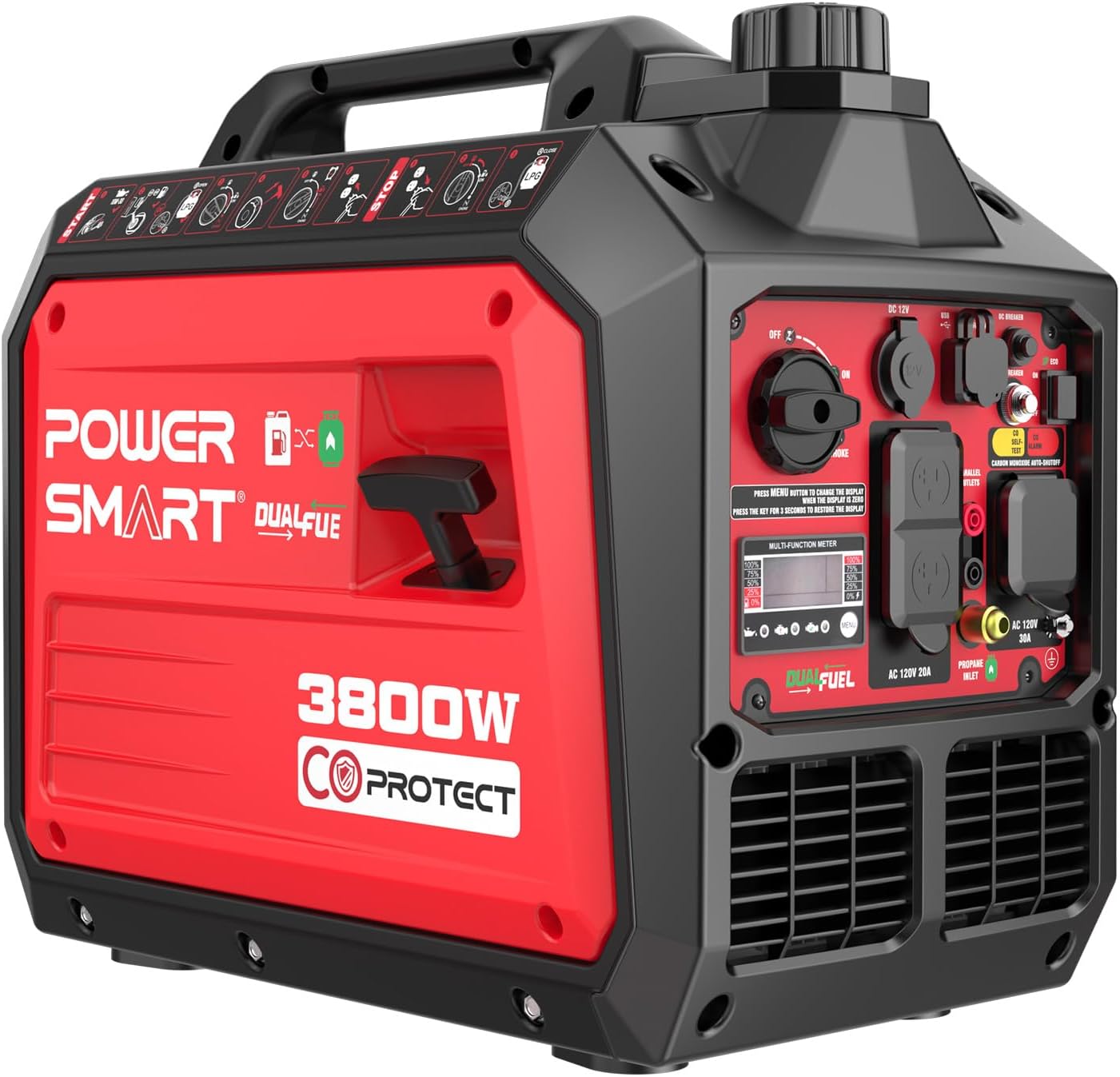
The PowerSmart 3800W Dual Fuel Inverter Generator offers affordable power, dual-fuel flexibility, compact portability, and convenient RV-ready outlets.

The Champion 4250-Watt Open Frame Inverter combines dual-fuel flexibility and inverter technology with rugged construction and reliable power for demanding outdoor use.

This 11,000W Tri-Fuel Inverter Generator delivers powerful, quiet performance with gasoline, propane, and natural gas flexibility for RVs and whole-home backup..
We looked at the features that matter most when choosing a dual fuel inverter generator for home backup. We considered power output, fuel flexibility, noise, portability, ease of use, safety features, starting options, and overall value to help identify which models make the most sense for different backup needs.
Dual-fuel inverter generators combine two useful features in one machine. They can run on either gasoline or propane, while inverter technology helps produce stable electricity for everyday appliances and electronics. Understanding how these two systems work together makes it easier to see where they differ from conventional generators and why they can be useful for home backup.
A dual-fuel generator gives you the flexibility to run on either gasoline or propane, which can be especially useful during a power outage when one fuel may be easier to find or store than the other. The generator's engine burns the selected fuel to produce electricity, while the control system manages fuel delivery and engine operation. Many models let you switch between gasoline and propane when needed, giving you more fuel flexibility for home backup and longer outages.
For homeowners choosing the best dual-fuel inverter generator for home backup, this fuel flexibility is one of the main advantages to consider. Gasoline can provide strong performance and is widely available, while propane can be stored for longer periods and may be more convenient to keep on hand for emergency use. The exact power output, runtime, and fuel consumption will vary between models, so it is worth checking the manufacturer's specifications before choosing a generator.
An inverter generator differs from a conventional generator mainly in how it produces and delivers electricity. Instead of sending raw power directly from the engine to the outlets, an inverter model converts the electricity into a stable, controlled output. This produces cleaner and more consistent power, which is useful for sensitive electronics such as laptops, TVs, phones, and other household devices.
Want to understand what happens inside a generator? Our guide to how a generator produces electricity explains how mechanical energy is converted into electrical power.
Inverter generators are also generally designed for quieter operation and better fuel efficiency than traditional open-frame generators. They can adjust engine speed based on the amount of power being used, rather than running at full speed continuously. For home backup, this can mean lower noise, reduced fuel consumption, and a more comfortable experience during an extended outage.
The main difference between a dual-fuel generator and a conventional single-fuel generator is the ability to use two fuel sources. A conventional generator typically runs on gasoline or another single fuel, while a dual-fuel model can switch between gasoline and propane. This gives you more flexibility when storing fuel or dealing with a prolonged power outage.
When comparing a dual-fuel inverter generator with a conventional generator, there can also be differences in noise, fuel efficiency, portability, and power delivery. Inverter models are generally better suited to situations where quieter operation and stable power are important, while conventional generators can offer a simpler and often more economical option when high power output is the main priority.
A dual-fuel inverter generator can be a practical choice for home backup because it combines fuel flexibility with stable, efficient power delivery. During an outage, you can use gasoline when it is readily available or switch to propanewhen you want a fuel that is easier to store for longer periods.
The inverter system also makes these generators well suited to powering household electronics and essential appliances. Quieter operation and improved fuel efficiency can be especially valuable when the generator needs to run for several hours or days. For homeowners preparing for outages, the combination of two fuel options, clean power, lower noise, and convenient operation makes dual-fuel inverter generators a versatile backup solution.
Choosing the right generator size starts with understanding how much power your home actually needs during an outage. A generator that is too small may struggle with starting certain appliances, while an oversized model can cost more to buy and operate than necessary. In this section, we will look at running watts and starting watts, how different generator sizes match different loads, and how to calculate your essential backup load. We will also walk through examples for powering essential appliances, larger household loads, and consider whether a dual-fuel inverter generator can power a whole house.
When choosing a generator, it is important to understand the difference between running watts and starting watts. Running watts are the amount of power an appliance needs to operate normally, while starting watts are the extra power some appliances require for a few seconds when they first turn on.
This difference matters because appliances with motors, such as refrigerators, freezers, sump pumps, and air conditioners, can have much higher starting requirements than their normal running wattage. Your generator needs enough starting watts to handle these initial surges and enough running watts to keep your essential appliances operating at the same time.
Generator size largely determines which appliances and household systems you can run at the same time. Smaller models are well suited to essential loads such as lights, refrigerators, Wi-Fi equipment, and small electronics, while higher-output generators can handle larger combinations of appliances. If you're comparing your broader options for backup power, see our guide to the best home generators for power outages.
As a general guide, a generator in the 2,000 to 3,000-watt range can cover basic essentials, while models producing around 3,500 to 5,000 watts offer more capacity for refrigerators, freezers, sump pumps, and several household devices at once. Generators rated at 7,000 watts or more can support heavier loads and more appliances simultaneously. The actual capacity depends on the running and starting watts of your appliances, so always check their ratings before connecting them.
To calculate your essential backup load, start by listing the appliances and devices you want to keep running during a power outage. Check the running watts for each one and add them together. Then identify the appliance with the highest starting watt requirement, such as a refrigerator, freezer, or pump, and account for that additional surge.
For example, if your essential appliances use 2,000 running watts combined and one appliance needs another 1,000 watts to start, you should look for a generator with enough capacity to handle both the total running load and the starting surge. Leaving some extra capacity is also a good idea, as it gives you room to add another small appliance without constantly running the generator at its limit.
For a home backup setup, the goal is usually to keep essential appliances running rather than every device in the house. A dual-fuel inverter generator can provide dependable power for selected loads such as a refrigerator, freezer, lights, Wi-Fi equipment, and small electronics. The key is to add their running watts together and make sure the generator also has enough starting wattage for appliances with motors or compressors. This approach helps you choose a generator that meets your actual backup needs without paying for more capacity than necessary.
When you need to run larger household loads, the calculation changes because appliances such as central air conditioners, well pumps, sump pumps, electric water heaters, and larger refrigerators can draw substantial power, especially when starting. A higher-output dual-fuel inverter generator can handle more of these loads at once, but you still need to account for running watts, starting watts, and which appliances operate simultaneously. For extended outages, prioritizing essential high-demand equipment can help you get useful whole-home backup without unnecessarily oversizing the generator.
A dual-fuel inverter generator can power a whole house, but whether it can do so comfortably depends on the home's electrical demand and the generator's output. Smaller models are better suited to essential circuits, while higher-output units can support more demanding loads such as refrigeration, lighting, HVAC equipment, and other household systems. A proper transfer switch or approved interlock is also needed for safe connection to a home's electrical system. For most households, the practical approach is to calculate the loads you actually need during an outage and choose a generator with enough running and starting wattage to handle them reliably
When choosing a dual-fuel inverter generator for home backup, the fuel you use can affect runtime, power output, storage, and convenience. Gasoline and propane each have advantages, particularly during a prolonged power outage. In this section, we look at how the two fuels compare in real-world backup use, including performance, runtime, fuel availability, and which option may make the most sense for different emergency situations.
Gasoline is often the more familiar fuel for portable generators because it is widely available and typically provides strong performance under load. For home backup, gasoline can deliver the generator's rated output while offering a practical option when you need to run multiple appliances at once. Runtime depends on the generator's fuel tank, load, and operating mode, so a larger tank does not necessarily mean longer runtime. For extended outages, it is also important to consider fuel storage, shelf life, and availability before relying on gasoline as your primary backup fuel.
Propane offers a useful alternative for home backup, particularly when you want to keep fuel stored for longer periods. It generally produces slightly different power and runtime characteristics than gasoline, depending on the generator and load. Propane can also be convenient during a prolonged power outage, since properly stored propane does not degrade in the same way as gasoline. The tradeoff is that generators may produce less power on propane than on gasoline, so it is worth checking the manufacturer's specifications before choosing which fuel to prioritize.
With a dual-fuel inverter generator, the available power can vary depending on whether you run it on gasoline or propane. Gasoline usually provides the higher wattage, while propane may produce slightly less power on the same generator. The difference matters most when you are operating close to the generator's capacity, such as when running air conditioners, pumps, refrigerators, or other high-demand appliances. Always compare the manufacturer's rated running and starting watts for both fuels rather than assuming the output is identical.
Fuel storage matters just as much as generator output when preparing for a power outage. Gasoline is widely available but requires more careful storage and can degrade over time, while propane can be stored for longer periods when kept in approved containers and handled correctly. Availability can also vary during extended outages, so keeping more than one fuel option gives a dual-fuel generator an important advantage. For reliable home backup, consider both how easily you can obtain each fuel and how safely you can store enough to meet your expected runtime.
The best fuel for a power outage depends on your priorities, the generator's specifications, and how long you expect to run it. Gasoline is often the better choice when you need maximum available power, while propane can be attractive for longer-term storage and backup preparedness. A dual-fuel inverter generator gives you the flexibility to switch between both, helping you adapt when fuel availability, runtime, or power demand changes during an outage.
If you are buying a generator primarily for home backup, dual-fuel capability can be worth it because it gives you more flexibility when fuel availability or power needs change. Gasoline and propane each have practical advantages, and having both options can be especially useful during a prolonged outage. The extra flexibility may also make a dual-fuel inverter generator a more practical long-term investment for homeowners who want reliable backup power without depending on a single fuel source.
Choosing the best dual-fuel inverter generator for home backup involves more than comparing wattage. The right model should match your household's power requirements while also being practical to operate, store, and maintain. In this section, we look at the key factors that can affect your decision, including power output, runtime, noise, portability, starting options, outlets, safety features, warranty, and maintenance.
Power output is one of the most important factors when choosing a dual-fuel inverter generator for home backup. Start by looking at the generator's running watts rather than focusing only on its peak rating, then consider the higher starting watts required by appliances with motors or compressors. Choose enough capacity to handle the essential loads you expect to run at the same time, with some extra headroom for startup surges and changing power demands.
Runtime and fuel capacity are especially important when a generator may need to operate for hours or even days during a prolonged outage. Look at the stated runtime at a specific load, not just the size of the fuel tank, because higher electrical loads consume fuel faster. It is also worth comparing runtime on both gasoline and propane, since the generator's performance can vary between fuels. A model with efficient operation, a practical tank size, and flexible fuel options can reduce the need for frequent refueling during an extended power outage.
Noise level can make a major difference when using a generator around your home, especially during an overnight outage or when the unit is positioned near living areas. Inverter generators are generally designed for quieter operation because they can adjust engine speed to match the electrical load. When comparing models, check the manufacturer's stated decibel rating and the conditions under which it was measured. A quieter generator can provide more comfortable home backup power while reducing disruption for you and your neighbors.
Portability and weight matter if you expect to move your generator between storage and the area where it will operate. Larger models can provide more backup power, but their added weight and size can make them difficult to position or transport. Look for practical features such as wheels, handles, and a compact design, while making sure the generator still provides enough capacity for your essential loads. For home backup, the best balance is a model that is powerful enough for your needs without being unnecessarily difficult to move.
If portability is a priority, see our guide to the best portable generators for home for more options.
Parallel capability can be useful when your power needs may grow over time. Some inverter generators can be connected to a compatible second unit to increase available power output without replacing the original generator. This can give homeowners more flexibility for larger backup loads while keeping the option of using a single generator for lighter needs. If this feature matters to you, check that the generator supports parallel operation and that the required connection equipment is compatible with the model.
A dual-fuel inverter generator can be much easier to use when starting it quickly matters, especially during a power outage. Electric start lets you start the generator with the push of a button instead of pulling a recoil cord, while remote start can add even more convenience when the unit supports it. For home backup, these features are particularly useful when the generator is stored outside or away from the main living area.
The outlets and home connection options determine how easily a dual-fuel inverter generator can fit into your backup setup. Look for a practical mix of standard household outlets, higher-output connections, and USB ports for smaller devices. If you want to connect the generator to selected household circuits, check whether it supports a transfer switchor other approved home connection method. Choosing the right outlet configuration can make it easier to power your essential appliances safely and efficiently during an outage.
CO detection and automatic shutdown are important safety features to consider when choosing a dual-fuel inverter generator for home backup. A built-in carbon monoxide (CO) detection system can monitor for dangerous levels of the odorless gas and automatically shut the generator down when unsafe conditions are detected. While this feature adds an important layer of protection, the generator should still be operated outdoors and well away from doors, windows, and vents.
A good warranty and maintenance plan can make a significant difference in the long-term value of a dual-fuel inverter generator. Before buying, check the length and coverage of the manufacturer's warranty, as well as the availability of replacement parts and service support. Routine maintenance, including oil changes, air filter checks, spark plug inspection, and proper fuel storage, also helps keep the generator reliable when you need it most. For home backup, choosing a model that is easy to maintain can save time and reduce ownership costs over the years.
Choosing a home backup power solution depends on more than just how much electricity a system can produce. In this section, we compare dual-fuel inverter generators with other common backup options to see how they differ in power, fuel flexibility, convenience, portability, and overall practicality. This makes it easier to understand where a dual-fuel inverter generator fits and which type of backup system may be the best match for your home.
A dual-fuel inverter generator combines two useful advantages: the ability to run on gasoline or propane and the cleaner, more stable power produced by inverter technology. Compared with a conventional generator, it can offer quieter operation, better fuel flexibility, and more consistent power for sensitive electronics. Conventional models can still be a practical choice when high output and lower upfront cost are the main priorities, but they generally lack the same combination of flexibility and refined operation.
A dual-fuel inverter generator and a standby generator take very different approaches to home backup power. A dual-fuel inverter model is portable and can be moved or stored when it is not needed, while a standby generator is permanently installed and can start automatically when the power goes out. Standby systems are better suited to whole-home backup and automatic operation, while dual-fuel inverter generators can be more practical when you want fuel flexibility, portability, and lower installation requirements.
A dual-fuel inverter generator and a battery power station both provide portable backup power, but they work best in different situations. A generator can be refueled with gasoline or propane and typically supports longer operation when fuel is available, while a battery power station runs silently and produces no direct emissions during use. Battery power stations are convenient for electronics, small appliances, and indoor use, while dual-fuel generators are generally better suited to longer outages and higher-power loads that require sustained energy.
If you're considering a battery-based alternative for home backup, see our guide to the best solar generators for home backup. If you spcifically want a portable solar setup with panels, see our guide to the best portable solar generators with panels.
A dual-fuel inverter generator runs on gasoline or propane, while a tri-fuel generator adds natural gas as a third fuel option. That extra flexibility can be valuable for homes with an existing natural gas connection, especially during longer power outages. However, dual-fuel inverter generators can offer a more practical balance of portability, fuel flexibility, quieter operation, and clean power for homeowners who do not need natural gas as an additional fuel source.
The right home backup power option depends on your priorities, the appliances you need to run, and how long you expect outages to last. A dual-fuel inverter generator is a strong choice if you want portable power, gasoline and propane flexibility, and quieter operation. A standby generator makes more sense for automatic whole-home backup, while a battery power station suits quieter, smaller-scale backup. If natural gas is readily available, a tri-fuel generator may provide the added fuel flexibility you need.
Using a dual-fuel inverter generator safely is just as important as choosing the right model. Proper placement, carbon monoxide precautions, safe connections, careful refueling, and sensible operation all help reduce the risks associated with portable generators. This section covers the key generator safety practices to follow, along with maintenance and storage steps that can help keep your unit reliable when the next power outage occurs.
A dual-fuel inverter generator should always be operated outdoors, in a well-ventilated area where exhaust fumes can disperse safely. Keep the generator well away from doors, windows, vents, garages, and other enclosed or partially enclosed spaces, even if they appear to have good airflow. Choose a stable, dry location away from combustible materials, and position the exhaust so it points away from the home and occupied areas.
Carbon monoxide (CO) safety is one of the most important considerations when using a dual-fuel inverter generator. Carbon monoxide is an odorless, colorless, and potentially deadly gas produced by fuel-burning engines, so never operate a generator inside a home, garage, shed, or other enclosed or partially enclosed space. Keep the unit outdoors and well away from windows, doors, and vents, and never rely on a CO detector as a substitute for proper generator placement and ventilation.
Connecting a dual-fuel inverter generator to your home requires the right equipment and a safe connection method. Never plug a generator directly into a household wall outlet, as this can create dangerous backfeeding. For selected household circuits, a properly installed transfer switch or approved interlock system can allow the generator to supply power safely. If you are unsure which setup your home requires, have the connection installed or inspected by a qualified electrician.
Refueling safely is essential when operating a dual-fuel inverter generator. Always turn the generator off and allow the engine to cool completely before adding gasoline, and refuel outdoors in a well-ventilated area away from flames, sparks, cigarettes, and other ignition sources. Avoid overfilling the tank and clean up any spilled fuel before restarting the generator. When switching between gasoline and propane, follow the manufacturer's instructions carefully and use the correct fuel connections and procedures for your model.
Operating a dual-fuel inverter generator in rain or snow requires extra caution because moisture can increase the risk of electric shock, equipment damage, and engine problems. Keep the generator dry and protected from direct precipitation, while still maintaining plenty of open airflow around the unit. Never operate it inside a garage, shed, tent, or other enclosed shelter. If severe weather is expected, use a purpose-built generator canopy or other manufacturer-approved protection that does not restrict ventilation.
A generator is easiest to use safely when you stay within its rated capacity. Avoiding overloads means understanding how much power your appliances draw, accounting for starting watts, and keeping the generator below its continuous output limit. Running too many high-demand appliances at once can trip protection systems, reduce performance, or damage the generator.
For home backup, prioritize essential loads such as a refrigerator, lights, heating equipment, or selected electronics rather than trying to power everything simultaneously. If the load is close to the generator's limit, switch appliances on gradually and avoid combining several high-wattage devices.
For reliable home backup, regular generator maintenance helps keep the engine, fuel system, and electrical components ready when you need them. After use, check the oil level, inspect cables and connections, and follow the manufacturer's service intervals rather than waiting for a problem to appear.
Proper storage is equally important, especially if the generator may sit unused between outages. Store it in a clean, dry, well ventilated location away from ignition sources, and follow the manufacturer's guidance for fuel storage and long term shutdown. A little preparation after each use can make a dual fuel inverter generator much easier to start and depend on during the next power outage.
This final section brings the key points together to answer the main question: are dual-fuel inverter generators worth it for home backup? We will look at who benefits most from this type of generator, when another backup option may make more sense, and the main advantages and drawbacks to consider. From there, we will give a clear overall verdict based on power, fuel flexibility, convenience, portability, and real-world home backup needs.
A dual-fuel inverter generator is a strong choice for homeowners who want flexible, portable backup power without committing to a permanently installed system. It can be particularly useful if you value fuel flexibility, quieter operation, and the ability to match the generator to different backup situations.
It is also worth considering for households that experience occasional power outages and want to keep essential appliances, electronics, and selected household loads running. The ability to switch between gasoline and propane gives you more options when one fuel is inconvenient or unavailable, making dual-fuel models a practical choice for many home backup needs.
The biggest advantage of a dual-fuel inverter generator is flexibility. Being able to run on gasoline or propane gives you more options for fuel availability, while inverter technology can provide cleaner power for sensitive electronics and generally quieter operation. Portable models can also offer a practical balance between backup power, portability, and cost.
There are tradeoffs, however. A dual-fuel model can cost more than a comparable single-fuel generator, and power output and runtime can vary by fuel. You also need to store and handle fuel safely, perform routine maintenance, and operate the generator outdoors. For larger homes that need seamless whole-house backup, a standby generator may be a better fit.
For most homeowners looking for flexible portable backup power, the Westinghouse iGen5000DFc is our strongest overall pick from this lineup.
It offers a useful combination of power, quiet operation, dual-fuel flexibility, and convenient starting options without moving into the size and complexity of a much larger generator.
The right choice ultimately depends on your backup load:
- Best overall: Westinghouse iGen5000DFc
- Best for RV use: Champion 4500-Watt
- Best budget option: PowerSmart 3800
- Best open-frame option: Champion 4250-Watt
- Best high-power option: Gidrox 11,000W
Before buying, calculate your actual running and starting-watt requirements, compare gasoline and propane output, consider how much noise you can tolerate, and make sure you have a safe plan for operating and connecting the generator.
The best generator isn't necessarily the one with the highest wattage. It's the one that can reliably handle the loads you actually need while remaining practical and safe to use.