Introduction
Small refrigerators are often marketed as efficient by default. They’re compact, use less power than full-size models, and are commonly used in dorms, offices, or as secondary units.
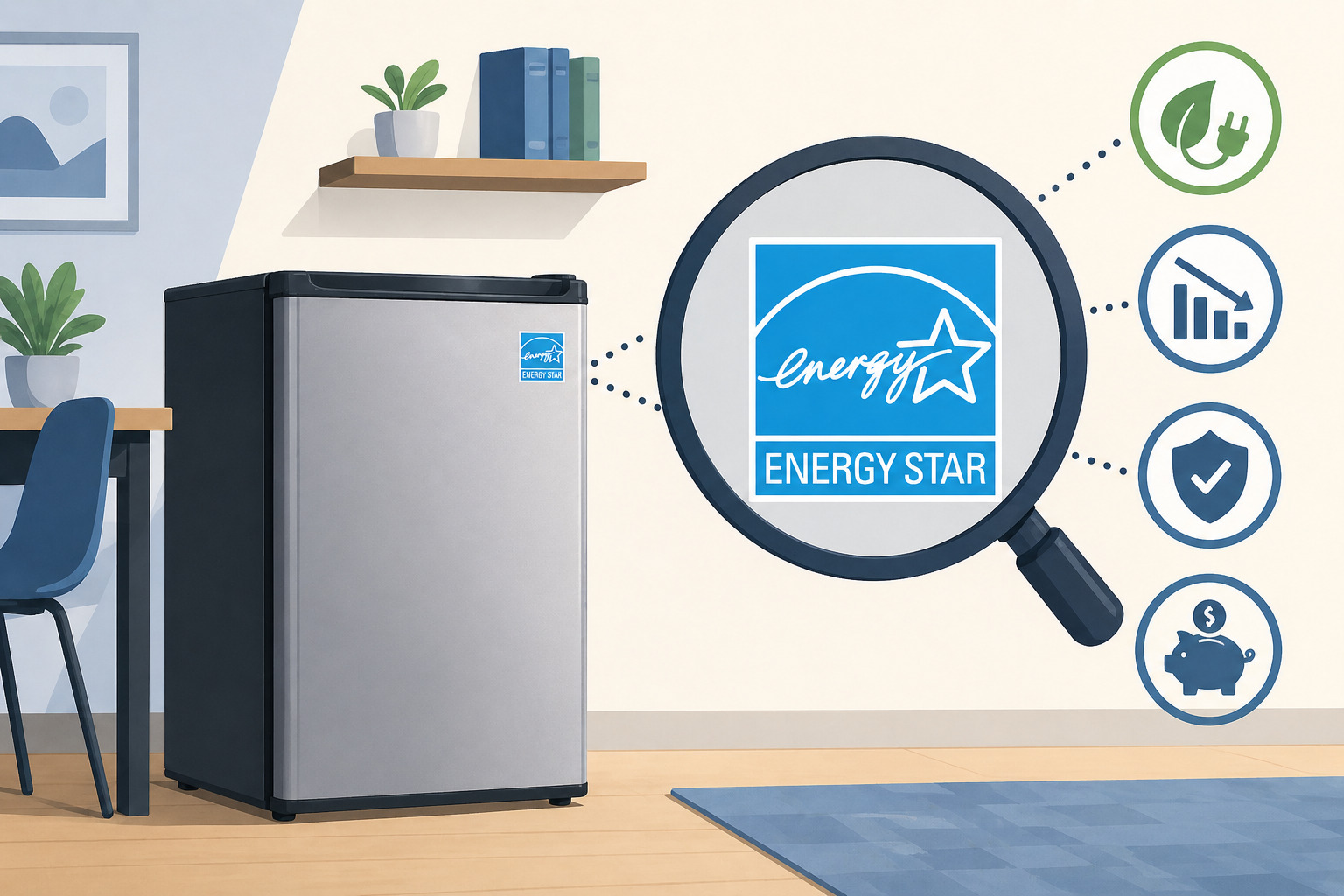
The Energy Star label adds another layer to that claim. It suggests verified efficiency, lower operating costs, and better environmental performance.
But like many certifications, its real value depends on context. Not all small fridges benefit equally from the label, and not all consumers will see meaningful savings.
The key question is not whether Energy Star matters—but what it actually guarantees, and where it makes a difference.
What Energy Star Certification Actually Is
Energy Star is a certification program developed by the U.S. Environmental Protection Agency in partnership with the U.S. Department of Energy.
Products that carry the label must meet strict efficiency standards compared to baseline models in the same category.
For small refrigerators, this typically means:
- Lower annual energy consumption than federal minimum standards
- Verified testing under standardized conditions
- Consistent performance across similar-sized units
The label is not self-declared. Manufacturers must submit products for testing and compliance verification.
What Counts as a “Small Refrigerator”
In Energy Star terms, small refrigerators generally include:
- Compact fridges (often 1.7 to 4.5 cubic feet)
- Mini fridges with or without freezer compartments
- Specialty units for offices, dorms, or hotel use
These are distinct from full-size refrigerators, which follow different efficiency benchmarks.
What the Label Guarantees
1. Lower Energy Use Than Baseline Models
Energy Star certified units must exceed federal efficiency standards by a defined margin.
In practical terms, this means:
- Reduced electricity consumption over a year
- Lower operating cost compared to non-certified equivalents
However, “lower” does not mean “low” in absolute terms. A poorly placed or heavily used small fridge can still consume a noticeable amount of energy.
2. Standardized Testing and Comparability
One of the more useful aspects of the label is consistency.
Energy consumption is measured under controlled conditions, allowing consumers to compare models directly using annual kWh ratings.
This is often more useful than marketing claims about “eco modes” or “high efficiency compressors.”
3. Baseline Performance Expectations
Certification ensures that efficiency does not come at the expense of basic functionality.
Temperature stability, compressor behavior, and insulation performance must meet minimum standards.
Where Energy Star Makes a Real Difference
Example 1: Always-On Secondary Fridges
Small refrigerators are often used as secondary units—in garages, offices, or bedrooms.
Unlike primary kitchen fridges, these are sometimes older, less efficient models that run continuously.
Replacing a non-certified unit with an Energy Star model can result in measurable energy savings over time.
Example 2: High-Density Environments
Dormitories, hotels, and shared housing often use large numbers of compact refrigerators.
In these settings, incremental efficiency improvements scale across many units, making certification more impactful at the aggregate level.
Example 3: Long-Term Ownership
The longer a fridge is in use, the more energy efficiency matters.
Even modest reductions in annual energy use accumulate over several years, particularly in regions with higher electricity costs.
Where It Matters Less
1. Infrequently Used Units
If a small refrigerator is used occasionally or turned off for long periods, energy efficiency becomes less relevant.
The difference between certified and non-certified models may not justify a higher purchase price.
2. Very Small Capacity Units
Extremely compact fridges already consume relatively little energy due to their size.
The efficiency gap between certified and non-certified models can be marginal in absolute terms.
3. Poor Placement and Usage
Energy Star does not account for real-world conditions like:
- Placement near heat sources
- Poor ventilation
- Frequent door opening
- Overloading or underfilling
These factors can offset efficiency gains regardless of certification.
Realistic Energy Savings
The actual savings from an Energy Star small refrigerator depend on several variables:
- Size and capacity
- Usage patterns
- Ambient temperature
- Age of the unit being replaced
Typical outcomes:
- Replacing older inefficient models: noticeable savings
- Replacing relatively new models: modest savings
- Light or occasional use: minimal impact
The label indicates relative efficiency—not guaranteed cost reduction.
The Branding Factor
Energy Star functions as both a certification and a trust signal.
For consumers, it simplifies decision-making. Instead of evaluating technical specifications, buyers can rely on a recognized standard.
However, this also creates a perception gap.
Many consumers assume:
- The most efficient option available
- Significant energy savings in all cases
- Environmental impact reduction regardless of usage
In reality, the label is narrower in scope. It confirms that a product meets defined efficiency thresholds—not that it is optimal for every situation.
How It Compares to Other Indicators
EnergyGuide Label
In the U.S., most appliances also include an EnergyGuide label showing estimated annual energy use.
This provides:
- A direct kWh estimate
- Cost projections based on average electricity rates
While Energy Star indicates compliance with a standard, EnergyGuide offers a more granular comparison.
The two are most useful when used together.
What to Look for Beyond the Label
Energy Star is a starting point, not a complete evaluation.
Other factors that influence real-world efficiency include:
- Compressor type (inverter vs fixed-speed)
- Insulation quality
- Internal layout and airflow
- Noise levels and heat output
In many cases, build quality and design have as much impact on user experience as energy efficiency.
Do Energy Star Small Refrigerators Pay for Themselves?
In some cases, yes—but not always quickly.
The financial return depends on:
- Energy price in your region
- Usage intensity
- Price difference between models
For high-use scenarios, the payback period can be reasonable. For low-use or already efficient setups, the return is slower.
The Main Trade-Off
Energy Star certification simplifies efficiency decisions, but it also compresses them.
It works best when:
- You are replacing an older, inefficient unit
- The refrigerator will run continuously
- Energy use is a meaningful concern
It is less impactful when:
- Usage is limited
- Size already constrains consumption
- Other factors (price, size, design) dominate the decision
Conclusion
Energy Star small refrigerators are more efficient than baseline models, but the benefits are situational.
The label provides a reliable benchmark for energy performance, not a guarantee of significant savings in every context.
For consumers, its value lies in filtering out inefficient options—not in identifying a universally “best” choice.
Like most efficiency upgrades, the real impact depends less on the certification itself and more on how the product is used.