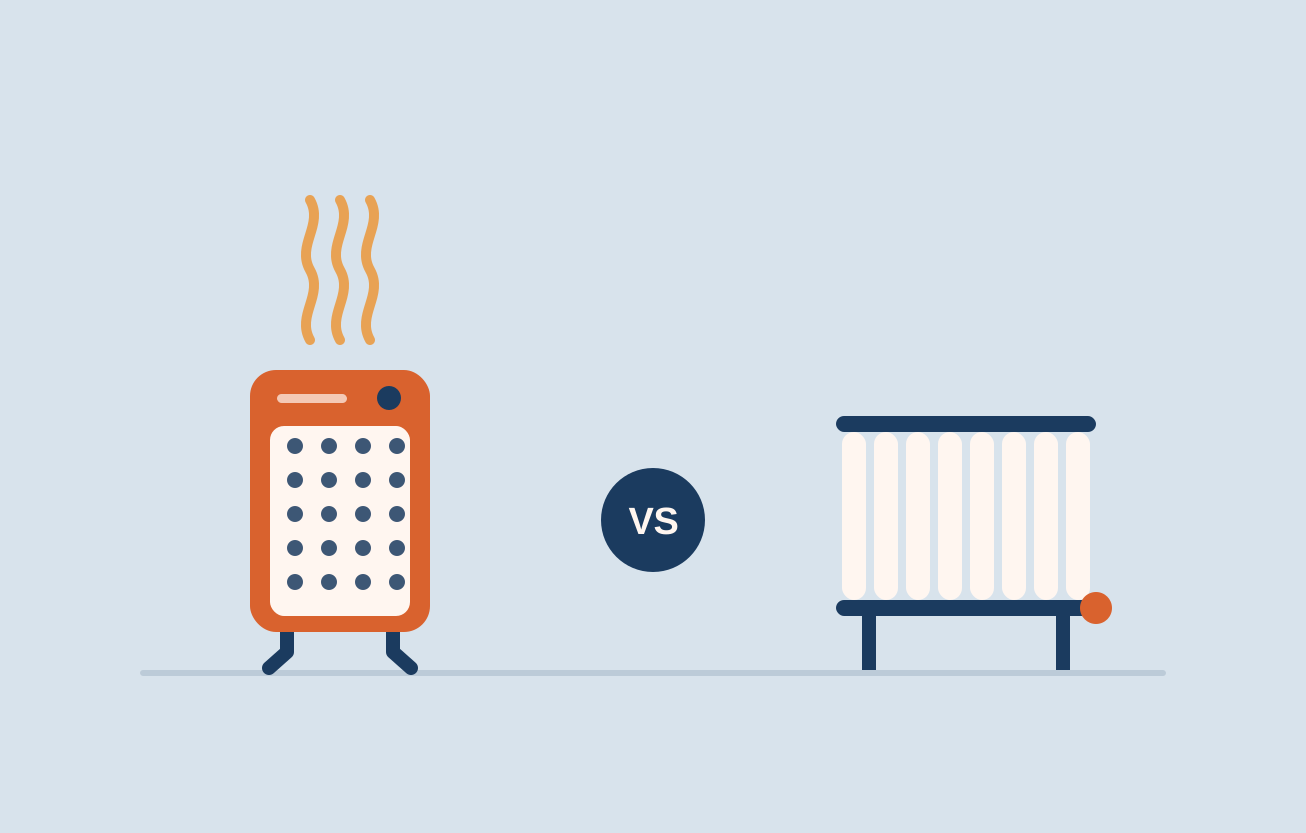
Space Heater vs Central Heating: Which Costs Less?
Wondering whether a space heater or central heating costs less? Compare running costs, use our simple calculator to estimate your expenses, and discover practical ways to stay warm while saving on energy bills in the US or Europe.
A space heater may cost less than central heating when you only need
to warm one room. Compare heater prices, wattage, and running costs
before deciding which option makes sense for your home.
Compare your options
Amazon
Explore space heaters and prices
Compare ceramic, infrared, and oil-filled heaters at different
price points. Check each model's wattage and thermostat features,
and remember that the purchase price is only part of the total cost.
Cost tip
Estimate running costs using the heater's wattage, how many hours
you use it, and your electricity rate. Compare that figure with the
cost of heating the same space using your central heating system.
Affiliate disclosure:
We may earn a commission if you purchase through links on this page,
at no additional cost to you.
Introduction
Heating your home can get expensive, but is a space heater actually cheaper than central heating? In many cases, it can be if you're only warming one room for a few hours. For example, a 1,500-watt space heater running for four hours uses 6 kWh of electricity. At $0.20 per kWh, that's $1.20 a day, or $36 a month if used daily. At €0.25 per kWh, the same usage costs €1.50 a day, or €45 a month. However, an efficient central heating system or heat pump may be cheaper, depending on your energy rates and how much of your home you need to heat. Let's compare the costs to help you find the most economical option.
01Is a Space Heater Cheaper Than Central Heating?
A space heater can be cheaper than central heating when you only need to heat one room for a few hours, but it isn't always the most economical option. The answer depends on your energy prices, the area you're heating, and the efficiency of your existing heating system.
For example, a 1,500-watt electric space heater running for four hours uses 6 kWh of electricity. At $0.20 per kWh, that costs $1.20 per day, or $36 per month if used daily. At €0.25 per kWh, the same usage costs €1.50 per day, or €45 per month.
However, these figures only cover the space heater. To determine whether it's cheaper than central heating, you also need to consider how much energy your main heating system would use to provide comparable warmth.
According to the Energy Saving Trust's guide to electric heating, portable electric heaters can be useful for warming individual rooms, but their running costs can be high compared with systems such as gas heating and heat pumps. Heat pumps are particularly worth considering because they can deliver substantially more heat energy than the electricity they consume.
If you mainly use one room during the day, a space heater may be worth considering. If you need to heat several rooms, an efficient central heating system may offer better value.
Enter your heating details in the calculator below to estimate your space heater's running costs and compare them with your central heating expenses. The cost table that follows provides examples for common space heater wattages.
02Space Heater vs. Central Heating Cost Calculator
A space heater's running cost depends on its power rating, how long you use it, and your electricity price. Use the calculator below to estimate daily and monthly costs, then compare them with your central heating expenses for the same period.
For example, a 1,500-watt space heater running for four hours uses 6 kWh of electricity. At $0.20 per kWh, that costs $1.20 per day, or $36 over 30 days. Your actual costs may differ depending on your electricity tariff and how often the heater operates at full power.
Enter your electricity price and typical heater usage, then add your estimated central heating cost for the same period. For the fairest comparison, consider the cost of heating a similar area to a similar comfort level.
The calculator provides an estimate, not a guaranteed saving. It assumes the space heater draws its full rated power while running. Actual consumption may be lower if its thermostat cycles off. Make sure the central heating figure covers the same period and a comparable heating need.
Understanding Your Results
A positive estimated difference means the space heater costs less than your entered central heating cost for the period. A negative difference means it costs more. If the difference is close to zero, the estimated costs are similar.
Remember that this is a running-cost comparison, not necessarily a measure of total heating efficiency. Electric resistance heaters convert electricity into heat at the point of use, whereas heat pumps can deliver several units of heat per unit of electricity consumed. As a result, an efficient heat pump may be cheaper to operate, depending on local energy prices and operating conditions.
Use your results alongside the cost table above to understand typical running costs. In the next section, we'll look at when a space heater is likely to offer better value and when central heating may be the more economical choice.
04Heating one room vs. heating the entire home
If you spend most of your day in one room, a portable heater may help you avoid heating unused areas. Whether this saves money depends on how much energy your central system would otherwise use and whether you can lower the main thermostat without making the rest of your home too cold.
For a whole home, the type of heating system matters as much as the area being heated. The International Energy Agency explains that heat pumps transfer heat rather than generating it all from electricity, so they can provide several units of heat for each unit of electricity consumed. This can make them cheaper to operate than conventional electric resistance heaters, depending on local energy prices (IEA guidance on how heat pumps work).
A 2023 review of heating technologies across 11 European countries also found substantial differences in efficiency and operating costs between systems. Its findings show why the best-value option varies with the technology and country (research published in Energy).
Similarly, a 2025 study in Applied Energy compared nine residential heating and cooling systems in Athens, Strasbourg, and Helsinki. It found that economic performance depended on local climate and energy prices, reinforcing the importance of comparing options under your own conditions (read the study on residential heating costs).
The bottom line: a space heater may be cheaper for occasional, single-room heating, but an efficient central system—particularly a heat pump—may offer better value for regular or whole-home heating. For the fairest comparison, compare the costs of heating a similar area to a similar comfort level over the same period.
05When Is a Space Heater Cheaper?
A space heater can be cheaper when you only need heat in a small area for a limited time. It’s most useful in these situations:
Heating one occupied room: If you’re working in a home office or relaxing in one bedroom, a space heater can warm that area without requiring you to heat the entire home.
Using supplemental heat for a few hours: If you need extra warmth during a cold morning or evening, a portable heater can be practical. However, compare its electricity cost with your main heating system, as electric heaters can be more expensive to run per unit of heat.
Avoiding unnecessary whole-home heating: If the rest of the home is unoccupied, turning down central heating and warming only the room you’re using may reduce energy use. This works best when your main system allows you to adjust heating effectively.
The U.S. Department of Energy’s guidance on room heaters notes that electric room heaters can be cost-effective for infrequently used rooms, particularly in well-insulated homes. The key is to heat only the space you need, for only as long as you need it—while keeping the home safely warm enough to avoid problems from excessive cold or dampness.
06When Is Central Heating Cheaper?
Central heating can be cheaper when you need to heat several rooms or your entire home regularly, especially if your system is efficient and your home is well insulated. Using multiple electric space heaters for long periods can become expensive, particularly if electricity rates are high.
Heating multiple rooms: If your family uses several rooms throughout the day, central heating may provide better value than running separate space heaters in each room.
Using an efficient heating system: Heat pumps are often among the cheapest systems to operate. The European Commission notes that switching from a gas boiler to a heat pump can reduce heating bills, depending on local energy prices and the home’s efficiency (European Commission guidance on heat pumps).
Maintaining comfortable temperatures throughout the home: If you want several rooms to stay warm throughout the day, an efficient central system can provide consistent heat without needing to manage multiple portable heaters.
However, central heating is not automatically cheaper. Heating unused rooms can waste energy, while a space heater may cost less if you only need warmth in one area. If your central system has zone controls, use them to heat the rooms you actually need.
Tip · Use Your Own Energy Rates
For the most accurate comparison, use the
calculators on this page.
Enter your electricity price in USD or EUR per kWh and your estimated
central heating cost to compare the options using your own figures.
Your actual energy rates will give you a more useful estimate than
national averages, especially if your tariff differs from typical
household prices.
08How to Save Money on Heating
You don’t always need to replace your heating system to lower your energy bills. Small changes to how you heat your home, combined with better insulation and regular maintenance, can help reduce energy use without sacrificing comfort.
Improve insulation and seal drafts: Seal gaps around doors and windows, and check whether your attic and walls have adequate insulation. According to ENERGY STAR’s guide to sealing and insulating, air sealing and insulation can improve comfort and reduce energy bills.
Heat occupied spaces efficiently: If you spend most of your time in one room, a space heater may help you avoid heating unused areas. Compare its running cost with your main heating system before deciding which is cheaper. If you’re choosing a heater for regular use, explore our guide to the most energy-efficient space heaters to learn more about options that may help reduce energy consumption.
Maintain your heating equipment: Clean or replace filters as recommended by the manufacturer, keep radiators and vents unobstructed, and arrange regular servicing where required. ENERGY STAR’s heating and cooling advice explains how maintenance can help equipment run efficiently.
Practical Tip · Heat Smarter
Turn the thermostat down when you don't need as much heat.
Lower the setting when you're asleep or away, and avoid heating
unused rooms unnecessarily. Combine sensible temperature settings
with draft-proofing and insulation to help reduce wasted energy.
For more personalized savings, use the space heater vs. central heating cost calculator above with your actual energy rates.
Final Verdict: Which Heating Option Costs Less?
So, is a space heater cheaper than central heating? It can be, but it depends on how much of your home you need to heat, how long you need heat, and the efficiency of your existing system.
If you spend most of your time in one room, a space heater may help lower your heating bill, especially if you turn down your central heating at the same time. However, using a portable electric heater for many hours a day can become expensive. For heating several rooms or an entire home, central heating may offer better value, particularly if you have an efficient heat pump.
Before choosing, compare the running costs using your actual electricity and fuel prices, and consider how much heat each option delivers. Improving insulation, sealing drafts, and using a thermostat wisely can also help reduce energy consumption.
The Bottom Line
A space heater can be a practical, cost-effective choice for
occasional, single-room heating,
while an efficient central heating system may be the better option
for regular, whole-home comfort. Use the calculator above to compare
your own costs before deciding which makes the most financial sense
for your home.
REFERENCES
Sources & further reading
Independent energy advice, official heating guidance, electricity
price data, and peer-reviewed research behind our space heater
versus central heating cost comparisons.
COMMON QUESTIONSSpace heater vs. central heating costs
A space heater is often cheaper for heating one occupied room, while central heating can be more practical for warming an entire home. The result depends on your energy prices, heating system efficiency, insulation, and how many rooms need heat. A portable electric heater may save money if it lets you turn down central heating, but running both systems without reducing central heating can increase your total energy bill.
A 1,500-watt space heater running at full power for 8 hours consumes 12 kWh of electricity. At $0.18 per kWh, that costs $2.16 per day, or about $64.80 over 30 days if used for 8 hours every day. At $0.30 per kWh, the same usage costs $3.60 per day, or $108 per month. These estimates assume full-power operation throughout the period.
Not necessarily. An electric space heater converts electricity into heat at the point of use, while a gas furnace burns fuel to heat the home. Electricity and natural gas have different prices, and the furnace has its own efficiency rating and operating costs. A space heater may cost less when you need warmth in just one room, but a gas furnace may be more economical when heating several rooms. Compare the cost of delivering the heat you need, not just the appliances' wattage or fuel type.
A standard electric space heater is not usually as efficient as a heat pump at delivering heat from electricity. A resistance heater typically produces about one unit of heat per unit of electricity, while a heat pump can deliver multiple units of heat per unit of electricity under suitable conditions. This can make a heat pump cheaper to operate, even when both use electricity. Actual performance depends on outdoor temperature, equipment efficiency, installation, and electricity prices. Compare running costs separately from installation and maintenance costs.
Using a space heater can save money when you spend most of your time in one room and can lower the central heating setting for the rest of the home. For example, you might heat a home office during working hours instead of maintaining the same temperature throughout the house. Savings depend on how much central heating you reduce, how long you use the portable heater, and the relative cost of each system. Targeted heating is most effective when it replaces some whole-home heating rather than simply adding extra heat.
Central heating is often the more convenient option when multiple rooms need consistent warmth. Whether it costs less depends on the system: a gas boiler, electric resistance system, and heat pump have different operating costs. Heating several rooms with separate electric space heaters can consume substantial electricity, particularly if they run for many hours. For whole-house heating, compare the central system's fuel use, efficiency, and controls with the combined cost of the portable heaters you would need.
Use this formula: Power in kilowatts × operating hours × electricity price per kWh = running cost. For example, a 1,500W heater equals 1.5 kW. If it runs for 8 hours at $0.18 per kWh, the calculation is 1.5 × 8 × $0.18 = $2.16. To estimate a monthly cost, multiply the daily cost by the number of days used. If the thermostat switches the heater off periodically, actual consumption may be lower than this full-power estimate.
A thermostat can reduce total electricity use by switching a space heater off when the room reaches the selected temperature. It generally does not make the heating element more efficient while it is operating; instead, it reduces unnecessary runtime. The amount saved depends on room insulation, outdoor conditions, thermostat placement, and the chosen temperature. A moderate setting and heating only occupied spaces can help control energy costs.
Heating one room is often cheaper if you can avoid heating unused areas. A portable space heater can work for occasional, localized warmth, while a zoned central heating system may provide similar control without relying on plug-in heaters. If several rooms are occupied, the advantage of targeted heating can shrink. The best option is the one that maintains comfortable temperatures in the spaces you use with the lowest total energy cost.
Portable space heaters can present a fire risk if used incorrectly, especially around bedding, curtains, and furniture. Follow the manufacturer's instructions, keep the required clearance from combustible materials, and plug the heater directly into a wall outlet rather than an extension cord or power strip. Turn the heater off when sleeping unless the manufacturer explicitly states that the model is designed and approved for that use. For overnight warmth, consider safely operated central heating with a suitable thermostat.