If you're looking for the most energy-efficient space heater, the answer isn't as simple as choosing between ceramic, infrared, or oil-filled models. Most plug-in electric space heaters use resistance heating, which means they convert the electricity they consume into heat at roughly the same point-of-use efficiency.
What really determines how much electricity a space heater uses is how much power it draws, how long it runs, how well its thermostat controls the temperature, and how much heat the room actually needs.
For example, a 1,500-watt space heater running continuously for four hours uses 6 kilowatt-hours (kWh) of electricity. A lower-wattage heater may consume less electricity, but it will also produce less heat. And a heater with a good thermostat may use less electricity over time because it cycles on and off instead of running continuously.
There's another important distinction: using less electricity isn't necessarily the same as being more energy efficient. An infrared heater may make you feel warm quickly by heating people and objects directly, while an oil-filled radiator may continue releasing heat after its heating element switches off. These characteristics can affect comfort and runtime, but they don't necessarily mean the heaters produce more heat from each unit of electricity.
In this guide, we'll look at what actually makes a space heater economical to operate, how much different wattages cost to run, how ceramic, infrared, oil-filled, and other heaters compare, and when using a space heater can make sense compared with central heating or a heat pump. We'll also put space-heater energy use in the broader context of home energy efficiency.
The goal isn't simply to find a heater with the word “efficient” on the box. It's to understand how much electricity you're using to get the amount of heat you actually need.
For most conventional electric space heaters, there isn't a single type that's dramatically more energy efficient than the others. Ceramic, infrared, oil-filled, and other electric resistance heaters all use electricity to produce heat, and their point-of-use efficiency is broadly similar.
That means choosing a heater based solely on its heating technology can be misleading. A heater doesn't necessarily use less electricity simply because it is marketed as “energy efficient,” “infrared,” or “eco-friendly.”
The biggest factors are:
- Wattage: A 1,500-watt heater uses more electricity per hour than a 750-watt heater when both are operating at full power.
- Runtime: The longer a heater operates, the more electricity it consumes.
- Thermostat: A good thermostat can switch the heating element off when the room reaches the target temperature, reducing unnecessary runtime.
- Room size and insulation: A well-insulated small room generally requires less heating than a large, drafty space.
- Temperature setting: The higher the target temperature, the more heat the room loses to its surroundings and the more work the heater has to do.
- How you're heating: Warming one occupied room can require much less energy than heating an entire home.
Not necessarily in the way you might expect.
A 750-watt heater consumes half as much electricity per hour as a 1,500-watt heater when both are running continuously. But it also produces roughly half as much heat.
If the 750-watt heater needs to run twice as long to maintain the same conditions, the total electricity consumption can be similar.
That's why wattage alone isn't a measure of efficiency. You need to consider both the heater's power consumption and how long it needs to operate.
Different heater designs can change how heat is delivered and how comfortable the room feels, but that isn't the same as producing more heat from each unit of electricity.
An infrared heater primarily transfers radiant heat directly to people and surfaces. This can make you feel warm quickly, particularly when you're close to the heater.
An oil-filled radiator heats a fluid inside the unit and releases heat gradually into the room. It tends to warm more slowly but can provide steady, quiet heat.
A ceramic fan heater can circulate warm air around the room quickly, making it useful when you want rapid heating.
These differences can affect comfort, heat distribution, and how you use the heater. They don't automatically make one technology more electrically efficient than another.
Rather than asking which type of space heater is “the most efficient,” it's more useful to ask:
How much electricity will this heater use to keep my room comfortable?
That's determined largely by its wattage and runtime.
For example, a 1,500-watt heater operating continuously for one hour consumes:
1.5 kWh of electricity
Run it for four hours and it consumes:
1.5 kW × 4 hours = 6 kWh
Your electricity rate then determines the cost.
This is why a heater with a good thermostat, appropriate power level, and sensible controls can be a better choice for reducing electricity consumption than simply choosing a particular heating technology. You can also explore our guide to energy-saving devices for the home for other ways to monitor or reduce household electricity use.
Bottom line: Most electric resistance space heaters are similar in their basic ability to turn electricity into heat. The biggest opportunities to reduce energy use come from heating only the space you need, choosing an appropriate wattage, maintaining a reasonable temperature, and avoiding unnecessary runtime.
The amount of electricity a space heater uses depends primarily on its wattage and how long it runs. The same wattage-and-runtime principle applies to other household appliances, such as an air conditioner, although heating and cooling systems can use energy very differently.
Space heaters commonly have power ratings of around 500 to 1,500 watts, although larger models can use 2,000 watts or more. A heater rated at 1,500 watts uses 1.5 kilowatt-hours (kWh) if it operates at full power for one hour.
You can estimate electricity consumption with a simple formula:
Watts ÷ 1,000 × hours of operation = electricity used in kWh
A 1,500-watt heater running continuously would use:
- 1 hour: 1.5 kWh
- 2 hours: 3 kWh
- 4 hours: 6 kWh
- 8 hours: 12 kWh
To estimate the cost, multiply the electricity consumed by your electricity rate.
For example, if electricity costs $0.20 per kWh, a 1,500-watt heater operating continuously for four hours would cost:
1.5 kW × 4 hours × $0.20 = $1.20
That is the cost of running the heater at full power for those four hours.
However, a heater with a thermostat may not draw its full rated power continuously. Once the room reaches the selected temperature, the heating element can switch off or cycle on and off. Actual consumption can therefore be lower than the simple maximum-runtime calculation.
The table below shows how much electricity different heater sizes consume when operating continuously.
These figures represent continuous operation at the heater's full rated power. In normal use, a thermostat may reduce the actual amount of electricity consumed.
Not necessarily.
A 1,500-watt heater doesn't automatically consume 1,500 watts every minute it's plugged in. If its thermostat switches the heating element off after the room reaches the target temperature, electricity consumption will fall while the heater is not actively heating.
Some heaters also offer multiple power settings. For example, a 1,500-watt heater might have a lower setting that uses 750 watts instead of its maximum 1,500 watts.
This makes runtime and controls just as important as the number printed on the heater.
You can use this three-step calculation:
1. Convert watts to kilowatts
Divide the heater's wattage by 1,000.
A 1,500W heater becomes:
1,500 ÷ 1,000 = 1.5 kW
2. Multiply by the number of hours
If you run it for five hours:
1.5 kW × 5 = 7.5 kWh
3. Multiply by your electricity price
If your electricity rate is $0.20 per kWh:
7.5 kWh × $0.20 = $1.50
So the maximum cost would be $1.50 for five hours of continuous operation at that electricity rate.
Your actual cost may be lower if the thermostat cycles the heating element off during part of that time. It also depends on the electricity rate you pay. If your utility uses time-of-use pricing, peak electricity hours can also affect when electricity is most expensive.
There isn't one universal answer to the question “How much does a space heater cost to run?”
Electricity prices vary considerably by location and electricity plan. A heater that costs a certain amount to operate in one home can cost substantially more or less in another.
For the most accurate estimate, check the per-kWh rate on your electricity bill and use it in the calculation above.
The key takeaway: A higher-wattage space heater consumes electricity faster, but wattage isn't the whole story. The total cost depends on wattage × runtime × your electricity rate, while thermostat cycling and other controls can reduce actual consumption.
If you're comparing ceramic, infrared, oil-filled, and other electric space heaters, it's tempting to look for the technology that uses the least electricity.
But there is an important catch: the heater's design does not automatically determine how much electricity it uses.
Most plug-in space heaters use electric resistance heating. When electricity passes through a resistive heating element, electrical energy is converted into heat. A 1,500-watt heater therefore has the potential to use about 1.5 kWh of electricity for every hour it operates at full power, regardless of whether the heater is marketed as ceramic, infrared, or another type of resistance heater.
What changes between heater types is primarily how that heat is delivered, how quickly you feel it, how evenly it spreads through the room, and how the heater's controls operate.
Ceramic heaters use an electrical heating element, often combined with a fan that moves warm air around the room.
Advantages:
- Can heat a room relatively quickly
- Usually compact and portable
- Many models offer multiple heat settings
- Often include adjustable thermostats and timers
Potential drawbacks:
- Fans can produce noticeable noise
- Moving air can feel less comfortable for some people
- A high-power setting can consume electricity quickly
A ceramic heater isn't inherently more energy efficient simply because it uses a ceramic heating element. Its practical energy use depends on its wattage, thermostat, settings, and runtime.
Infrared heaters transfer heat primarily through infrared radiation rather than relying entirely on heated air.
You can often feel radiant heat quickly when you're positioned within the heater's effective range. This can make infrared heating useful for personal or spot heating, where the goal is to warm people or nearby surfaces rather than raise the temperature of an entire room.
Advantages:
- Can provide noticeable warmth quickly
- Useful for targeted or personal heating
- Doesn't necessarily require a fan
Potential drawbacks:
- Warmth can be less uniform across a room
- The heating effect depends on your position relative to the heater
- An infrared heater isn't automatically more electrically efficient than another resistance heater with the same power rating
This last point is important. Feeling warmer sooner doesn't necessarily mean using less electricity.
If an infrared heater allows you to remain comfortable while keeping the surrounding air cooler, however, it may be useful as a practical spot-heating solution.
Oil-filled radiators contain a sealed heat-transfer fluid that is heated by an electrical element. The heated fluid warms the radiator's metal surface, which then releases heat into the room.
Advantages:
- Quiet operation
- Provides steady, gradual heat
- No fan is required
- The radiator remains warm for a while after the heating element switches off
Potential drawbacks:
- Slower to warm up
- Can be heavier than compact fan heaters
- The residual warmth doesn't mean the heater is creating heat without consuming electricity
Oil-filled heaters are sometimes described as being more efficient because they retain heat after the element switches off. The important distinction is that stored heat is not free heat. The energy was already consumed when the electrical element heated the fluid.
Their thermal characteristics can still make them comfortable and practical for maintaining a steady temperature.
Micathermic heaters use a heating element combined with mica panels to transfer heat through both convection and radiation.
They are typically designed to provide relatively quiet, steady heating without relying on a powerful fan.
As with other resistance heaters, their electricity consumption is primarily determined by their power rating and how long the heating element operates.
Fan heaters use a heating element and a fan to distribute warm air around the room.
Their main advantage is speed. A fan can move heated air around a space faster than passive convection alone.
However, faster heating doesn't automatically mean lower electricity consumption. A high-output fan heater can consume more electricity per hour if it operates at a higher wattage.
There isn't a universal winner among conventional electric resistance heaters.
A 1,500-watt ceramic heater, 1,500-watt infrared heater, and 1,500-watt oil-filled heater can all consume roughly 1.5 kWh for each hour their heating elements operate at full power.
The more useful question is which heater is appropriate for the way you heat your space.
The heater that uses the least electricity in practice is often the one that provides enough heat for the situation without unnecessary runtime.
For a small occupied area, that might mean a lower-power heater. For a whole room, it might mean choosing a heater with an effective thermostat and appropriate output. And if you're considering electric heating for an entire home, a heat pump is a different category altogether and should be compared separately.
Bottom line: Don't choose a space heater because its technology is advertised as inherently more efficient. Look at wattage, controls, room size, heating pattern, and expected runtime. Those factors are much more useful for estimating real-world electricity consumption.
We compared these space heaters across wattage, heating controls, thermostat features, timers, heating style, room suitability, safety features, and overall practicality.
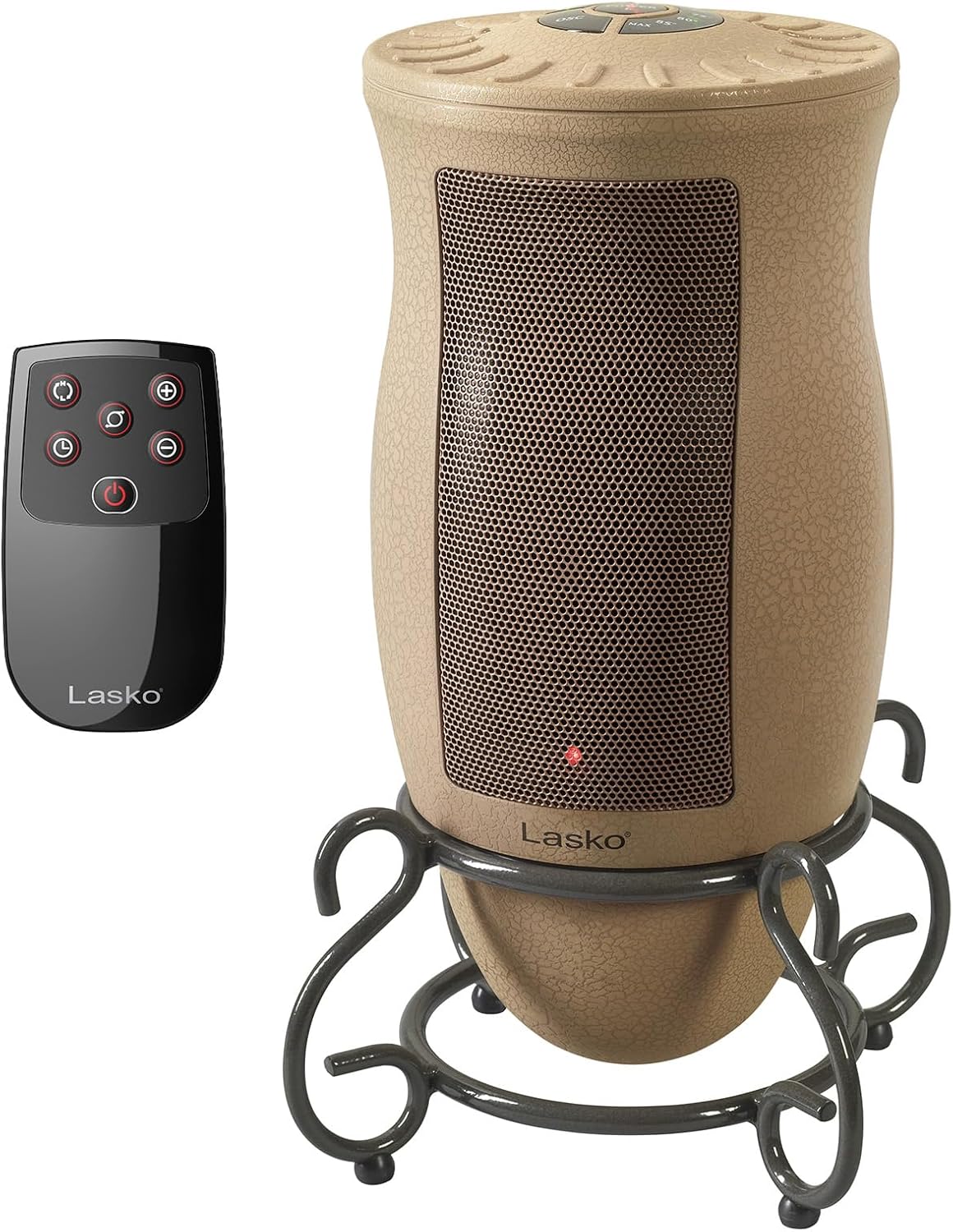
A compact 1500W ceramic tower heater with an adjustable thermostat, two heat settings, widespread oscillation, remote control, and a built-in 7-hour timer. Its small-to-medium-room design makes it practical for bedrooms, home offices, guest rooms, and other spaces where targeted supplemental heat is useful.

A feature-rich ceramic heater designed for quiet, even warmth indoors. It combines 70° oscillation, three heating modes, an adjustable 41–95°F thermostat, Eco Mode, Fan Only mode, remote control, and a programmable timer. Safety features include SafeFuse power protection, overheat and tip-over protection, a child lock, and flame-retardant internal components.
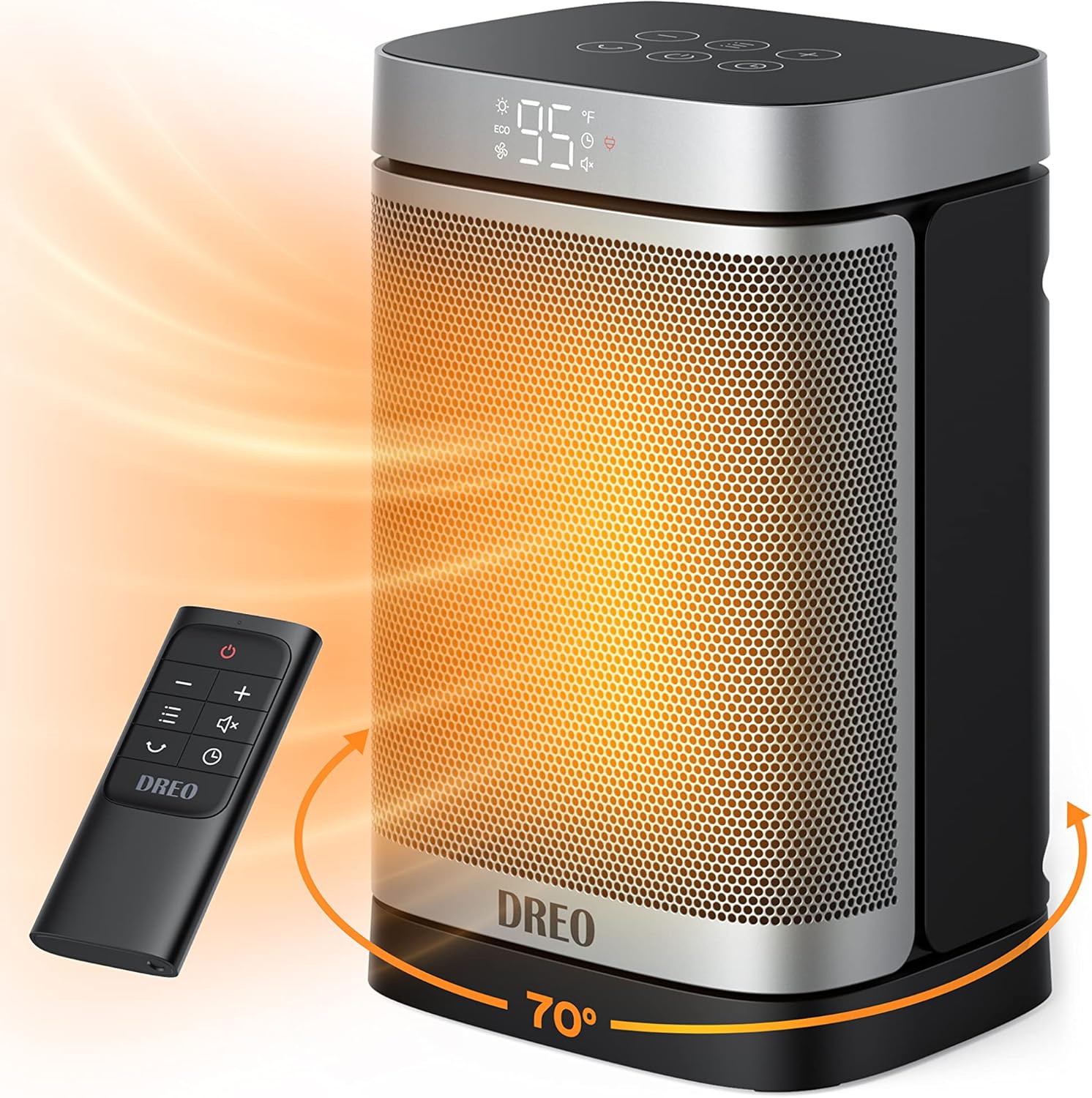
A compact PTC ceramic heater that combines fast heating with quieter operation for bedrooms, home offices, and other indoor spaces. The 41–95°F digital thermostat, ECO mode, 70° oscillation, remote control, and 1–12 hour timer make it easy to maintain a comfortable temperature without constantly adjusting the heater. DREO also includes tip-over, overheat, enhanced plug, and flame-retardant material protections.

A larger convection-style heater designed to distribute warmth broadly without relying on a noisy fan. Its 1500W heating capacity, ECO mode, adjustable thermostat, remote control, wheels, and 12-hour timer make it well suited to living rooms, bedrooms, offices, and other spaces where steady, quiet heating is a priority.

This 1500W cabinet-style heater combines infrared quartz heat with PTC heating and a low-noise blower for steady warmth. It includes an electronic thermostat, remote control, 12-hour timer, wheels, and multiple safety features including tip-over protection, overheat protection, and automatic shutoff.
Since most electric resistance space heaters convert electricity into heat in broadly similar ways, the features that matter most are the ones that determine how much heat you need and how long the heater has to run.
When comparing models, look beyond labels such as “energy efficient” and pay attention to these factors.
A heater with a higher wattage can produce more heat, but it also consumes electricity at a faster rate while operating.
That doesn't mean you should always choose the lowest-wattage model. A heater that is too small for the space may need to run continuously without comfortably reaching the desired temperature.
The goal is to choose a heater with enough output for the room without substantially more capacity than you need.
A good energy-saving thermostat can switch the heating element off when the room reaches the target temperature, reducing unnecessary runtime.
Instead of running continuously, a heater with a thermostat can stop heating when the room reaches the selected temperature and turn the heating element back on when the temperature falls.
This means the heater's rated wattage doesn't necessarily represent its average electricity consumption over several hours.
A 1,500-watt heater, for example, may draw 1,500 watts while actively heating but consume less electricity over time if its thermostat regularly switches the heating element off.
Many space heaters offer two or more power levels.
For example, a heater might provide a lower setting around 750 watts and a maximum setting around 1,500 watts.
Having multiple settings gives you more control over heat output. Once the room is comfortable, you may not need maximum power continuously.
However, a lower setting isn't automatically more efficient. If the heater has to run for twice as long to produce the heat you need, the total electricity consumption can be similar.
A timer can prevent a heater from operating longer than necessary.
This can be particularly useful if you only need supplemental heat for a specific period, such as while working at a desk or getting ready in the morning.
Smart controls can provide additional scheduling options, although their usefulness depends on how you actually use the heater.
The simplest energy-saving principle is often the most effective:
Don't heat a space when you don't need to heat it.
A space heater doesn't operate in isolation. The amount of heat required depends on the room and its surroundings. Improving home energy efficiency can reduce heat loss and make it easier to maintain a comfortable temperature with less heating.
A small, well-insulated room may warm relatively quickly. A large room with high ceilings, poor insulation, or significant drafts can lose heat much faster.
Before buying a heater, consider:
- Room size
- Ceiling height
- Windows and exterior doors
- Insulation
- Drafts
- Outdoor temperature
- Desired indoor temperature
A heater that is appropriate for a small bedroom may not be suitable as the primary source of heat for a large living area.
If heat is escaping through poorly insulated walls, windows, doors, or other parts of the building, the heater has to keep replacing that lost heat.
Improving the room's ability to retain heat can therefore reduce the amount of time the heater needs to operate.
Simple measures such as sealing noticeable drafts, closing doors to unheated areas, and using appropriate window coverings can sometimes make a meaningful difference.
The heater itself can only control how efficiently it uses electricity. It can't prevent heat from escaping through the building envelope.
How you use a heater can be just as important as which heater you buy.
If you're sitting at a desk for several hours, heating the entire home may be unnecessary. Targeted heating can allow you to stay comfortable while leaving other areas cooler.
This is one reason a space heater can sometimes reduce total energy use compared with heating an entire home.
But that depends on the home's existing heating system and energy prices. A space heater isn't automatically cheaper simply because it heats a smaller area.
A heater that makes you feel warm quickly isn't necessarily consuming less electricity.
An infrared heater can provide immediate radiant warmth. A fan heater can quickly raise the temperature of the air around you. An oil-filled radiator can provide steady, quiet heat.
All of these characteristics can affect how comfortable you feel and how you use the heater.
The practical goal is therefore not simply to find the heater with the highest efficiency claim. It's to find a combination of appropriate heat output, good temperature control, and sensible runtime.
If reducing electricity consumption is your priority, look for:
- An appropriate wattage for your space
- A reliable adjustable thermostat
- Multiple power settings
- A timer or scheduling function
- Clear temperature controls
- Safety features such as overheat and tip-over protection
Features such as Wi-Fi connectivity, displays, remote controls, and different heating technologies can improve convenience, but they don't inherently make a resistance heater more energy efficient.
Bottom line: The biggest energy savings usually come from using the right amount of heat for the space and avoiding unnecessary runtime. A well-controlled heater used in an appropriately sized, reasonably well-insulated room can be much more economical than simply choosing a model marketed as “energy efficient.”
A space heater can be an economical way to heat a room, but it isn't automatically cheaper than your home's main heating system.
The answer depends on what type of central heating you have, the energy it uses, its efficiency, your energy prices, and how much of the home you're trying to heat.
The biggest potential advantage of a portable space heater is that it allows you to heat one area instead of the entire home.
Suppose you're working in a home office for several hours but don't need every room in the house to be warm.
Using a portable heater in the office allows you to concentrate the heat where you need it. You can potentially keep the rest of the home at a lower temperature rather than running the central heating system to maintain the same temperature everywhere.
This is often called zone or spot heating.
The savings come primarily from heating less space, not because the portable heater magically converts electricity into heat more efficiently than other electric resistance heaters.
If several people are using different rooms throughout the home, running multiple space heaters can quickly add up.
For example, three 1,500-watt heaters operating simultaneously at full power would have a combined electrical load of:
1.5 kW × 3 = 4.5 kW
If they operated continuously for four hours, they would consume:
4.5 kW × 4 hours = 18 kWh
That's why it's important to compare the total energy required to heat the space, rather than simply comparing the power rating of one heater with another.
The cost comparison can be very different depending on what heats your home.
A high-efficiency furnace or boiler can produce a large amount of heat from its fuel, and the cost of that heat depends on the efficiency of the equipment and the price of the fuel.
A resistance space heater, meanwhile, uses electricity directly.
Whether one is cheaper depends on the cost per unit of useful heat, rather than simply the energy source.
If your home's central heating system also uses electric resistance heating, the comparison is more straightforward.
Both systems ultimately turn electricity into heat. A portable heater may still use less total energy if you're heating a much smaller area.
Heat pumps are different because they don't primarily generate heat from electricity. They use electricity to move heat from one location to another.
Under suitable conditions, a heat pump can provide substantially more heat per unit of electricity than conventional electric resistance heating.
We'll look at that comparison in more detail in the next section. But this BBC explainer shows the basic science behind heat pumps and why moving heat is different from creating heat with electrical resistance.
Consider two situations:
Scenario A: One occupied room
You're sitting in a 150-square-foot home office for six hours. The rest of the house doesn't need to be at the same temperature.
A properly sized space heater may allow you to heat just that room.
Scenario B: An entire home
You want every bedroom, living area, hallway, and other occupied space to remain warm.
Using several portable heaters may not be an efficient or practical solution. Your home's primary heating system may be better suited to maintaining temperatures throughout the building.
It's easy to see a 1,500-watt space heater and assume it must be expensive compared with a central heating system rated at a much higher number.
That's not necessarily a useful comparison.
Central heating systems and portable electric heaters measure and deliver energy differently. The relevant question is:
How much does it cost to provide the amount of useful heat you need?
That calculation depends on:
- The heating system's efficiency
- Electricity and fuel prices
- The amount of space being heated
- Indoor and outdoor temperatures
- Insulation and air leakage
- How long the system operates
- The temperature you're trying to maintain
A space heater is most likely to be useful as a supplemental heating solution when you can reduce the amount of space being heated.
For example, you might lower the home's general temperature slightly and use a portable heater while you're working in one room.
The potential benefit comes from avoiding unnecessary heating elsewhere, not from the space heater having a fundamentally higher conversion efficiency.
To determine which approach is cheaper for your home, compare the cost of delivering the same amount of useful heat.
For a space heater, start with:
Wattage ÷ 1,000 × hours used × electricity price
For a central heating system, you'll need to account for its fuel or electricity consumption and its efficiency.
Because energy prices and heating systems vary considerably, there is no single answer that applies to every home.
Bottom line: A space heater can reduce energy use when it allows you to heat a small occupied area instead of the entire home. But whether it actually costs less than central heating depends on your existing system, energy prices, the size of the area you're heating, and how long the equipment runs.
If your goal is to heat a home using electricity, there's an important distinction between a conventional space heater and a heat pump.
A typical portable space heater uses electric resistance heating. Electricity passes through a heating element, producing heat directly.
A heat pump works differently. Instead of creating heat directly from electricity, it uses electricity to move heat from one place to another.
That difference can have a major effect on electricity consumption. If you're considering a heat pump for regular heating, our guide to whether a heat pump is worth it explores the broader factors that affect the decision.
A conventional space heater converts the electricity it consumes into heat.
For example, a 1,500-watt heater operating for one hour uses:
1.5 kWh of electricity
That electricity produces approximately 1.5 kWh of heat while the heater is operating.
This is why comparing different resistance-heater technologies based solely on their advertised efficiency can be misleading. At the point of use, conventional electric resistance heaters are already highly effective at converting electrical energy into heat.
A heat pump uses electricity to move existing thermal energy from one location to another.
In heating mode, an air-source heat pump typically extracts heat from outdoor air and transfers it indoors. Because it is moving heat rather than generating all of it directly, it can provide more heat energy than the amount of electrical energy it consumes under suitable operating conditions.
Heat-pump performance is commonly described using measures such as coefficient of performance (COP) or seasonal efficiency ratings.
For example, a system operating with a COP of 3 would theoretically deliver about three units of heat for each unit of electricity consumed under those particular operating conditions.
Actual performance varies with the outdoor temperature, system design, installation, controls, and other factors.
If you're comparing a portable resistance heater with a heat pump, it's not useful to ask which type of resistance heater is “more efficient.”
The more important question is whether you need:
Short-term, localized heat
or
efficient heating for a larger area or the whole home.
A portable space heater can be convenient when you're only heating one occupied room for a limited period.
A heat pump can be much more relevant when you're looking for an efficient way to provide ongoing heating throughout a home or larger space.
The efficiency advantage of heat pumps doesn't make portable space heaters obsolete.
A space heater can be practical when:
- You need heat in one small area
- You're only occupying the space temporarily
- You want supplemental heat rather than whole-home heating
- Installing or operating a heat pump isn't practical
- You need a portable heating solution
For example, someone working at a desk in one room may prefer to heat that occupied space rather than increase the temperature throughout the entire home.
Heat-pump performance can change as outdoor conditions change.
As the temperature outside falls, an air-source heat pump generally has to work harder to extract and transfer heat. Modern systems are designed to operate in cold climates, but their efficiency and heating capacity vary by model and operating conditions.
This is one reason you should look at actual performance ratings and cold-climate specifications when evaluating a heat pump rather than assuming that every system performs identically.
A conventional electric space heater can be described as highly efficient at converting electricity into heat, but that doesn't mean it is the most energy-efficient way to heat a building.
Those are two different questions.
Resistance heater:
Electricity → heat
Heat pump:
Electricity → transferred heat
The second approach can deliver more heat per unit of electricity because the electricity is primarily being used to move thermal energy rather than generate it directly.
That depends on what you're trying to accomplish.
If you need an inexpensive, portable way to provide supplemental heat to one room, a space heater can be a practical option.
If you're choosing a system for regular whole-home heating, the comparison should include a heat pump and other available heating systems, along with installation costs, local energy prices, climate, and expected operating conditions.
Bottom line: Conventional electric space heaters are effective at converting electricity into heat, but heat pumps can deliver substantially more heat per unit of electricity under appropriate conditions. For that reason, “most energy-efficient space heater” and “most energy-efficient way to heat a home” are two very different questions.
Once you understand how wattage, runtime, thermostats, and heating technology affect electricity use, choosing a space heater becomes much easier.
Instead of looking for one universally “most efficient” model, choose a heater based on where you'll use it, how long you'll use it, and how you want the heat to feel.
If you're heating a relatively small bedroom, look for a heater with:
- An adjustable thermostat
- Multiple heat settings
- A timer
- Overheat protection
- Tip-over protection
- A relatively quiet operating mode
You may not need the highest available wattage. A heater that can maintain a comfortable temperature without continuously running at maximum output can be a more practical choice.
For overnight use, follow the manufacturer's instructions carefully and use only models specifically designed and approved for the intended application. Never assume that a heater is safe to leave unattended simply because it has a thermostat or timer.
A home office is a good example of where spot heating can be useful.
If you're spending several hours at a desk but don't need the rest of the house to be warm, a portable heater can provide localized heat.
Look for:
- Adjustable temperature control
- Lower power settings
- Quiet operation
- A thermostat
- A timer
- Compact size
A lower-power heater may be sufficient if you're sitting relatively close to it. The goal is to provide enough heat for the occupied area without unnecessarily heating the entire room.
If you want to raise the temperature of a room quickly, a fan-assisted ceramic or other forced-air heater can be useful.
These heaters circulate warm air around the room, allowing you to feel the effect relatively quickly.
Look for multiple power settings and a thermostat so that you can reduce the output once the room reaches a comfortable temperature.
Remember that faster heating doesn't necessarily mean lower electricity consumption. A high-output heater can use more electricity per hour while operating.
If noise is a priority, an oil-filled radiator may be worth considering.
Because it doesn't need a fan to distribute heat, it can operate quietly while providing gradual, steady warmth.
Oil-filled radiators can take longer to heat up than fan heaters, so they're generally better suited to situations where you want consistent heat rather than an immediate burst of warmth.
If you mainly want to warm yourself rather than raise the temperature of an entire room, a radiant or infrared heater can be worth considering.
Radiant heat can be felt directly by people and nearby surfaces, so you may feel warmer without first having to raise the temperature of all the air in the room.
This can make radiant heating useful for situations such as:
- Sitting at a desk
- Reading in a chair
- Working in a workshop
- Spending time in a partially heated room
The potential energy-saving benefit comes from heating the area or person you actually need to warm, not because infrared electricity is inherently more efficient than other resistance heating.
Large rooms generally require more heat to maintain the desired temperature, particularly if they have high ceilings, large windows, poor insulation, or significant air leakage.
Before simply buying the highest-wattage heater available, consider whether:
- The heater is actually rated for the room size
- The room has significant drafts
- Doors can be closed to reduce heat loss
- Windows or other surfaces are allowing substantial heat loss
- Your home's primary heating system would be more appropriate
A portable heater can be useful for supplemental heating, but using several high-wattage heaters to heat a large home can result in substantial electricity consumption.
Regardless of the type of heater you choose, these features are worth considering:
FeatureWhy it mattersAdjustable thermostatHelps maintain a target temperatureMultiple heat settingsGives you more control over heat outputTimerCan limit unnecessary operating timeTip-over protectionHelps reduce fire risk if the heater is knocked overOverheat protectionAdds an important safety measureClear controlsMakes temperature and power settings easier to manageAppropriate room ratingHelps ensure the heater is suitable for the spaceQuiet operationImportant for bedrooms, offices, and other quiet environments
Modern space heaters can include Wi-Fi controls, smartphone apps, remote controls, digital displays, oscillation, multiple operating modes, and other features.
Some of these can be useful, particularly if they make it easier to control temperature and runtime.
But extra features don't automatically make a heater more energy efficient.
If your main priority is reducing electricity consumption, prioritize appropriate power, effective temperature control, sensible scheduling, and safe operation before convenience features.
Bottom line: The right space heater depends on the job. Choose based on the size and characteristics of the space, how quickly you need heat, how long you'll use the heater, and whether you want to heat the entire room or primarily the area around you.
Even an appropriately sized space heater can use a significant amount of electricity if it runs unnecessarily. The easiest way to reduce consumption is to use the heater only where and when you need it.
Here are some practical ways to avoid wasting energy.
If you're spending several hours in one room, consider heating that room rather than increasing the temperature throughout the entire home. For broader improvements, see our guide to home energy management systems, which can help monitor and control energy use across the home.
Closing doors between heated and unheated areas can also help limit heat loss.
If your heater has an adjustable thermostat, use it instead of simply leaving the heating element running continuously.
Once the room reaches the selected temperature, the heater can cycle off and restart when additional heat is needed.
The thermostat setting won't eliminate heat loss, but it can prevent the heater from providing more heat than necessary.
Every degree of temperature difference between indoors and outdoors affects how quickly a room loses heat.
You don't necessarily need to maintain a very high indoor temperature to remain comfortable.
If you're using a space heater for supplemental heat, try a moderate temperature and adjust it based on how the room actually feels.
If your heater has multiple power levels, you may not need maximum output once the room is comfortable.
A higher setting can be useful for bringing a cold room up to temperature, while a lower setting may be sufficient for maintaining comfort.
Keep in mind that using a lower power setting isn't automatically cheaper if the heater then has to run for substantially longer. The important factor is total electricity consumed over time.
A heater has to replace heat that escapes from the room.
Check for obvious drafts around:
- Doors
- Windows
- Exterior walls
- Other openings to unheated areas
Simple improvements to air sealing can reduce heat loss and make it easier for the heater to maintain the desired temperature.
One of the simplest ways to reduce electricity consumption is to turn the heater off when the space doesn't need to be heated.
A timer can be useful if you regularly use the same room at predictable times.
For example, instead of running a heater throughout the day, you could schedule it to operate around the hours when you normally occupy the room.
Don't place furniture, curtains, clothing, bedding, or other objects directly in front of or on top of a space heater.
Obstructions can interfere with heat distribution and may create a safety hazard.
Always maintain the clearances specified by the manufacturer.
If a room is extremely cold because of severe drafts, inadequate insulation, or another building problem, continuously increasing the heater's output may not be the best solution.
The heater can only replace the heat that is being lost.
Addressing significant sources of heat loss can improve comfort while reducing the amount of heating required.
If you're trying to reduce your electricity bill, don't rely solely on the heater's marketing claims.
A plug-in energy monitor can help you see how much electricity a particular appliance is actually consuming, provided the monitor is appropriate for the heater's electrical load and used according to its instructions.
You can then compare consumption at different settings and usage patterns.
Energy savings should never come from using a heater in an unsafe way.
Don't cover a heater, block its ventilation, disable safety features, or use it contrary to the manufacturer's instructions simply to reduce heat loss or operating costs.
Keep combustible materials away from the heater and follow the manufacturer's guidance for electrical connections and placement.
Bottom line: The most effective way to save electricity with a space heater is usually simple: heat only the space you need, use a reasonable temperature, limit runtime, and let the thermostat control the heater when appropriate. How you operate the heater can matter more to your electricity bill than whether the heater is ceramic, infrared, or oil-filled.
Energy efficiency should never come at the expense of safety. Portable space heaters can become a fire or electrical hazard when they're placed too close to combustible materials, connected incorrectly, damaged, or left operating in unsuitable conditions.
Follow the manufacturer's instructions for your specific heater, and keep these basic precautions in mind.
Place the heater on a stable, level surface and keep it away from things that can catch fire, including:
- Curtains and drapes
- Bedding
- Clothing
- Furniture
- Paper and cardboard
- Rugs or other materials that could obstruct the heater
Don't place clothing, towels, blankets, or anything else on top of a space heater.
Don't block the heater's intake or exhaust openings.
Furniture or other objects placed directly in front of or around the heater can restrict airflow, interfere with normal operation, and potentially cause overheating.
Always follow the clearance requirements specified by the manufacturer.
Space heaters can draw substantial electrical power, particularly at their highest settings.
Use the electrical connection specified by the manufacturer and avoid using damaged cords, plugs, or outlets.
Don't use a heater if its power cord or plug shows signs of damage.
Extension cords and power strips can introduce additional electrical risks. Unless the manufacturer specifically permits their use and the equipment is appropriately rated, connect the heater directly to a suitable wall outlet.
When buying a portable space heater, useful safety features include:
- Tip-over protection: Automatically shuts the heater off if it is knocked over.
- Overheat protection: Shuts the heater down if its internal temperature becomes unsafe.
- Thermostat: Helps regulate room temperature and can reduce unnecessary operation.
- Timer: Can limit how long the heater operates.
These features don't make a heater risk-free, but they can provide additional protection when used correctly.
Portable heaters can have hot surfaces and should be positioned where children and pets cannot easily knock them over or come into direct contact with hot components.
Don't leave children or pets unsupervised around an operating heater.
Water and electricity are a dangerous combination.
Don't use an ordinary indoor space heater in a bathroom or other damp location unless the heater is specifically designed and approved for that environment and the manufacturer's instructions allow it.
Never bypass a tip-over switch, thermostat, thermal cutoff, or other built-in safety mechanism.
If a heater repeatedly shuts itself off unexpectedly, don't assume the safety feature is malfunctioning and try to disable it. Turn the heater off, check the manufacturer's instructions, and have a potentially defective unit inspected or replaced as appropriate.
A timer can limit operating time, but it doesn't automatically make unattended operation safe.
Whether a particular heater is suitable for overnight use depends on its design and the manufacturer's instructions. Follow those instructions rather than assuming that a timer, thermostat, or other control makes continuous or unattended operation safe.
Before using a portable heater, check for obvious signs of damage.
Pay particular attention to:
- Frayed or damaged cords
- Cracked plugs
- Loose connections
- Damaged housing
- Unusual smells
- Unusual noises
- Signs of overheating
If something doesn't appear normal, stop using the heater and follow the manufacturer's guidance.
Avoid placing a heater somewhere it can easily be knocked over or where its hot surfaces or airflow could come into contact with combustible objects.
The safest location is generally one that provides the required clearance while allowing the heater to sit securely on a stable surface.
Bottom line: Choose a heater with appropriate safety features, connect it according to the manufacturer's instructions, keep combustible materials and obstructions away, and never disable built-in safety mechanisms. A space heater can be a useful supplemental heating appliance, but it should always be treated as a high-power electrical device.
The cost to run a space heater depends on three things: its wattage, how long it runs, and your electricity rate.
You can estimate the running cost with this simple formula:
Cost = (Watts ÷ 1,000) × Hours Used × Electricity Rate
For example, a 1,500-watt space heater running for 4 hours uses:
1,500 ÷ 1,000 × 4 = 6 kWh
If your electricity rate is $0.20 per kWh:
6 × $0.20 = $1.20
So, running a 1,500-watt heater continuously for 4 hours would cost about $1.20 at that electricity rate.
Use the table below to estimate the maximum electricity cost at different wattages. The figures assume the heater runs continuously at its full rated power.
Your actual cost may be lower if the heater has a thermostat that cycles the heating element on and off. The table represents continuous full-power operation, so it is useful as a maximum-use estimate rather than a prediction of your exact bill.
To estimate monthly cost, multiply the daily cost by the number of days you use the heater.
For example, a 1,500-watt heater used for 4 hours per day at $0.20/kWh would consume:
1.5 kW × 4 hours × 30 days = 180 kWh per month
At $0.20 per kWh, that would be:
180 × $0.20 = $36 per month
If the thermostat cycles the heater off for part of that time, actual consumption could be lower.
The same heater can cost very different amounts to operate depending on local electricity prices. Check your electricity bill for the rate you pay per kWh and use that figure in the calculation.
For example, a 1,500-watt heater running for 4 hours uses 6 kWh, so:
- At $0.15/kWh: $0.90
- At $0.20/kWh: $1.20
- At $0.30/kWh: $1.80
- At $0.40/kWh: $2.40
A lower-wattage heater does not automatically cost less to heat a room.
A 750-watt heater running for 8 hours uses the same amount of electricity as a 1,500-watt heater running for 4 hours:
750W × 8 hours = 6 kWh
1,500W × 4 hours = 6 kWh
The more useful question is therefore not simply “Which heater has the lowest wattage?” but “How much electricity will it take to keep the space comfortable?”
A heater with an appropriate power level, a good thermostat, and a suitable heating pattern can help prevent unnecessary runtime.
To estimate your cost, find the heater's wattage, estimate how many hours you use it each day, and enter the electricity rate from your bill:
Daily cost = (Wattage ÷ 1,000) × Hours per day × Cost per kWh
Monthly cost = Daily cost × Days used per month
This gives you a much better estimate of operating cost than choosing a heater based solely on its advertised energy-efficiency claims.
The most energy-efficient space heater isn't necessarily a particular type of heater. For conventional electric resistance heaters, ceramic, infrared, oil-filled, and similar models can all be highly effective at converting electricity into heat.
What matters more is how much heat you need, how long the heater operates, and how effectively you control it.
If you want to reduce electricity consumption, focus on:
- Choosing an appropriate wattage for the space
- Using an accurate thermostat
- Taking advantage of lower heat settings when appropriate
- Heating only occupied areas
- Limiting unnecessary runtime
- Reducing drafts and heat loss
- Comparing the heater's running cost with your existing heating system
A portable space heater can make sense when you want to heat one room or a small area rather than the entire home. But if you're looking for the most efficient way to heat a whole home with electricity, don't limit your comparison to resistance heaters—a heat pump can operate on a fundamentally different principle and may deliver substantially more heat per unit of electricity under suitable conditions.
Ultimately, don't choose a space heater simply because the packaging calls it “energy efficient.” Look at wattage, controls, operating time, room requirements, and your electricity rate. Those factors will tell you far more about how much the heater is likely to cost to operate.