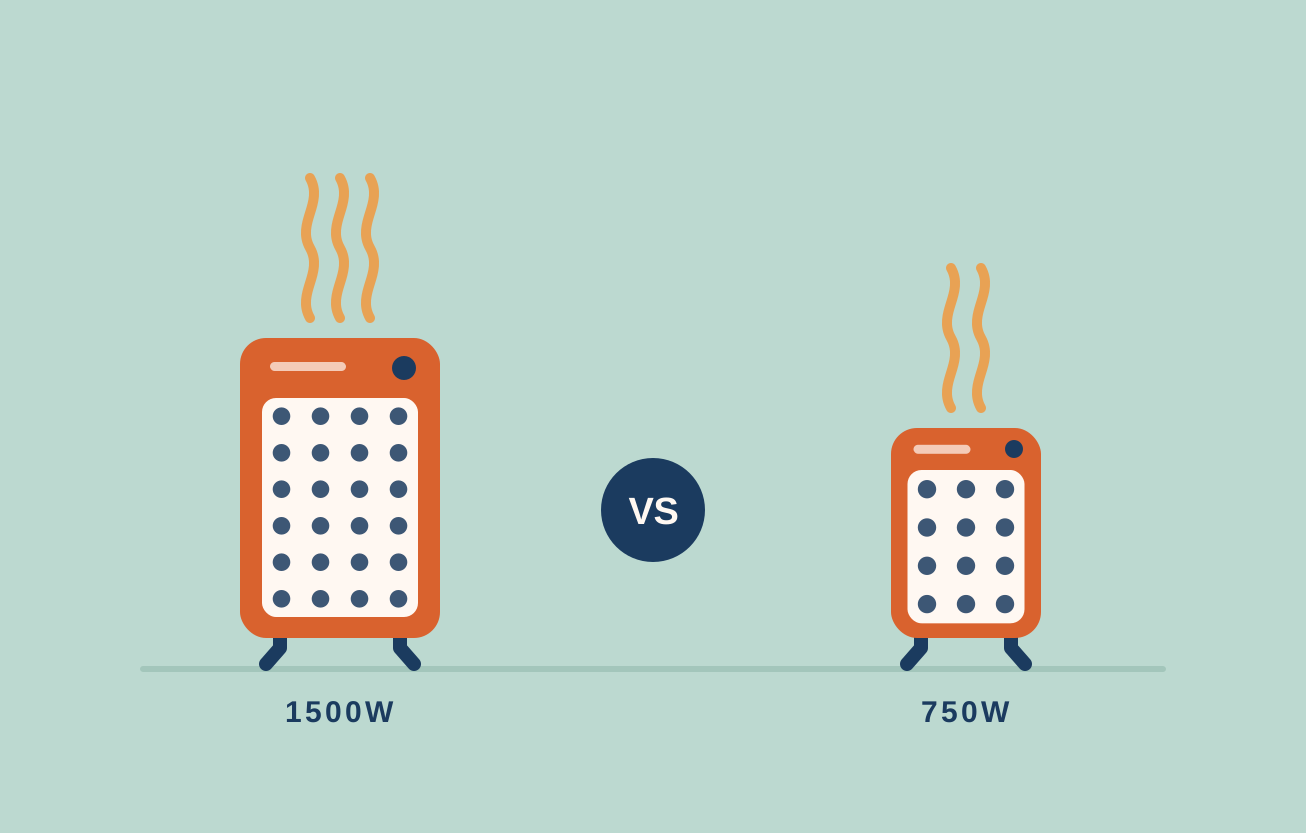
Choosing between a lower-wattage and higher-wattage space heater depends on how much heat your room needs, how quickly you want it to warm up and how often you plan to use it. A heater rated around 1,500W can deliver considerably more heat than a smaller model rated around 750W, making it more suitable for spaces with greater heating demands. However, the lower-powered option uses less electricity per hour and may be perfectly adequate for a small room or occasional supplemental warmth.
As a general guide, this comparison uses 750W and 1,500W as indicative reference points, not fixed product categories. Not every smaller space heater is rated at exactly 750W, and not every larger model operates at precisely 1,500W. You may find lower-powered heaters rated around 500W to 900W, while higher-powered models commonly range from approximately 1,200W to 2,000W. Some heaters also offer multiple heat settings, allowing a single model to operate at different wattages.
The key difference is that a higher-wattage heater can produce more heat while operating at full power, but it also consumes more electricity per hour. That doesn't automatically make a lower-wattage heater cheaper overall, as it may need to run for longer to keep the room comfortable.
In this guide, we'll compare the heating performance, room suitability and electricity use of smaller and larger space heaters to help you decide which type makes more sense for your home.
The main difference is how much heat each heater can produce while operating at full power. A typical 1,500W space heater draws 1.5 kilowatts of electricity, while a 750W model draws 0.75 kilowatts. For standard electric resistance heaters, this means the 1,500W model can produce roughly twice as much heat per hour, but it also uses twice as much electricity while running at full power.
These ranges are guidelines rather than strict categories. You may find a 1,000W heater that sits between the two, or a model with adjustable settings that lets you switch between lower and higher power. For a fair comparison, always check the actual wattage listed by the manufacturer and the power used at each available setting.
In practical terms, a smaller heater may be enough to keep a compact space comfortable, while a larger model gives you more heating capacity when a room needs it. If you're considering running a space heater from a portable power station, the heater's wattage will also affect how long the battery can keep it running. Our guides explain how long a portable power station can run a space heater and what size power station you need to run a space heater.
The right choice depends on the size of the space, how well it's insulated and how much heat the room needs. A smaller heater rated around 750W may work well in a compact bedroom, home office or other enclosed space where you only need a little extra warmth. It's also a sensible option if you're sitting relatively close to the heater rather than trying to warm an entire room.
A larger heater rated around 1,500W is generally better suited to bigger rooms or spaces that lose heat quickly. It has more heating capacity, which can help it bring a chilly room up to a comfortable temperature without having to run at its maximum setting for as long.
However, room size alone doesn't determine which heater you need. Ceiling height, draughts, insulation, window size and outdoor temperatures all affect how much heat a space requires. A well-insulated room may stay comfortable with a smaller heater, while a draughty room of the same size may need considerably more power.
If you're unsure what wattage to choose, start with the room's size and heating requirements rather than assuming that a higher-powered model is always better. Our guide to choosing the right space heater for your room size explains how to estimate the heating capacity you need.
A 1,500W space heater will generally warm a room faster than a 750W model, provided both are suitable for the space and are operating at full power. The higher-powered heater produces more heat each hour, allowing it to raise the room temperature more quickly.
This difference is most noticeable when you're trying to warm a cold room. A 750W heater may gradually make a small space more comfortable, but it can struggle to bring a larger or poorly insulated room up to temperature. A 1,500W model has greater heating capacity, so it can usually make a noticeable difference sooner.
However, wattage isn't the only factor. Fan-assisted heaters circulate warm air around the room, while oil-filled radiators and some other radiant heaters deliver heat differently. Room layout, insulation and the heater's thermostat settings also influence how quickly you feel the warmth.
It's also worth remembering that faster heating doesn't necessarily mean lower overall electricity use. A larger heater draws more power while operating, even if it reaches the desired temperature sooner. The best choice depends on whether you need quick warmth, gentle background heating or a balance of both.
If you're mainly looking for personal warmth while sitting at a desk or relaxing on the sofa, an electric blanket may be another option worth considering. Our comparison of electric blankets vs space heaters looks at their electricity use, running costs and practicality.
A 750W space heater uses less electricity per hour than a 1,500W model when both operate at full power. However, that doesn't automatically mean it will cost less to heat your room.
For example, a 750W heater running for four hours uses 3 kWh of electricity. A 1,500W heater running for the same amount of time uses 6 kWh. But if the smaller heater needs to run twice as long to provide enough warmth, the difference in electricity use disappears.
The thermostat also makes a difference. Once a room reaches the set temperature, a heater with a thermostat may switch off or reduce its heating cycles. A higher-powered model might therefore run for shorter periods, while a smaller heater may need to operate for longer to maintain the same comfort level. If your heater keeps switching off unexpectedly, it may be worth investigating the cause. Here's our guide to why your space heater keeps turning off and what you can check.
The most economical choice is the heater that can keep your space comfortable without using more electricity than necessary. If a 750W model provides enough warmth for your room, there's little reason to choose a larger one. But if it's consistently struggling to heat the space, a higher-powered heater with a suitable thermostat may be the more practical option.
For a closer look at electricity consumption and running costs, see our guides to how much electricity a space heater uses and how much it costs to run a space heater.
You can also compare electric space heating with your home's main heating system. Our guide to space heater vs central heating costs explores when using a portable heater as supplemental heating may make financial sense.
Once you've decided whether a smaller or larger heater is more suitable, compare the features that affect everyday use. Two heaters with similar wattage ratings can offer quite different levels of convenience, comfort and control.
Adjustable heat settings: Some models offer low, medium and high settings, allowing you to use less power when you don't need maximum heat. A heater with a 750W and 1,500W setting, for example, can provide both gentle warmth and stronger heating when needed. Check the actual wattage of each setting rather than relying on labels such as low or eco.
A reliable thermostat: A built-in thermostat helps maintain a comfortable temperature by switching the heating element on and off as needed. This is particularly useful if you plan to leave the heater running for extended periods while you're in the room.
Heating style: Fan heaters warm the air quickly and circulate it around the space. Ceramic heaters often combine this approach with a ceramic heating element. Oil-filled radiators provide more gradual, steady warmth, while radiant heaters are better suited to warming people and objects directly.
Size and portability: If you want to move the heater between rooms, look for a manageable weight, a carrying handle and a stable base. A compact lower-wattage model may be easier to position in a small office or bedroom, while larger heaters can take up more floor space.
Safety features: Look for overheat protection and a tip-over safety switch, particularly if the heater could be knocked or accidentally moved. Check that the model is certified to the relevant safety standards in your country, and follow the manufacturer's clearance and placement instructions. Never cover a space heater or use it with an extension lead unless the manufacturer explicitly permits it.
A higher wattage doesn't necessarily mean a better heater. The best model is one with enough heating capacity for your space, useful controls and safety features you'll actually rely on. If energy efficiency is your main priority, take a look at our guide to the most energy-efficient space heaters, where we compare different heater types and the features worth looking for.
The best choice depends on whether you need gentle supplemental warmth in a compact space or enough heating power to warm a larger room. When comparing individual models, pay attention to their actual wattage settings, thermostat controls, safety features and room coverage.
A compact heater in the 500W to 900W range can be a good fit for a home office, small bedroom or personal workspace. Look for adjustable heat settings and a thermostat so you can manage the temperature without relying on maximum power all the time.
For rooms that need more heating capacity, consider a model rated around 1,500W. Ceramic fan heaters are worth considering if you want warm air circulated quickly, while oil-filled radiators may suit people who prefer more gradual, steady warmth.
When comparing models, check the manufacturer's specifications carefully. A heater advertised as having multiple heat settings may not offer the exact 750W and 1,500W levels used in this comparison.
There's no universal winner between a 750W and 1,500W space heater. It really comes down to the room you're heating and the kind of warmth you're looking for.
If you want to take the chill off a small bedroom, keep your home office comfortable or add a little warmth while you're sitting in one place, a smaller heater may be perfectly adequate. But if you're trying to warm a larger room or dealing with a space that never seems to hold its heat, stepping up to a 1,500W model makes more sense.
It's easy to assume that buying a lower-wattage heater is always the smarter way to save electricity. In reality, choosing a model that struggles to heat your room can be a false economy. Equally, there's little point paying for more heating power than you actually need.
If you can, look for a heater with adjustable heat settings and a decent thermostat. Having the flexibility to turn the output up on colder days and dial it back when you only need a little warmth can make everyday use much more convenient.
Our advice? Match the heater to your space first, then think about wattage and running costs. The right space heater isn't necessarily the biggest or the smallest. It's the one that keeps your room comfortable without using more energy than the job requires.