A portable solar generator with panels gives you a rechargeable source of electricity for camping, RV trips, remote work, and emergency backup without relying on fuel. But choosing one isn't simply a matter of finding the largest battery or the most powerful inverter. The right combination of battery capacity, output, solar input, panel wattage, portability, and overall kit value depends on how you plan to use it. If your main priority is emergency power at home, see our guide to solar generators for home backup.
For this guide, we compared portable solar generator and panel packages from leading brands, looking at specifications, charging capabilities, battery technology, included equipment, pricing, warranty coverage, and independent reviews and market feedback. We focus on the complete generator-and-panel system rather than the power station alone, because the panel capacity and the generator's solar-input limits need to work together.
We don't personally test every generator featured here, so we don't present manufacturer claims or third-party test results as our own. Instead, our recommendations are based on a transparent comparison of the available market and the specifications and evidence that matter most to buyers. The goal is to help you find the best portable solar generator with panels for your particular needs and budget.
We’ve narrowed down the best portable solar generators with panels for keeping your essential devices and appliances running when the power goes out. These picks stand out for their balance of power output, battery capacity, portability, solar charging capability, and overall value, with options to suit different budgets and power needs.
After comparing these complete solar generator kits for capacity, power, charging performance, portability, included panels, and overall value, we’ve selected the models that stand out most for different types of buyers.
The BROWEY 1600W with Built-in Solar Panel stands out as our top pick if portability and convenience are the priorities, but each generator in this lineup has a specific advantage:
- It keeps the solar panel built in. You don't need to carry a separate panel or connect extra equipment when you want to recharge from the sun, making it a genuinely grab-and-go option.
- It has enough power for more than basic electronics. With 1,024Wh of capacity and 1,600W of continuous output, it sits well above small power banks and can handle a wider range of everyday devices.
- It hits a practical middle ground. The roughly 1kWh capacity gives you useful backup power for camping, road trips, and short outages without the size and weight of a multi-kWh home backup system.
- The other picks make sense for different priorities. The BLUETTI Elite 300 is the better choice when maximum capacity matters, with 3,014Wh and 2,400W of output. The Jackery Solar Generator 1000 v2 is the straightforward all-rounder, while the EF ECOFLOW DELTA 3 MAX is the pick for fast charging and higher output. At the other end, the Jackery Solar Generator 300 is the simplest budget option for phones, laptops, and other small electronics.
So, if you want the easiest solar generator to grab, carry, and use without dealing with a separate panel, we'd put the BROWEY first.
We compared these solar generator kits across capacity, output power, charging speed, portability, and whether the panels are actually included in the box.

The largest capacity in this lineup at over 3kWh, and the two 200W panels are included in the box rather than sold separately, making it the strongest all-round pick for extended off-grid or backup use.
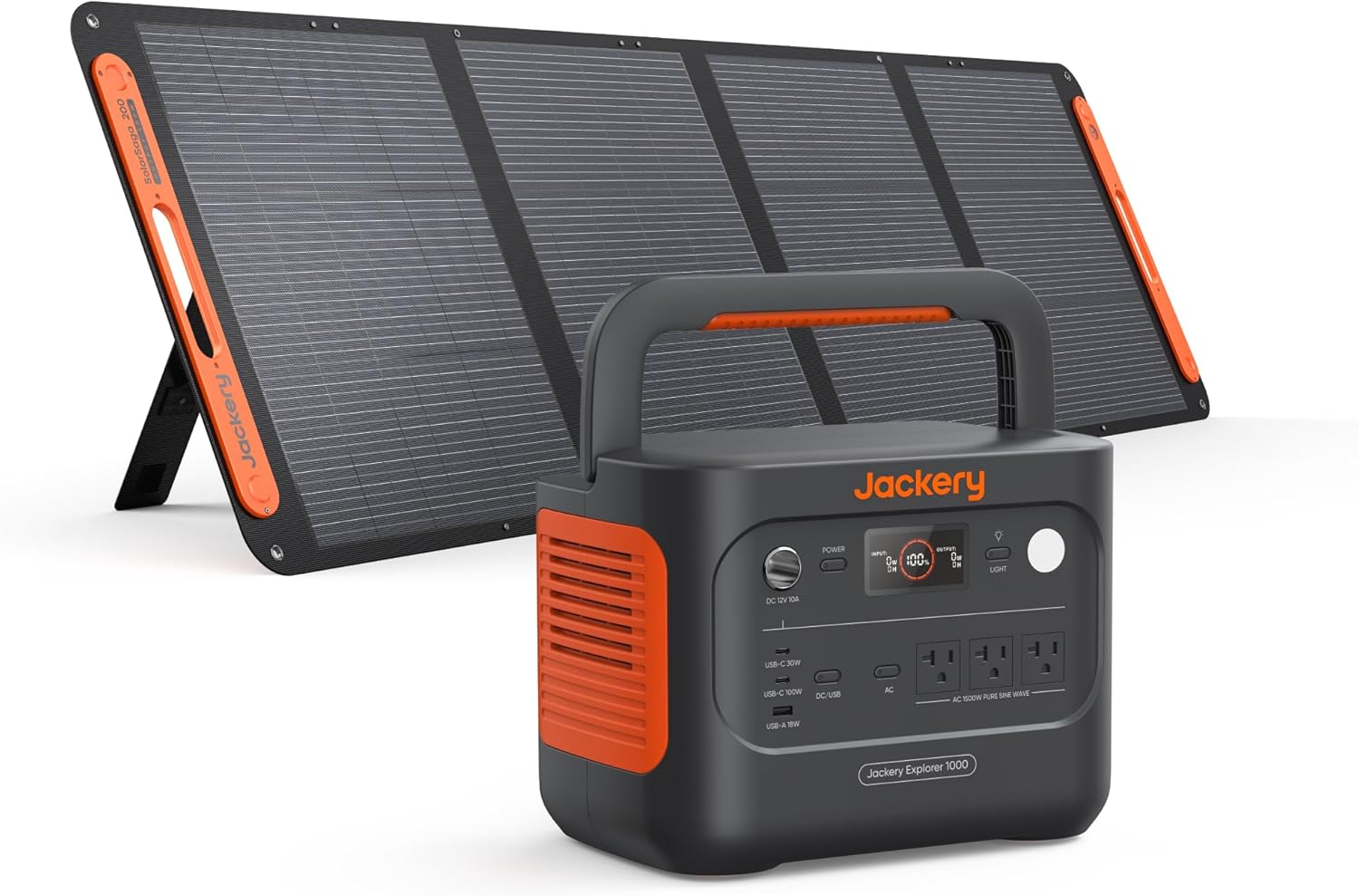
The most reviewed model in this lineup by a wide margin, with a 1-hour fast charge and a proven track record that makes it a safe, well-tested choice for most households.

Recharges from 0 to 80% in about an hour via AC, and pairs with a bifacial panel that can pick up reflected light, useful if you need a quick top-up rather than a slow trickle charge.

Integrates the solar panel directly into the unit rather than as a separate accessory, trading some charging flexibility for a genuinely grab-and-go footprint at just over 1kWh.

A small 292Wh unit paired with a 40W panel, sized for keeping phones and small electronics topped up rather than running appliances, and the lowest-commitment way to try solar backup.
Choosing the best portable solar generator with panels requires looking at the complete system, not just the battery capacity or advertised price. A portable power station may have a large battery but limited solar input, while another model may include more powerful solar panels but have less battery storage. We compared the models in this guide across the specifications, features, pricing, and real-world considerations that matter most when choosing a solar generator kit.
Battery capacity is measured in watt-hours (Wh) and tells you how much energy a portable solar generator can store. Higher capacity generally means longer runtime, but the advertised capacity doesn't necessarily equal the amount of electricity available to your appliances.
We compare battery capacity alongside the intended use of each generator, considering whether the system is better suited to small electronics and camping, RV use, or longer periods of home backup. We also look at expandable battery options where available.
Battery capacity determines how long a solar generator can provide power, while inverter output determines which appliances it can run.
We compare continuous AC output and surge or peak output, paying particular attention to appliances with motors and compressors, such as refrigerators, freezers, pumps, and some power tools. A generator with plenty of watt-hours can still be unsuitable if its inverter cannot handle the required load.
Solar charging is one of the most important factors when comparing a portable solar generator with panels. We look at the maximum solar input each power station can accept, how that compares with the included panel capacity, and the other charging options available.
A larger battery does not automatically mean a better solar generator. The system also needs enough solar input to recharge that battery efficiently.
We also consider AC and vehicle charging because many buyers will use solar as one of several ways to recharge their portable power station.
Because this guide focuses specifically on portable solar generators with panels, we pay close attention to what is included in each kit.
Some products are sold as complete solar generator kits with panels, while others are marketed as solar-ready power stations with panels available separately. We check the configuration being compared, including the number and total wattage of the solar panels, rather than comparing the price of a power station alone with the price of a complete kit.
This gives us a more meaningful way to judge overall bundle value and helps buyers avoid assuming that a solar panel is included when it is actually an optional accessory.
Battery chemistry affects the lifespan, weight, charging characteristics, and long-term value of a portable solar generator.
We pay particular attention to LiFePO4 (LFP) batteries, which are widely used in modern portable power stations because of their long cycle life and durability. We also consider other lithium battery chemistries where they offer advantages in areas such as weight, portability, or price.
If you're building a larger solar setup rather than buying an all-in-one power station, choosing the best battery for a solar inverter is another important consideration.
Where manufacturers provide cycle-life information, we consider it as part of the overall comparison rather than treating a single cycle-life figure as the only measure of battery quality.
The best portable solar generator for camping may not be the best choice for home backup. Weight, dimensions, handles, wheels, and the portability of the included solar panels can make a significant difference depending on how you plan to use the system. For RV users, quiet operation can also be an important consideration alongside portability and power output.
We also compare useful features such as USB-C charging, 12V outputs, AC outlets, app connectivity, display information, UPS functionality, pass-through charging, expandable batteries, and weather-resistance ratings where applicable.
Price is important, but we don't automatically rank the cheapest portable solar generator as the best value.
Instead, we compare what you get for the money, including battery capacity, inverter output, solar input, included panels, features, expandability, and warranty coverage. A more expensive kit may offer considerably more capability, while a less expensive model may be the better choice for someone with lighter power requirements.
We also consider whether the advertised price represents a complete generator-and-panel kit or only the power station.
Manufacturer specifications provide the baseline for our comparisons, but independent reviews can provide additional insight into how portable solar generators perform in areas such as usability, charging behavior, noise, portability, and overall ownership experience.
We use reputable independent testing, reviews, and available market feedback as supporting evidence. We do not present third-party test results as our own, and we don't rely on a single review to determine whether a product belongs among our top picks.
We don't personally test every portable solar generator featured in this guide. Instead, our recommendations are based on market analysis and product comparison.
We evaluate manufacturer specifications, current generator-and-panel configurations, solar charging capabilities, battery technology, pricing and bundle value, warranty information, independent reviews, and the intended use of each system.
Our goal is not simply to find the portable solar generator with the biggest battery or highest output. We look for the best overall combination of battery capacity, power output, solar charging capability, included panels, portability, features, and value for different types of buyers.
This approach also allows us to keep the guide useful as new models and configurations enter the market, while maintaining a clear standard for how each portable solar generator is evaluated.
The best portable solar generator isn't necessarily the one with the biggest battery or the highest wattage. What matters is whether the battery, inverter, solar input, and included panels work well together for your intended use. Before buying, pay attention to the following specifications.
Battery capacity, measured in watt-hours (Wh), tells you how much energy a portable solar generator can store. The higher the Wh rating, the longer the generator can potentially power your devices before needing to recharge.
As a general guide, a smaller 300–500Wh solar generator can be suitable for phones, laptops, cameras, lights, and short camping trips. Around 500–1,000Wh provides more flexibility for weekend camping, CPAP machines, and multiple electronics. Systems in the 1,000–2,000Wh range are better suited to longer trips, RV use, and essential appliances during short power outages, while larger expandable systems can provide substantially more backup capacity. If you're comparing solar options with conventional fuel-powered models for home use, our guide to portable generators for home covers the main alternatives.
However, don't assume that a 1,000Wh battery will deliver 1,000Wh of usable AC power. Inverter and conversion losses reduce the energy available to connected appliances. Your actual runtime will also depend on how much power those appliances consume.
Watt-hours tell you how long a solar generator can store energy, while watts tell you how much power it can deliver at once. Understanding the difference between stored energy and power output is easier if you know the basics of how a generator produces electricity and how the inverter delivers that electricity to your appliances.
Check both the continuous AC output and the surge rating. Continuous output determines the load the inverter can handle during normal operation, while surge capacity provides additional power when certain appliances start up.
Small electronics generally require relatively little power, but appliances such as refrigerators, microwaves, coffee makers, kettles, heaters, and power tools can require significantly more. Motors and compressors can also draw extra power when starting.
For this reason, don't choose a solar generator based on battery capacity alone. Make a list of the appliances you want to run and compare their running and startup requirements with the generator's continuous and surge output.
Solar input is one of the most important specifications when choosing a portable solar generator with panels. It tells you how much power the battery can accept from solar panels, usually expressed in watts.
For example, a generator with a 2,000Wh battery and a 200W maximum solar input has substantially different charging potential from a similar-sized battery that can accept 800W or more of solar power.
The maximum solar input also needs to be considered alongside the panels you plan to use. Buying higher-wattage panels doesn't necessarily mean the generator will charge faster if its solar-input limit is lower. For systems that use separate components, the best solar charge controller can also help manage how efficiently energy from the panels reaches the battery.
If you're choosing a generator specifically to keep essential appliances running during an extended outage, our guide to home generators for power outages covers other backup-power options worth considering.
Actual charging times will also vary with sunlight intensity, panel orientation, temperature, shading, and other conditions. Treat the manufacturer's maximum solar input as a limit rather than a guaranteed real-world charging rate.
If you're using a separate solar charging setup, it's also worth understanding whether MPPT charge controllers are worth it for your particular system.
The solar panels are what allow a portable power station to recharge away from an electrical outlet, so their combined wattage matters.
A 200W solar panel setup may be sufficient for smaller generators and occasional camping, while 400W or more can make more sense for larger batteries or buyers who want faster solar recharging. High-capacity systems may support 600W, 800W, 1,000W, or more of solar input.
The key is to match the panel capacity to the generator's maximum solar input. If the generator can accept only 400W, connecting substantially more panel capacity won't necessarily provide more than the generator's rated input.
Also consider portability. Larger panels can provide more charging potential but may take longer to set up and be more difficult to transport. For camping and RV use, the best panel setup is often a balance between charging capability and convenience.
This is easy to overlook when shopping for a portable solar generator with panels.
Some products are sold as complete kits containing the power station and solar panels, while others are sold as a power station that is merely compatible with solar panels. A product page may advertise a solar generator even though the panels are an optional extra.
Before comparing prices, check exactly what the advertised configuration includes:
- Power station: Which model and battery capacity?
- Solar panels: How many panels are included?
- Total panel wattage: What is the combined rated output?
- Cables and adapters: Are the necessary connections included?
- Bundle price: Is the listed price for the complete kit or the generator alone?
A cheaper power station isn't necessarily the better deal if you still need to purchase several hundred dollars' worth of solar panels separately. Compare complete generator-and-panel packages on a like-for-like basis to get a realistic picture of overall value.
Rest assured, every pick in our curated selection includes solar panels, whether built in or included separately, so you can make a true like-for-like comparison of the complete setup.
Battery chemistry affects how long a portable solar generator can last, how much it weighs, how quickly it can charge, and how much value you get over time.
Most newer portable solar generators use either LiFePO4 (LFP) or another type of lithium-ion battery. LiFePO4 has become particularly common in larger and newer power stations because it generally offers a longer cycle life and good thermal stability. That can make it a strong choice for buyers who expect to use their solar generator regularly rather than only during occasional emergencies.
Other lithium-ion chemistries can still make sense when lower weight, compact size, or a lower purchase price is more important. For occasional camping or emergency use, paying substantially more for a longer cycle life may not always provide a meaningful benefit.
When comparing models, look beyond the battery chemistry itself. Consider the manufacturer's stated cycle life, warranty, charging capabilities, usable capacity, and how frequently you expect to use the generator.
A portable solar generator can be surprisingly heavy once you move beyond the smaller models. Battery capacity, inverter size, and the construction of the power station all add weight, while the solar panels also need to be transported and set up.
For camping and outdoor use, pay close attention to the total weight of the generator and panels rather than the power station alone. A compact 500Wh system may be much easier to carry than a 2,000Wh unit, even if the larger model offers considerably more power.
For RVs and home backup, weight may be less important, particularly if the generator has wheels and a suitable handle. However, you should still consider where you will store it and whether you can comfortably move it when necessary. If you want a fuel-powered alternative with quieter inverter technology for home backup, see our guide to dual-fuel inverter generators for home backup.
Foldable solar panels can also make a difference. A high-wattage panel may provide faster charging, but a larger panel can take more space to transport and set up.
Some portable solar generators allow you to connect additional batteries to increase total storage capacity. This can be useful if your power requirements may grow over time.
For example, a smaller system might be enough for camping today, while an expandable model could later provide significantly more stored energy for home emergency backup. If your goal is a more permanent renewable power setup, an off-grid solar kit may be a better fit than a portable power station.
However, expandability isn't automatically worth paying extra for. If you mainly need a lightweight generator for occasional weekend trips, a fixed-capacity system may be simpler and more portable.
Before buying an expandable solar generator, check which expansion batteries are compatible, the maximum total capacity, and whether adding batteries affects portability or charging requirements.
Once battery capacity, output, and solar charging are covered, additional features can help determine which generator is the better fit.
UPS functionality can be useful for keeping sensitive electronics such as computers, networking equipment, or other essential devices running during a power interruption. If you need uninterrupted power specifically for electronics and networking equipment, our guide to the best uninterruptible power supplies for home covers a more specialized option.
Pass-through charging allows the generator to power connected devices while it is being recharged, although the exact behavior varies between models.
Other useful features include USB-C ports for modern electronics, 12V outputs for camping and RV equipment, multiple AC outlets, built-in displays, smartphone apps, Bluetooth or Wi-Fi connectivity, and LED lighting.
If you plan to use the generator outdoors, also check its weather-resistance or IP rating. Portable power stations and solar panels aren't automatically waterproof simply because they are designed for outdoor use.
Price is important, but the cheapest portable solar generator isn't necessarily the best value. The more useful comparison is what you receive for the total cost of the complete system.
When comparing two kits, consider the battery capacity, inverter output, solar input, included panel wattage, battery chemistry, expansion options, features, and warranty—not just the headline price.
Pay particular attention to whether you're comparing like-for-like configurations. One manufacturer may advertise a power station at a lower price but sell the solar panels separately, while another may include a complete panel package in the listed price.
It's also worth considering the long-term cost. A generator with a higher initial price may provide better value if it has a longer-lasting LiFePO4 battery, faster solar charging, more usable capacity, or a more comprehensive warranty.
The best value is the kit that provides the capabilities you actually need without paying for capacity, power, or features you'll rarely use.
After comparing these five solar generator kits, we think the BLUETTI Elite 300 is the strongest overall choice if you want substantial backup capacity and enough power to handle more demanding loads. Its 3,014Wh battery, 2,400W output, and included 400W of solar panels give it a level of capability that makes sense for longer outages and more serious off-grid use.
That said, we wouldn't automatically recommend the biggest generator to everyone. For most people who want a practical balance of price, portability, and everyday usefulness, the Jackery Solar Generator 1000 v2 is an easier choice to live with. If fast recharging is your priority, the EF ECOFLOW DELTA 3 MAX has the edge, while the BROWEY 1600W is particularly appealing if you value the convenience of having the solar panel built into the unit. And if you simply want an inexpensive way to keep phones, laptops, lights, and other small devices running, the Jackery Solar Generator 300 is the sensible entry point.
Ultimately, we'd choose based on how we'd actually use the generator rather than chasing the biggest battery or highest wattage. A larger system is worthwhile when you need longer runtimes or want to power larger appliances, but a lighter and simpler kit can be the better option for camping, travel, and occasional backup. The best solar generator is the one whose battery capacity, output, solar charging capability, and included panels match your real power needs without making you pay for more system than you'll use.