Choosing an off-grid inverter is one of those decisions that can make the rest of your system either pleasantly simple or unnecessarily complicated. The inverter sits at the center of your setup, converting electricity from your solar panels and batteries into usable AC power for your appliances, while also helping manage how energy flows through the system.
Bigger isn't automatically better here. The inverter that makes sense for a weekend cabin could be completely wrong for a full-time off-grid home.The right choice depends on your energy consumption, battery voltage, solar array, surge requirements, available backup power, and whether you want a system that can expand over time.
In this guide, we'll explain how off-grid inverters work, the different types available, what features actually matter, and how to choose the right inverter for your system. We'll also look at 48V inverters, hybrid options, microinverters, generator integration, and popular models such as the EG4 3KW.
If you're still figuring out how an inverter fits into your overall solar setup, our guide to off-grid solar kits explains how the inverter works alongside solar panels, batteries, and charge controllers.
By the end of this guide, you'll have a clearer understanding of what to look for in an off-grid inverter and how to match one to your actual energy needs, rather than simply choosing a model based on wattage or price.
The best off-grid inverter is one that matches your power requirements, battery system, solar array, and intended use. There is no single inverter that is best for every off-grid home, cabin, RV, or remote property.
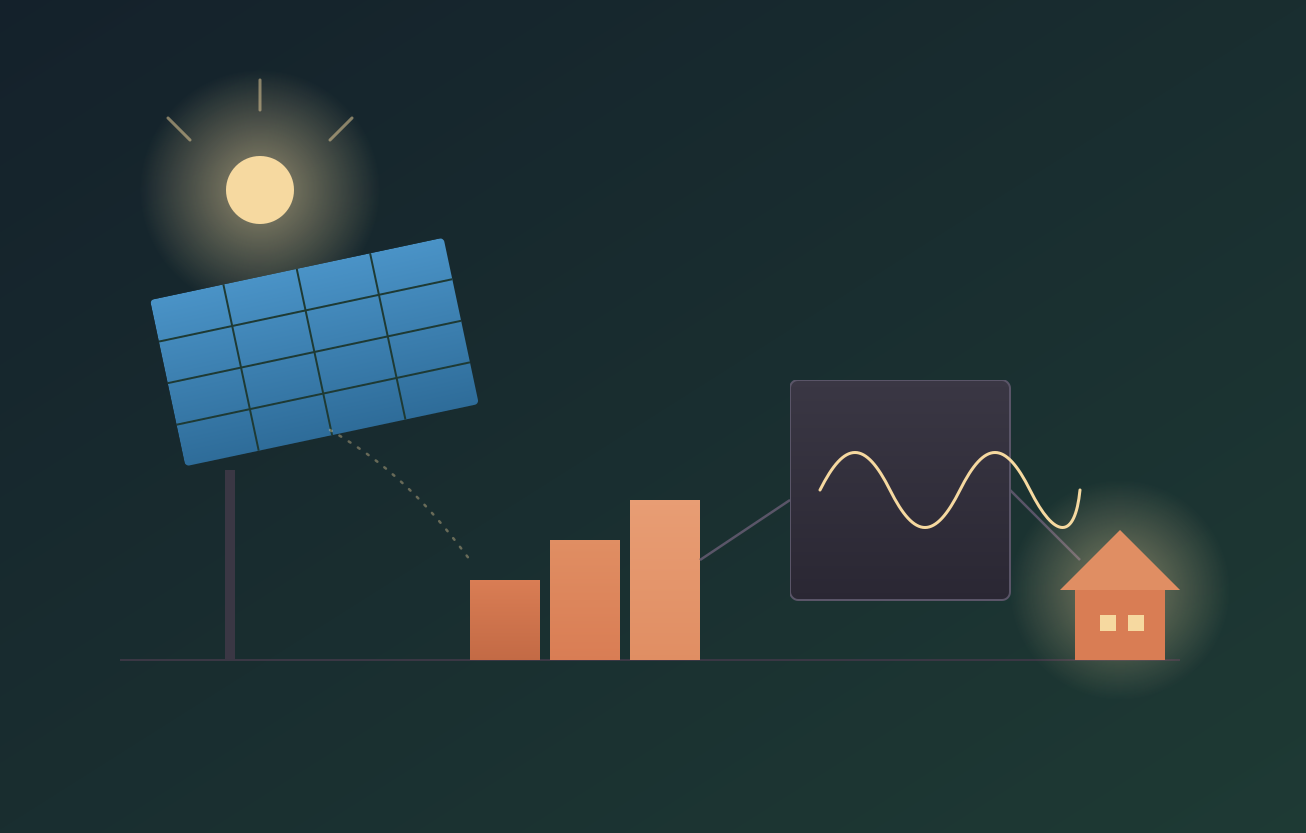
An off-grid inverter converts DC electricity from your solar panels or batteries into AC electricity that can be used by household appliances, tools, lighting, and other equipment. In many systems, the inverter also manages battery charging, power distribution, and backup sources such as a generator.
Solar panels and batteries store and produce electricity as direct current (DC), while most household appliances use alternating current (AC). The inverter performs the conversion between the two.
In a typical off-grid solar system, energy may flow like this:
Solar panels → charge controller/inverter → batteries → inverter → household appliances
The exact configuration depends on the type of equipment you choose. Some modern inverter systems combine several functions, such as the inverter, battery charger, and solar charge controller, into a single unit.
This makes the inverter one of the most important components in an off-grid power system. If it is undersized, incompatible with your batteries, or unable to handle the startup surge of your appliances, the rest of the system may not perform as expected.
Resist the temptation to shop by wattage alone. A 6,000W inverter isn't necessarily a better choice than a 3,000W model if your battery bank and loads don't need it.
Important factors include:
- Continuous power output: How much power the inverter can supply continuously.
- Surge capacity: How much additional power it can provide briefly when appliances such as refrigerators, pumps, or power tools start.
- Battery voltage: Whether it is compatible with your 12V, 24V, or 48V battery bank.
- Efficiency: How much energy is lost when converting DC electricity to AC.
- Battery compatibility: Whether the inverter works with your chosen battery chemistry and charging requirements.
- Solar input: If the inverter includes a charge controller or MPPT, check the supported solar voltage and power range.
- Backup capabilities: Some systems can integrate a generator or other backup power source.
- Scalability: If you expect your energy needs to grow, consider whether the system can be expanded later.
For a larger home, I'd generally start by looking at 48V systems. At the same power level, 48V means considerably less current than 12V or 24V, which makes the wiring and battery side of the system much more manageable.
Your inverter should be sized around both your normal electricity consumption and your peak power demand.
For example, an inverter that can comfortably run your everyday lighting, refrigerator, and electronics may still struggle if you simultaneously start a well pump, power tool, or other appliance with a high startup surge.
Before choosing an inverter, make a list of the appliances you expect to run and note their:
Running watts + starting/surge watts + how long they operate each day.
This gives you a much better starting point than choosing an inverter based solely on the size of your solar array.
If you're designing the entire system rather than replacing an inverter, it's also important to consider the relationship between your solar panels, batteries, inverter, and charge controller. A properly matched system will generally be more reliable than choosing each component independently.
Not necessarily.
A more expensive inverter may provide higher efficiency, greater surge capacity, more monitoring features, better expansion options, or broader battery compatibility. But those features only provide value if your system actually needs them.
For a small cabin or RV, a relatively simple inverter may be sufficient. A full-time off-grid home with refrigeration, water pumps, power tools, heating equipment, and other high-demand appliances may require a much more capable system.
The best off-grid inverter is therefore the one that provides the capacity, compatibility, reliability, and features your particular system requires — not simply the one with the highest specifications.
Off-grid inverters come in several configurations, and choosing between them depends on the size and design of your power system. The most important distinction is whether you need a dedicated off-grid inverter, a hybrid inverter, or a microinverter-based system.
Battery voltage is another important consideration. Larger off-grid systems commonly use 48V inverter systems, while smaller cabins, RVs, and compact solar setups may use 12V or 24V equipment.
A dedicated off-grid solar inverter is designed to operate independently of the utility grid. It converts DC electricity from your battery bank and, depending on the model, can also manage energy coming from solar panels.
Many modern units combine multiple functions, including an inverter, battery charger, and MPPT solar charge controller. This can simplify installation by reducing the number of separate components required.
For a complete overview of how these components work together, see our guide to off-grid solar kits.
When comparing dedicated off-grid inverters, pay particular attention to continuous output, surge capacity, battery voltage, efficiency, solar input limits, and battery compatibility.
The U.S. Department of Energy explains that stand-alone renewable energy systems generally need to account for generation, storage, and power conversion when they are designed to operate independently of the grid. DOE's guide to stand-alone renewable energy systems is a useful technical reference when planning a system.
48V inverters are particularly common in larger off-grid solar systems because increasing battery voltage allows the system to deliver the same amount of power at lower current.
For example, a system delivering 4,800 watts would theoretically draw about:
- 400 amps at 12V
- 200 amps at 24V
- 100 amps at 48V
Lower current can make larger systems easier to design because it can reduce the size of conductors and associated electrical losses, although the complete system still needs to be designed according to the inverter, battery, wiring, protection, and installation requirements.
For a small RV or cabin, 48V may be unnecessary. For a larger off-grid home with substantial energy demands, however, a 48V battery system can be a more practical starting point.
A hybrid inverter combines several power-management functions into one system and can work with multiple energy sources. Depending on the model, this can include solar panels, batteries, the utility grid, and a backup generator.
This makes hybrid inverters particularly useful for homeowners who want to reduce their dependence on the grid while retaining a backup source of electricity.
However, it's important to distinguish between a grid-tied hybrid inverter with backup capability and a genuinely off-grid inverter capable of forming its own electrical grid. Not every hybrid inverter can operate a home independently when the utility grid is unavailable.
The U.S. Department of Energy notes that solar-plus-storage systems can provide power when solar production is unavailable, but the system must be appropriately configured for independent operation. DOE's solar and storage guidance explains the relationship between solar generation and battery storage.
Microinverters are installed at the individual solar-panel level rather than using one central inverter for an entire array.
One advantage is that each panel can operate more independently. This can be useful on roofs or arrays where panels have different orientations or experience partial shading.
However, microinverters are not automatically the best choice for a traditional battery-based off-grid home. A conventional off-grid system needs to maintain a stable AC power source and manage battery storage, so compatibility between the microinverter architecture, batteries, and grid-forming equipment is critical.
Don't choose a microinverter just because the panel-level numbers look attractive. In an off-grid system, the bigger question is whether the whole architecture works when there is no grid to lean on.
A quick way to narrow the field is to start with the property itself.
These are starting points rather than strict rules. Your energy consumption, battery bank, solar array, appliances, climate, and backup requirements should ultimately determine the inverter architecture.
If you're building an entire off-grid system from scratch, it's usually better to select the inverter as part of the complete system design rather than choosing it in isolation.
Solar and batteries can provide most or all of the electricity an off-grid home needs, but relying on a single energy source can leave you vulnerable during extended periods of poor weather or unusually high electricity demand.
This is where a backup generator can become useful. When properly integrated, a generator can provide additional electricity or recharge the battery bank when solar production is insufficient.
Solar production changes throughout the day and across the seasons. Several consecutive days of cloudy weather can reduce the amount of energy available to charge your batteries.
A generator provides another source of power when your battery reaches a low state of charge or your energy requirements temporarily exceed what the solar system can provide.
A generator can be particularly useful for:
- Extended periods of cloudy weather
- Winter months with lower solar production
- High-demand appliances and equipment
- Emergency backup power
- Remote properties where reliability is especially important
Ideally, your generator isn't running every day. It is there for the stretches when the sun hasn't been doing its job.
Depending on the equipment, an off-grid inverter can work with a generator in several ways.
The generator may provide AC electricity directly to the home's loads, or the inverter can use generator power to charge the battery bank. Some advanced inverter systems can automatically start a compatible generator when the batteries reach a predetermined state of charge.
This creates a layered energy system:
Solar panels → batteries → inverter → household loads
with:
Generator → inverter/charger → batteries → household loads
The exact configuration depends on the inverter and generator, so compatibility should always be confirmed before purchasing equipment.
If you're adding a generator to an off-grid system, don't choose one based solely on its maximum wattage.
Consider:
- Continuous output: How much power the generator can provide for sustained operation.
- Starting surge: Whether it can handle the initial demand from connected equipment.
- Fuel type: Gasoline, propane, diesel, or another fuel source.
- Fuel availability: How practical it is to store and obtain fuel at your property.
- Noise: Particularly important for residential or remote properties.
- Automatic start capability: Useful when the generator needs to operate without manual intervention.
- Inverter compatibility: The generator must be compatible with the inverter or charger controlling the system.
For larger systems, automatic generator-start functionality can be particularly useful because it allows the power system to respond to low battery levels without requiring someone to manually start the generator.
Not necessarily.
A sufficiently sized solar-and-battery system may provide all the electricity you need without a generator. Whether backup generation is worthwhile depends on your climate, energy consumption, battery capacity, solar resource, budget, and tolerance for interruptions.
For a small cabin that is only used occasionally, a simple backup generator may be enough. For a full-time off-grid home in a location with long periods of low solar production, having a generator can provide an additional layer of resilience.
A generator shouldn't be used to paper over an undersized solar array or battery bank. It should be the backup layer of a system that already makes sense without it.
If you're designing a complete off-grid system, start by calculating your energy requirements and then determine how much solar and battery capacity you need before deciding how much backup generation makes sense.
Choosing the best off-grid inverter is about more than finding the highest wattage or the cheapest model. The inverter needs to work with your battery bank, solar array, appliances, and overall energy strategy.
Before comparing specific models, focus on the specifications that will affect how reliably the system operates.
Continuous power output tells you how much electricity the inverter can supply under normal operating conditions.
Start by adding up the power requirements of the appliances you expect to run at the same time. Your inverter should have enough continuous capacity to handle that combined load without operating constantly at its limit.
A small cabin with lighting, refrigeration, electronics, and a few appliances may require considerably less inverter capacity than a full-time home with pumps, workshop equipment, large appliances, and other high-demand loads.
Don't size the inverter based only on your solar-panel wattage. Your electrical loads and peak demand are equally important.
Some appliances require significantly more power when they start than they do while running.
Refrigerators, well pumps, compressors, power tools, and other motor-driven equipment can create a temporary startup surge. If the inverter cannot handle that surge, the appliance may fail to start or the inverter may shut down.
When comparing models, check both the continuous output and the manufacturer's specified surge or peak capacity.
The inverter must be compatible with the voltage of your battery bank.
Common system voltages include:
- 12V — often used in smaller systems and RV applications
- 24V — suitable for some medium-sized systems
- 48V — commonly used for larger residential off-grid systems
Battery chemistry matters as well. If you're using lithium batteries, for example, verify that the inverter supports the battery manufacturer's charging requirements and, where applicable, communication protocols.
A mismatch between the inverter and battery system can lead to poor performance, charging problems, or unnecessary equipment limitations.
Inverter efficiency determines how much of the available DC energy is converted into usable AC electricity.
That sounds like a small difference on paper, but in an off-grid system those losses ultimately have to come from your solar panels and batteries.
Also look at idle or standby consumption. An inverter can consume electricity even when the household load is relatively low, and that background consumption can become significant in a system that operates continuously.
The U.S. Department of Energy's guidance on stand-alone renewable energy systems provides additional context on system design and the role of power-conversion equipment. DOE's stand-alone renewable energy systems guide is a useful reference when comparing system components.
If your inverter includes a built-in solar charge controller, check its maximum solar input voltage, current, and power capacity.
Many modern systems use MPPT (Maximum Power Point Tracking) to optimize the amount of energy harvested from the solar array as conditions change.
If your system uses a separate charge controller, make sure the controller and inverter are compatible with the battery bank and solar array.
If you're still working out how these components fit together, our guide to the best solar charge controllers covers the role of the charge controller in more detail.
Some off-grid inverters include a built-in battery charger that can accept electricity from a generator or another AC source.
This can be particularly useful for systems that use a generator as backup. Instead of simply powering appliances directly, the generator can potentially recharge the battery bank through the inverter/charger.
If you plan to use a generator, check whether the inverter supports:
- Generator input
- Automatic generator start
- Adjustable charging current
- Generator compatibility
- Battery charging profiles
These features can make an off-grid system considerably easier to manage.
Good monitoring is one of those features you may not appreciate until you have a system without it.
Depending on the model, you may be able to monitor:
- Battery voltage and state of charge
- Solar production
- Household power consumption
- Inverter output
- Fault conditions
- Generator operation
Some systems provide mobile apps or web-based monitoring, while others use a local display or control panel.
Monitoring becomes particularly valuable when you're managing limited solar and battery capacity because it helps you identify unusually high energy consumption before it becomes a problem.
Think beyond your current electricity needs.
If you expect to add more solar panels, batteries, appliances, or living space later, check whether the inverter supports system expansion.
Some systems can be connected in parallel or integrated with additional battery capacity, while others have relatively fixed limits.
Choosing equipment that leaves reasonable room for growth can be more economical than replacing an undersized inverter later.
Reliability matters more with an off-grid inverter than it does with a lot of household equipment. If it fails, there isn't a utility connection waiting in the wings.
Look beyond the headline specifications and consider:
- Manufacturer reputation
- Warranty length and terms
- Replacement availability
- Technical support
- Installation requirements
- Environmental operating limits
- Availability of replacement parts
This is particularly important for remote properties where equipment failure can mean losing access to essential electricity until a replacement or repair is available.
One of the easiest mistakes to make is choosing the inverter first and trying to make everything else fit around it.
Your solar panels, charge controller, batteries, inverter, generator, wiring, and electrical loads all need to work together.
For example, buying a very powerful inverter doesn't automatically make a system more capable if the battery bank cannot supply the required current or the solar array cannot generate enough energy to recharge it.
If you're building a complete system rather than replacing an existing inverter, our guide to off-grid solar kits is a useful next step because it looks at how the major components work together.
The best inverter is ultimately the one that fits the whole system, not simply the one with the longest feature list.
Not every solar inverter is designed to do the same job. The biggest difference is how the inverter interacts with the electrical grid and battery storage.
Understanding the difference between off-grid, grid-tied, and hybrid inverters will help you avoid choosing equipment that isn't suitable for your intended setup.
A dedicated off-grid inverter is designed to operate without a utility-grid connection.
Instead of relying on the grid to provide a stable electrical reference, an off-grid inverter can create and manage the AC power needed by the home's appliances. It typically works alongside a battery bank and solar generation system.
A typical system looks like:
Solar panels → batteries → off-grid inverter → household appliances
Some systems also incorporate a generator as backup.
Off-grid inverters are therefore suited to remote homes, cabins, workshops, RVs, and other properties where grid electricity isn't available or where complete energy independence is the goal.
If you're considering this lifestyle more broadly, our guide to living off the grid for beginners covers the other infrastructure you'll need beyond electricity, including water, wastewater, heating, and shelter.
A grid-tied inverter is designed to work with the utility electricity network.
Its primary job is to convert electricity generated by solar panels into AC electricity that can be used by the property or exported to the grid, depending on the local system and regulations.
Grid-tied systems can be relatively simple because they generally don't need a large battery bank to operate.
However, a standard grid-tied solar system usually does not continue supplying electricity during a grid outage. This is an important distinction that is sometimes overlooked when comparing solar systems.
If energy independence during outages is important, you'll need equipment specifically designed for backup or off-grid operation.
A hybrid inverter combines solar generation, battery storage, and grid interaction in one system.
Depending on the model, a hybrid inverter may be able to:
- Use solar electricity to power household loads
- Charge batteries from solar
- Draw electricity from the grid
- Export surplus solar electricity
- Provide backup power during an outage
- Work with a generator or other energy source
This flexibility makes hybrid inverters attractive for homeowners who want to use solar and batteries while retaining a grid connection.
If you want your home to function without the grid for extended periods, check whether the inverter is grid-forming and specifically designed for off-grid operation.
The right inverter depends primarily on how you intend to use your property.
These are general guidelines rather than strict rules. The exact choice depends on your electrical loads, battery system, solar array, local regulations, and whether you need the system to operate independently for hours, days, or indefinitely.
Choosing the wrong type of inverter can create problems that aren't obvious from the product's wattage or efficiency rating.
For example, a high-quality grid-tied inverter may be excellent for reducing electricity bills but unsuitable for a home that needs to operate independently during a grid outage.
Likewise, an off-grid inverter may provide the independence you need but require a larger battery bank and more careful energy management than a grid-connected system.
The inverter should therefore be chosen after you've defined how you want the entire energy system to operate.
For a genuinely off-grid property, the inverter is only one part of the equation. Your solar generation, battery storage, water system, heating, and other infrastructure all need to support the way you intend to live.
If you're evaluating whether an off-grid property is right for you, our guide to off-grid homes looks at the wider systems involved in creating a self-sufficient home.
Choosing the best off-grid inverter starts with your energy requirements, not a particular brand or price tag.
The right model needs to provide enough power for your appliances, work with your battery bank and solar array, and offer the features you actually need. A good inverter should also leave enough room for reasonable future expansion.
Here's a practical way to narrow down your options.
Start by listing the appliances and equipment you expect to use.
For each one, note its:
- Running wattage
- Starting or surge wattage
- Typical hours of use per day
- Whether it needs to operate at the same time as other large loads
Pay particular attention to appliances with motors or compressors, such as refrigerators, freezers, pumps, and power tools. Their startup demand can be considerably higher than their normal operating consumption.
Once you understand your peak demand, you can determine the approximate continuous and surge capacity your inverter needs.
Don't automatically choose the largest inverter available. Oversizing can add unnecessary cost and may increase standby energy consumption.
Your inverter needs to match the voltage of your battery bank.
For smaller systems, 12V or 24V may be appropriate. For larger residential systems, 48V is often a more practical configuration because higher voltage allows the same power to be delivered at lower current.
The battery bank also needs enough capacity to provide the energy your household requires between periods of solar production.
This means you should size the inverter and battery together, rather than treating them as separate purchases.
If you're choosing an inverter with an integrated solar charge controller, check the maximum:
- Solar input voltage
- Solar input current
- Solar array power
- MPPT operating range
Your solar array needs to fall within the inverter's specified input limits.
If you're using a separate charge controller, the same principle applies: the controller needs to be correctly matched to the solar array and battery bank.
For a deeper look at the role of the charge controller, see our guide to the best solar charge controllers.
If you have access to utility electricity but want solar, batteries, and backup power, a hybrid inverter may make more sense than a dedicated off-grid inverter.
If the property has no grid connection and you intend to operate independently, a dedicated off-grid inverter may be more appropriate.
Think about what you want the system to do when the sun isn't shining and when the grid isn't available.
That question can quickly eliminate unsuitable inverter types.
Ask yourself what happens if solar production is low for several days.
You might rely on:
- A larger battery bank
- Additional solar capacity
- A backup generator
- Reduced electricity consumption
- A combination of these
For a remote full-time home, having a backup source can provide an important additional layer of resilience.
For a small seasonal cabin, however, a simpler system may be perfectly adequate.
Your electricity consumption may increase over time.
You might eventually add:
- A larger refrigerator or freezer
- A well pump
- Power tools
- Additional living space
- An electric vehicle
- Air conditioning
- Heat-pump heating or cooling
Before buying an inverter, consider whether it can accommodate reasonable future expansion.
This doesn't mean buying the biggest inverter available. It means avoiding a system that is already operating at its practical limit on the day you install it.
If you're considering electrically intensive heating, for example, it's worth understanding how a heat pump compares in terms of energy use and efficiency before finalizing your inverter and battery requirements.
The cheapest inverter isn't necessarily the cheapest system.
When comparing models, consider the total cost of:
- Inverter
- Batteries
- Solar panels
- Charge controller, if required
- Wiring and protection equipment
- Installation
- Monitoring equipment
- Generator integration
- Future replacement or expansion
An inverter with more integrated functionality may cost more initially but simplify the rest of the system.
Conversely, a basic inverter may be the better choice if you don't need advanced features.
Off-grid equipment needs to work reliably because there may be no utility connection to fall back on.
Before buying, check:
- Warranty length
- Warranty coverage
- Manufacturer support
- Availability of replacement parts
- Installation requirements
- Environmental operating limits
- Whether qualified technicians are available in your area
For a remote property, support and replacement availability can be just as important as the inverter's headline specifications.
The final decision should come back to how you actually intend to live.
A weekend cabin, RV, tiny home, and full-time off-grid house can have completely different energy requirements.
If you're new to off-grid living, it's worth understanding the broader lifestyle before investing heavily in equipment. Our guide to living off thle grid for beginners covers the practical considerations involved in becoming more independent from public utilities.
Likewise, if you're still deciding where to establish an off-grid home, our guide to the best states for off-grid living looks at the broader location question.
Choosing an off-grid inverter isn't really about finding the one with the biggest number on the box. It's about finding the piece of equipment that makes sense for the way you actually use electricity.
A weekend cabin, an RV and a full-time off-grid home can have completely different requirements. Start with your loads, work out your battery voltage and storage needs, then make sure the inverter, solar array and backup system all fit together.
And if you're building from scratch, don't rush this part. A good inverter can make the rest of the system easier to live with for years. The wrong one can leave you fighting compatibility issues, unnecessary standby consumption or a lack of capacity every time you add another appliance.
The best off-grid inverter is the one you stop thinking about because it simply does its job.