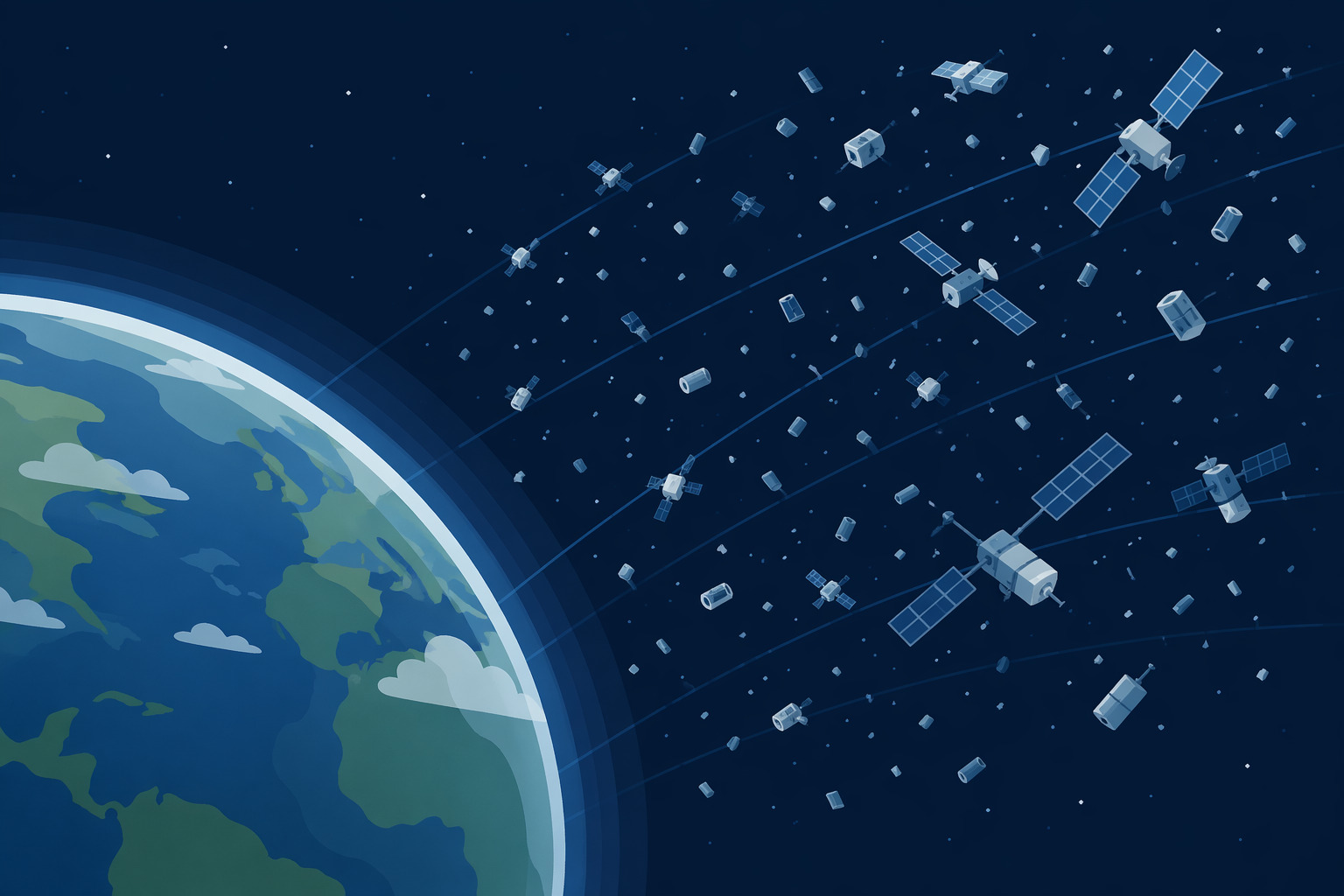
Space sustainability is becoming one of the most important challenges of modern technology. As humanity relies more on satellites for communication, navigation, weather forecasting, and climate monitoring, the safety of Earth’s orbital environment has never mattered more.
Space sustainability means using space in a way that keeps it safe, accessible, and functional for future generations. Without it, Earth’s orbit risks becoming overcrowded with debris and defunct satellites, making space operations more dangerous and expensive.
Organizations such as the Organisation for Economic Co-operation and Development highlight that space is a shared global resource that must be managed carefully to avoid long-term damage.
Earth’s orbit is getting crowded
The number of satellites in orbit has grown rapidly due to commercial space companies, government missions, and scientific projects. At the same time, old satellites and rocket fragments remain in space, creating a growing layer of debris.
According to the European Space Agency, orbital debris is increasing and poses a direct risk to operational satellites.
Even small debris particles can cause severe damage because objects in orbit travel at extremely high speeds. This makes collisions extremely dangerous and difficult to prevent.
Why space debris is a serious risk
One of the biggest concerns in space sustainability is the possibility of cascading collisions. If one collision occurs, it can create thousands of fragments, increasing the chance of further collisions.
This process could eventually make certain orbital regions unsafe or unusable. The OECD warns that without proper management, valuable orbits could become increasingly difficult to use over time.
This is why space debris is considered one of the most urgent environmental challenges beyond Earth.
Why space matters in everyday life
Most people do not realize how much daily life depends on satellites. Space systems support:
- GPS navigation for phones, cars, and logistics
- Weather forecasting and storm tracking
- Banking and financial timing systems
- Aviation safety and routing
- Emergency communication systems
- Earth observation for agriculture and disaster response
The European Space Policy Institute highlights that modern society is increasingly dependent on space infrastructure and that protecting it is essential for global stability.
If space systems become unreliable due to debris or congestion, the impact would quickly spread across multiple critical industries.
Space sustainability and climate science
Satellites are essential for monitoring climate change. They measure sea level rise, ice loss, greenhouse gas concentrations, and extreme weather patterns.
Without satellite data, climate models would become significantly less accurate, making it harder to understand environmental changes and respond effectively.
Space infrastructure therefore plays a key role in global climate monitoring and environmental decision-making.
This depends heavily on satellite monitoring systems that enable climate action through real-time Earth observation and data analysis. You can read more about this in our article on Satellite Monitoring for Climate Action.
The rise of commercial space activity
The rapid growth of private space companies has increased the number of satellites in low Earth orbit. Large satellite constellations are now being deployed to provide global internet coverage and other services.
While these systems bring major benefits, they also increase congestion in orbit. This makes coordination between operators more important than ever.
ESPI research shows that the expansion of commercial space activity is increasing both opportunities and sustainability challenges.
Space debris is growing faster than it is removed
A major issue in space sustainability is that debris accumulates faster than it is cleared. Many defunct satellites remain in orbit for years or even decades.
Although some satellites are designed to burn up or deorbit at the end of their mission, this is not yet universal practice.
Efforts such as active debris removal are being developed, but they are still in early stages and not widely implemented.
The ESPI Zero Debris approach emphasizes the importance of preventing debris creation at the design stage rather than relying only on cleanup.
Academic research on space sustainability
Academic studies increasingly describe Earth’s orbit as a finite and fragile environment. Research shows that increasing satellite density creates long-term risks if not properly managed.
Other studies describe a “space sustainability paradox,” where expanding space activity can also increase long-term risks if debris and congestion are not controlled.
These findings highlight the need for long-term planning and global coordination.
Why space sustainability matters for the future
Space sustainability is not just a technical issue. It is a long-term infrastructure challenge that affects communication systems, economic stability, and environmental monitoring.
Without proper management, orbital regions could become increasingly congested, making satellite operations more expensive and risky. In extreme cases, some orbits could become difficult to use safely.
Institutions such as the European Space Policy Institute, Organisation for Economic Co-operation and Development, and the European Space Agency all stress the importance of coordinated global action.
Conclusion
Space sustainability is about protecting the systems that modern society already depends on.
As space becomes more crowded, the risks of collisions and debris increase. Without responsible management, the orbital environment could become significantly more dangerous over time.
However, with proper regulation, improved technology, and international cooperation, space can remain a safe and valuable resource for future generations.
Space is still open. But it is no longer limitless.